
The number of people looking for an industry's products is growing fast. Does that mean every company in the industry makes money?
No, it does not. Even in a market where customers are increasing, a company can make a loss if it spends more on making and selling its products than it brings in as revenue. You need to check the growth of an industry and the profitability of a single company separately.
Revenue can grow without leaving a profit
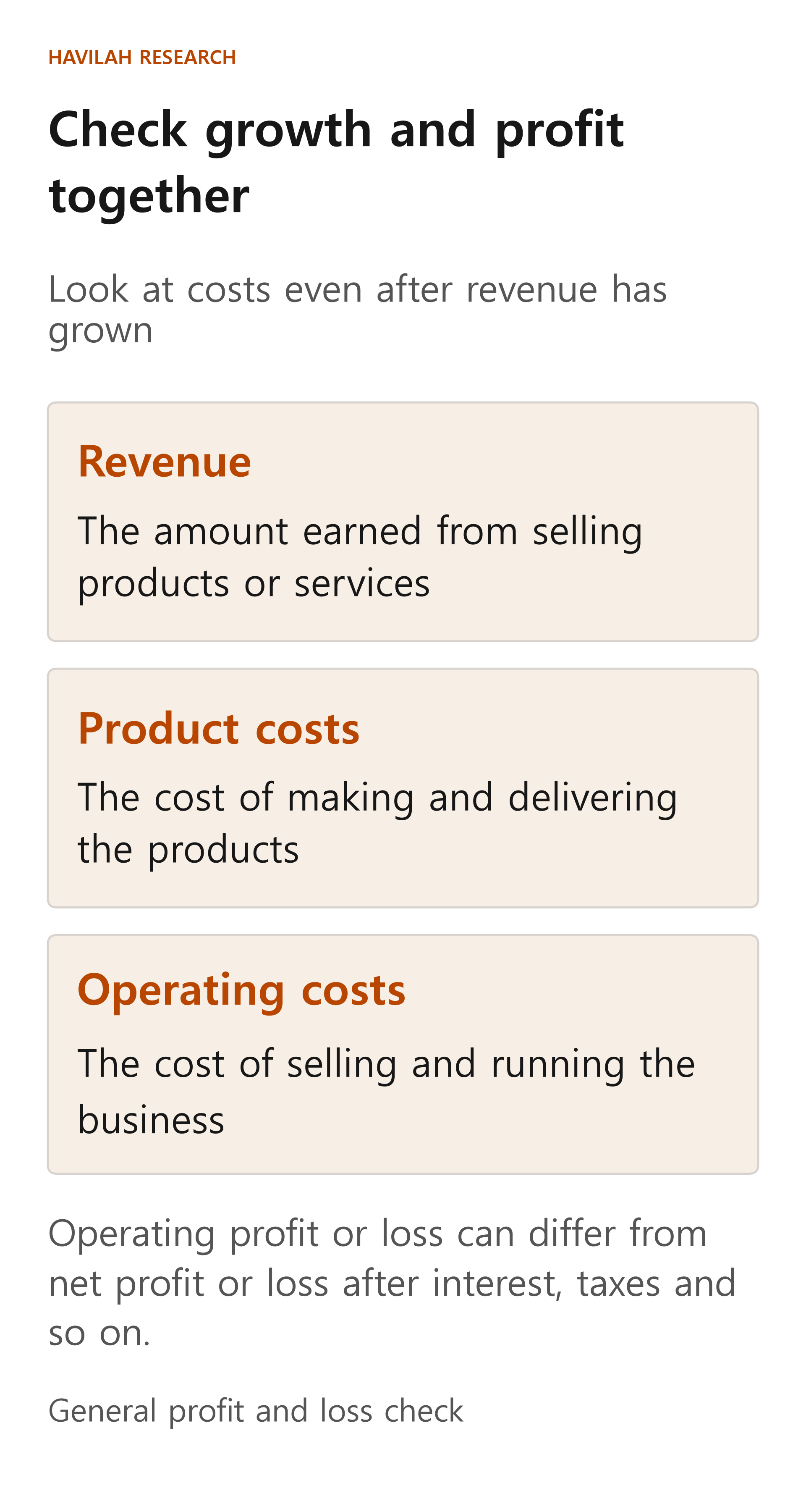
Suppose a hypothetical company sells its products over a year and earns $1,000 in revenue. Making and delivering the products costs $700, and selling them and running the company costs $400.
Revenue $1,000 − product costs $700 − operating costs $400 = operating loss of $100.
This company lost $100 on its operations. An operating loss is the shortfall you get when you subtract the related costs from the revenue earned by selling products or services. It can differ from the final net loss, which also takes into account items such as interest and taxes.
Now assume revenue rises to $1,500 the following year. Revenue grew by 50%, but if product costs also rose to $1,100 and operating costs to $450, the result looks like this.
Revenue $1,500 − product costs $1,100 − operating costs $450 = operating loss of $50.
The loss shrank from $100 to $50, but the company is still not making a profit. These numbers are a hypothetical example to help you understand the idea. They are not the results or the outlook of any real company.
Why can a company lose money while it grows?
To win new customers, a company may need to spend money on advertising or lower its prices. Research and development spending to improve its products also comes first. After spending money up front like this, the company may gain customers and see its profit improve, but that outcome is not guaranteed.
The cost that comes with each product sold may also simply be too high. In the example above, product costs rose sharply while revenue grew. That is why you need to see what costs more, and by how much, as the company sells more.
The technology company Vuzix explains in its annual report that outside development costs related to new products and depreciation of equipment, among other things, contributed to an increase in its research and development costs. This is a real example of how preparing new products can cost money. That explanation alone cannot tell you whether those products will succeed.
Is a company with losses always a bad company?
You cannot jump to that conclusion. A company whose costs are heavy now may become profitable later as its customers and revenue grow. On the other hand, its costs may rise every time its revenue does, so that the losses go on for a long time. What matters is which costs rose and why, and what has to change for the losses to shrink.
You should also look at the company's cash. The loss recorded on the income statement and the cash that actually went out during that period may not be the same number. If the company is short of cash right now, it may borrow money or issue new shares. When the number of shares grows, existing shareholders' percentage of ownership can fall.
What should investors check?
First, look separately at why the industry as a whole is growing and at whether this company is actually gaining customers. Even when the market grows, competitors may win most of the customers.
Second, see how much is left after subtracting product costs from revenue, and whether that amount is enough to cover operating costs. Do not look at revenue growth alone. Compare the changes in costs over the same period as well.
Third, look at the cash the company has available to absorb its losses and at its plans for raising money. A company's forecast that it will become profitable is an assumption, not a promise, so think through whether it still works if sales volume, prices or costs turn out differently from what is expected.
A growing market can be an opportunity. When you invest, check all the way through to how that opportunity turns into this company's revenue and profit.