
You hear that orders at a company have gone up. Its products are selling well, so will its revenue keep growing from here?
It might. But customers may also have placed orders to stock up their warehouses in advance. To find out why orders rose, you need to look at inventory and actual sales as well.
How are inventory and orders different?
Inventory means the products a company holds for sale, the materials it will use in production and similar items. An order is a customer's request to buy a product. If the ordered products have not been delivered yet, you need to keep the fact that an order came in separate from the fact that a sale has actually been completed.
A store's numbers and a manufacturer's numbers are also different. The amount a store orders from a manufacturer may not match the amount the store sold to consumers. The store may buy more than usual to fill its warehouse, or it may cut its orders so that it can sell the stock it already has first.
Work out how much stock is left
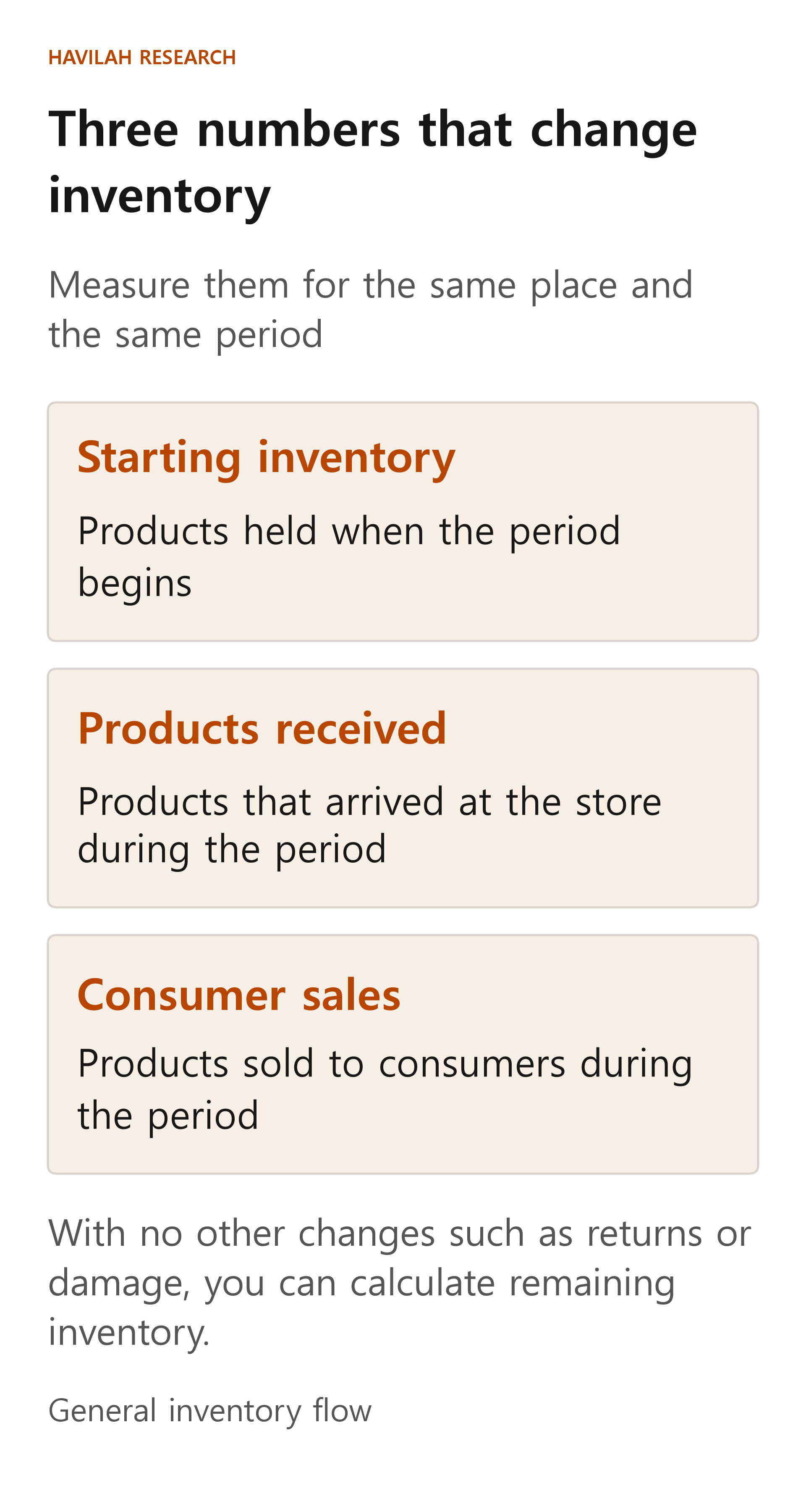
A hypothetical store started a month with 50 products on hand. During that month it received 100 new ones and sold 80 to consumers. Assuming there were no returns or damaged goods, its inventory at the end of the month is 70 units.
50 at the start + 100 received − 80 sold = 70 in inventory at month-end.
The next month, it starts with these 70 units and receives 120 new products, but sells only 60 to consumers. Its inventory at the end of that month comes to 130 units.
70 at the start + 120 received − 60 sold = 130 in inventory at month-end.
In the second month, the store received more products, but its sales to consumers fell from 80 to 60. If you assume that the products received each month equal the store's orders to the manufacturer that month, this is a case where the manufacturer's orders went up while consumers bought less. In reality, there can be a delay between an order and the delivery, so do not automatically treat orders and deliveries in the same period as equal.
Is rising inventory always bad?
Not necessarily. A company may stock up ahead of a season when it expects sales to rise, or build up inventory in case components become hard to get. On the other hand, goods can also pile up because sales were weaker than expected.
With too much inventory, storage costs go up, and the company may have to sell older products at a discount or lower the value recorded for them in its books. With too little, it can lose sales because it has nothing to deliver when orders come in. The right level depends on the product, how long it can be kept for sale and the demand for it.
One semiconductor company has disclosed that if its distributors hold too much inventory, its own sales may fall or orders may be postponed. This describes a possible risk. It does not mean that this result always follows whenever inventory rises.
What should you compare when you invest?
First, check who placed the orders. More orders from distributors are not necessarily the same as more purchases by end consumers. Orders can also rise for a while as customers restock.
Second, look at where the inventory is piling up. Whether it sits in the manufacturer's warehouse or a distributor's can make a difference to the next round of orders. If a company does not disclose the inventory held further down the distribution chain, leave that part as unconfirmed.
Third, compare sales and inventory for the same period. In a company's financial statements, inventory is usually shown as an amount of money, so you cannot compare it directly with product counts like those above. Also check which part has grown: raw materials, products still being made or finished goods.
Inventory and orders are clues to how the economy may be changing. But seasons, price changes, delivery times and a company's strategy also affect the numbers. Do not draw firm conclusions about the whole economy or the direction of a share price from one company's figures for one month. Look at several periods together with customer demand.