
A company announces that it will build a new factory. It will be able to make more, so will its revenue rise right away too?
A factory increases a company's ability to make products. But actual revenue depends on how many of the finished products customers buy. You also need to look at how long it takes to finish the factory and how much it costs to run.
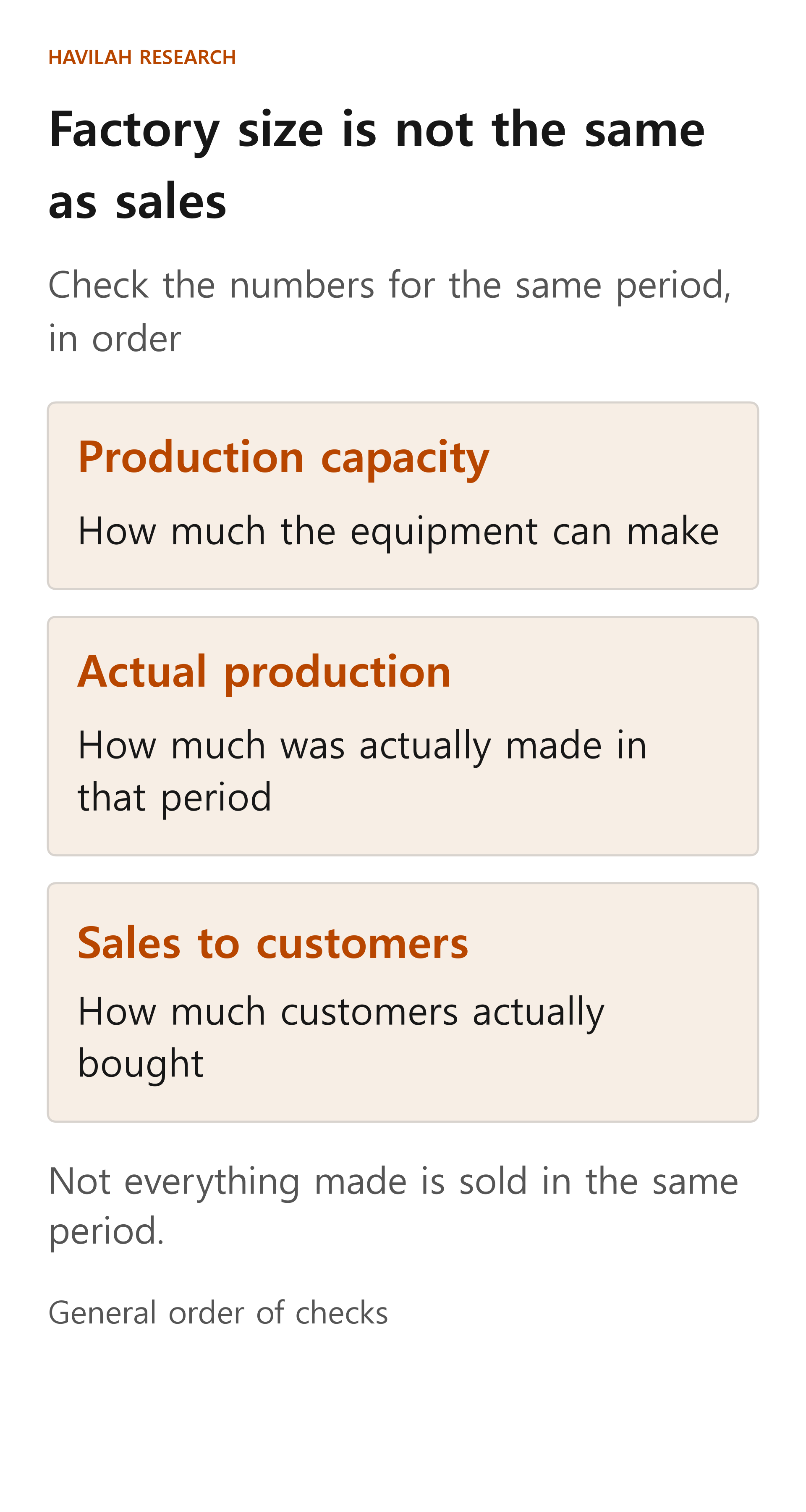
How much you can make versus how much you actually sell
Suppose a hypothetical factory can make up to 100 products a month. If it produced 80 that month, it used 80% of its production capacity. A ratio like this, which shows how much of the available equipment was actually used, is called the utilization rate.
80 units ÷ capacity of 100 units × 100 = utilization rate of 80%.
Now assume the company expands the factory so that its monthly capacity becomes 200 units, but customers will buy only 100 products that month. If the company produces only 100 units to match this demand, the utilization rate is 50%.
100 units ÷ capacity of 200 units × 100 = utilization rate of 50%.
If each product sells for $10 and everything produced is sold in the same month, sales were $800 for the earlier 80 units and $1,000 for the 100 units after the expansion. Capacity doubled, but sales did not. That is because of the hypothetical conditions: the selling price stays the same, and demand after the expansion is 100 units.
Not everything a company produces gets sold, either. Products that are not sold can be left over as inventory. So you should not assume that production equals revenue. Companies also differ in what they count as output when they calculate the utilization rate and in how they measure capacity, so check the definitions and the periods before you compare them.
New equipment takes time
Even after the factory building is finished, it can take time to install the equipment, run trial production and reach the point where the factory reliably makes the quantity and quality the company wants. The time when orders rise and the time when the equipment is ready may also fail to line up.
The semiconductor company STMicroelectronics explains that when customer demand rises, there can be a time lag before its manufacturing capacity catches up, so capacity may fall short. On the other hand, if demand turns out weaker than expected once the equipment is ready, there may be spare capacity.
A factory has costs even when it is not busy
Running a factory can involve costs for staff, maintenance and equipment even when it makes only a few products. GlobalFoundries explains that its factories have costs that arise regardless of how much they actually produce, and it describes depreciation as one of them.
Depreciation takes an amount based on what the equipment cost to buy, after allowing for things such as the value expected to remain once the company has finished using it, and spreads it over the years of use as an accounting expense. It does not mean that the factory is paid for in installments. When cash actually goes out depends on the payment contract.
For example, suppose equipment is bought for $1,200, used evenly over 10 years and has no value left at the end. The depreciation expense for 1 year is then $120.
$1,200 ÷ 10 years = $120 per year.
This is a simple example to show how depreciation works. A real company may calculate it differently depending on the type of equipment, how long it expects to use it and the accounting standards it follows. Look separately at when the money for building a factory was paid and when the depreciation expense is recorded.
What should investors check?
When you see an expansion announcement, first check how long it will take to finish the factory and start production. Next, look at whether customer orders have already been secured and how much of the new equipment is likely to be used. Order outlooks can change, so keep confirmed facts separate from the company's plans.
Finally, check how much cash the equipment investment will take and what the costs will be once the factory is running. If capacity is left unused, the equipment-related costs may have to be spread over fewer products. On the other hand, if demand is strong enough and production rises steadily, the expansion can help the company grow.
The key is not the size of the factory itself. When it can produce, who will buy, and how much it costs along the way all have to fit together.