
Imagine you want to buy a popular product, but it is in short supply and you have to wait. If many people are waiting, the seller might raise the price. That is why investors who hear that "this component is in short supply" start to wonder whether the profits of the companies that supply it will rise.
But the word "shortage" alone cannot give you the answer. Even if the price goes up, profit can fall if the quantity the company can sell drops, or if the cost of making the product rises even more.
Why do supply shortages happen?
A supply shortage happens when the amount available for sale falls short of the amount people want to buy. Supply can drop because something goes wrong with production facilities. Or output can stay the same while orders suddenly jump.
Even when a factory has made the goods, customers will not receive them on time if transport is delayed. A situation like this, where one part of the process of producing or delivering a product holds up the whole flow, is called a bottleneck. Picture a channel that water runs through becoming narrower, so that the flow slows down.
Prices do not always rise right away. A contract may fix the price, or a supplier may change its prices only gradually. In that case, delivery times may grow longer first, or some customers may not receive the goods at all.
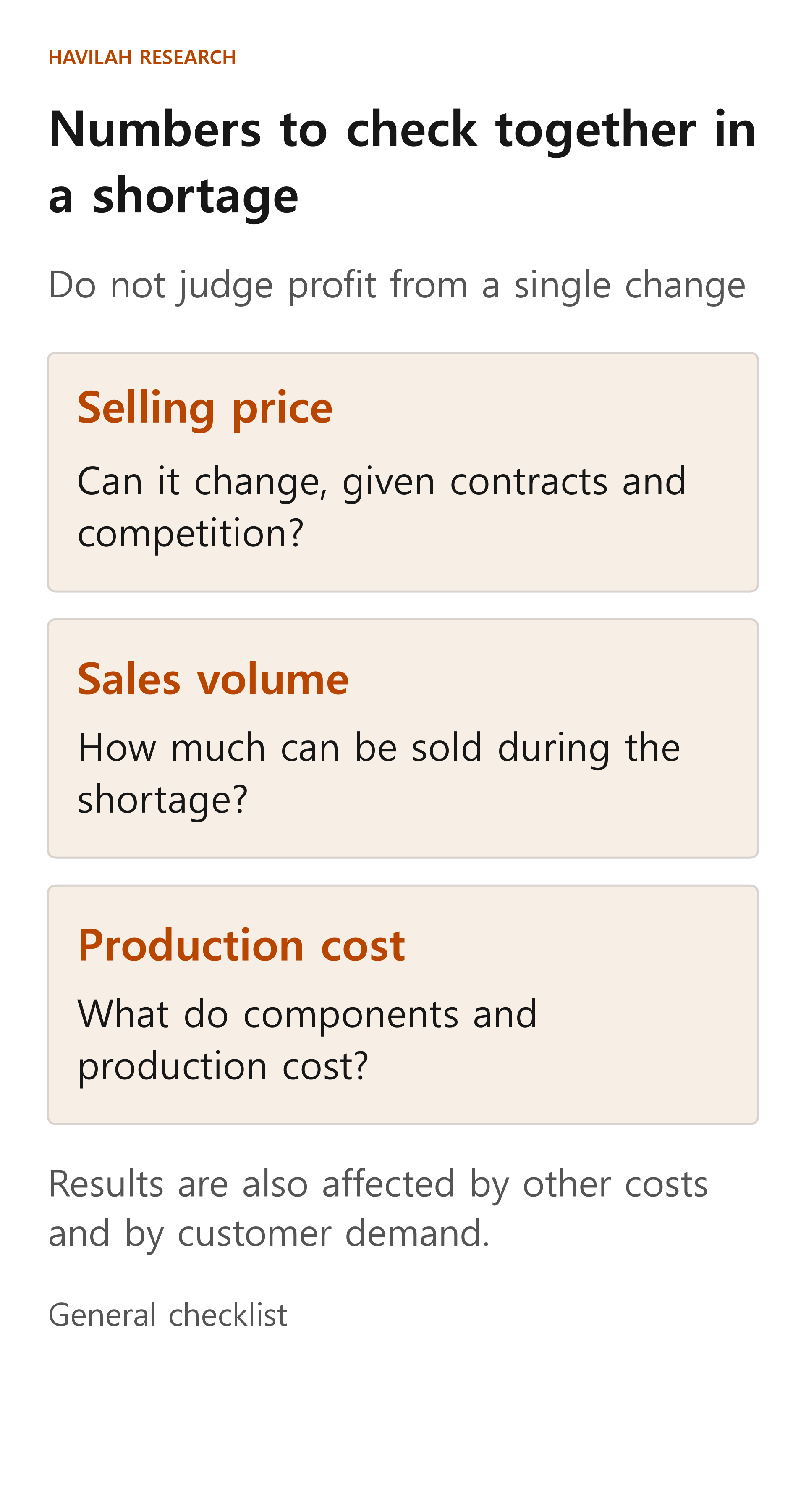
Look at price, quantity and cost together
Suppose a hypothetical component company sells 100 components a month at $10 each, and it costs $6 to make one. Subtracting those production costs from its sales leaves $400.
100 units × ($10 selling price − $6 production cost) = $400.
Later, supply runs short and the company can sell only 80 units. For this explanation, assume the selling price rises to $14 and the cost of making one unit rises to $8.
80 units × ($14 selling price − $8 production cost) = $480.
In this example, the company sells fewer units, but it keeps more from each one, so the total difference grows from $400 to $480. This amount is not net income, though. Some costs are left out of the calculation, such as the cost of running the factory, head-office staff costs and taxes. The two figures are assumptions that show how the mechanism works, not the results of a real company.
If the price cannot rise, the result changes
Now change the same situation so that a contract requires the selling price to stay at $10. If sales of 80 units and a production cost of $8 per unit stay the same, the difference is $160.
80 units × ($10 selling price − $8 production cost) = $160.
The shortage is the same, but the result is different from the earlier $480. How the company is affected depends on when it can change its prices and who bears the costs. Even if it can raise prices, it may not sell as much as expected if customers cut their orders or switch to other products.
What about the companies that buy the components?
A company that buys components to make finished products may see its costs rise when component prices go up. If it cannot get the components it needs on time, production at its factories and sales of its finished products may be delayed as well. On the other hand, if it can pass the higher component prices on in the price of its finished products, it may be able to reduce part of the burden. You should also watch whether customer demand falls as that happens.
NVIDIA explains in its annual report that if its manufacturing partners cannot increase supply to match demand, it may fail to meet customer demand in time and lose revenue. Supply problems with other components a product needs can also hold back sales of that product. This is a risk the company has disclosed, not a prediction that it will definitely happen.
What should investors check?
First, check which component or production step is in short supply, and whether it relates to the products the company itself sells. Next, look at how its actual selling prices, quantities and production costs have changed. Because of the company's contract terms or long-term supply commitments, market prices may not show up in its results right away.
Finally, do not assume you know how long a shortage will last. The situation can change if competitors increase production or customers find substitutes. Even if the business becomes more profitable, there is no guarantee that the share price will move the same way if high expectations are already built into it.
The key is not to stop at "there is a shortage." You get closer to an investment decision only when you connect it to which company sells what, at what price, in what quantity and at what cost.