
When you buy a laptop, your money goes to the store. But the store is not the only company that took part in making that laptop. There are also companies that make the screen and the chips, companies that assemble the parts and companies that transport the product.
The companies and activities linked together as a product is made and delivered to the customer are called a supply chain. As an investor, you should not just look at whether a product sells well. You also need to know what the company you are studying does in this process and who pays it.
Follow the path a product takes
Take a laptop as an example. Components such as the screen and semiconductors (chips) are made from raw materials, and the components are then brought together to assemble the finished product. Factories also use equipment to make components or to assemble them. The finished product reaches the customer through transport and sales.
Real relationships are more complicated than a straight line. Even a single component can have several suppliers, and one company may handle design, manufacturing and sales all at once. A company that designs a product may also hand its production over to another company.
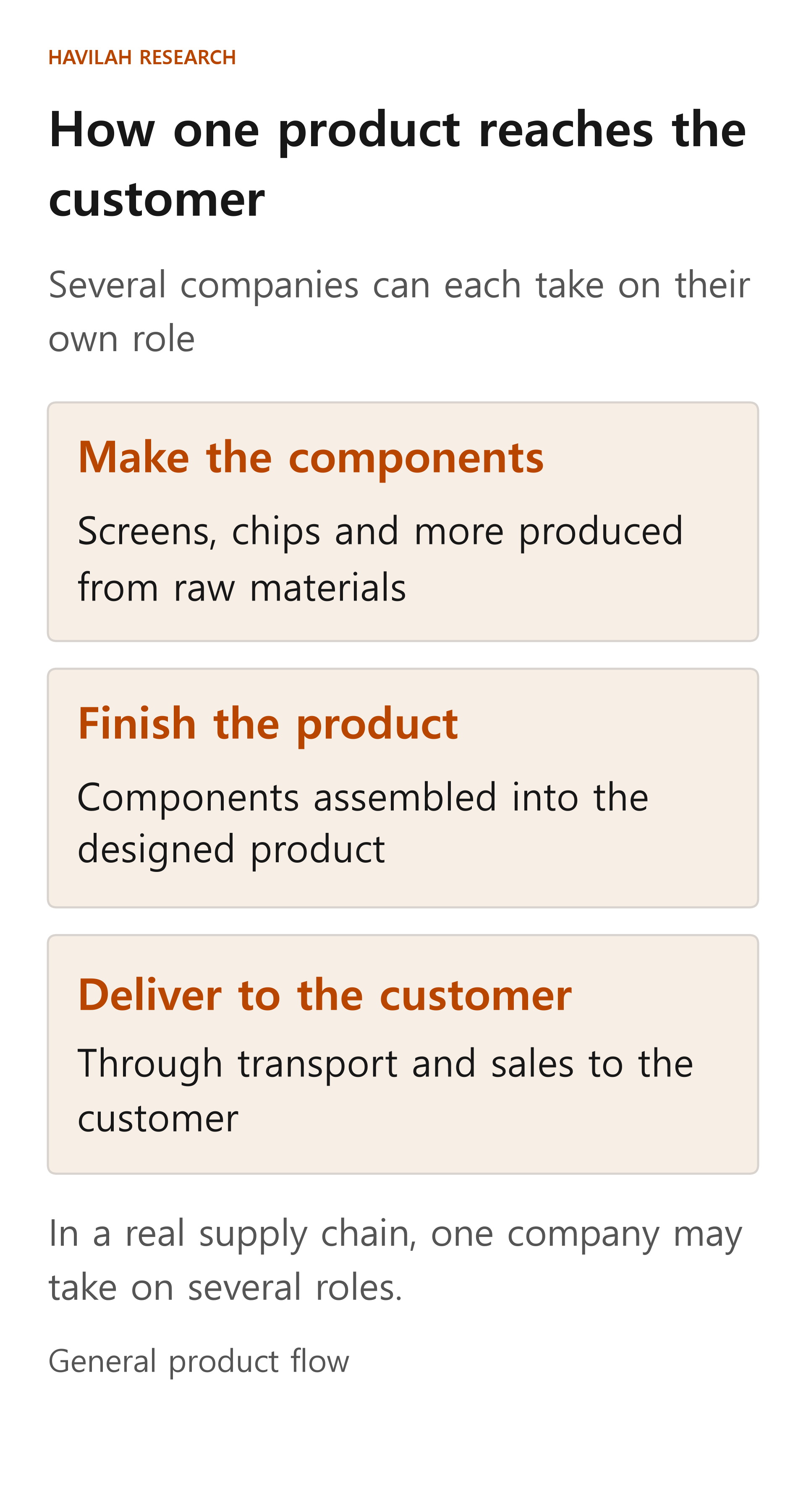
Companies behind the same product play different roles
Apple explains in its annual report that it relies on outside partners for the components, manufacturing and final assembly of its products. It also leaves much of its transportation and logistics management to outside firms. In other words, even when a product carries the Apple name, Apple does not run every step of making it by itself.
On the other side, a component maker's customers may be the companies that make finished products, or assemblers, rather than end consumers. For example, Texas Instruments explains that it sells its semiconductor products to makers of finished products, contract manufacturers (companies that produce goods for other companies) and distributors, among others. Even companies that take part in the same product differ in what they sell and to whom.
When one customer's orders grow, an opportunity can open up for its component suppliers as well. But if a supplier also has many other customers, a change in that one product may have only a small effect on the supplier's total revenue. You also need to check separately whether higher sales of that product actually lead to more orders or more profit for the supplier.
Do not add up every selling price
Here is a hypothetical example to make this easier to follow. Suppose a consumer buys a laptop for $1,000, and the store bought it from the company that makes the finished product for $900. That company spent $600 on components and $200 on the other costs of making and assembling one laptop.
- The difference between the store's selling price and its purchase price: $1,000 − $900 = $100.
- What the finished-product company has left from the sale after component and manufacturing costs: $900 − $600 − $200 = $100.
Neither $100 amount is the net income of the store or of the finished-product company. Costs left out of this example still remain, such as the store's wages and rent and the finished-product company's research and development and selling expenses. These numbers do not describe the cost structure of any real company either.
Also, do not add the $600 component sale, the $900 sale of the finished product and the $1,000 sale to the consumer, and conclude that this laptop created $2,500 of new money. Each time the same product is traded, the money paid at the earlier stage is included in the price at the next stage. What the consumer finally paid is $1,000.
Where should you look when you invest?
First, check what products or services the company you are interested in sells, and whether it makes them itself or relies on outside firms. In the 10-K, the annual report of a U.S.-listed company, the business description and the risk factors are the place to start.
Next, look at its main customers and suppliers. Within what the company discloses, check how much it depends on particular customers or components, and whether it could easily find an alternative if supply were cut off. A company may not disclose all of its business partners or its revenue by product, however, so treat any relationship you cannot confirm as an estimate.
The point of mapping a supply chain is not to memorize lots of names. It is to find where the company makes its money and where problems could arise. In the next lesson, we will look at what happens when supply runs short at one of these links.