
A company says, "The market we are entering is worth $10 billion." Does that mean the company can earn $10 billion?
No, it does not. How many customers in a market are able to spend money is one question. How much one company will actually receive is another. Market size is a starting point for judging how large an opportunity is.
Start by calculating the market size
Think of a hypothetical booking program for shops. Assume that 10,000 shops in total need this program, and that each shop can pay $100 a year for it. If every shop bought it at the same price and used it for a full year, the total annual market size would be $1 million.
10,000 shops × $100 per shop per year = $1 million per year.
This number does not mean that 10,000 shops have already bought the program. It is an opportunity calculated on the assumption that every one of them buys. If you counted shops that use a free alternative, or shops that do not need the program at all, as potential customers, you may have made the market too large.
The customers this company can reach may be fewer
In the hypothetical market above, suppose the company can serve 4,000 of these shops with the regions and features it currently supports. If these shops bought at the same price and used the program for a full year, the market the company can reach would be worth $400,000 a year.
4,000 shops × $100 per shop per year = $400,000 per year.
Even within the market the company can reach, not every shop will become this company's customer. Some shops already use another program, and some have no plans to buy one.
Assume the company wins 10% of them, or 400 shops, and all of them pay $100 for a full year. Its annual revenue would then be $40,000. The 10% is an assumption made for this explanation. It is not an actual market share or a figure the company can be expected to reach.
What are TAM, SAM and SOM?
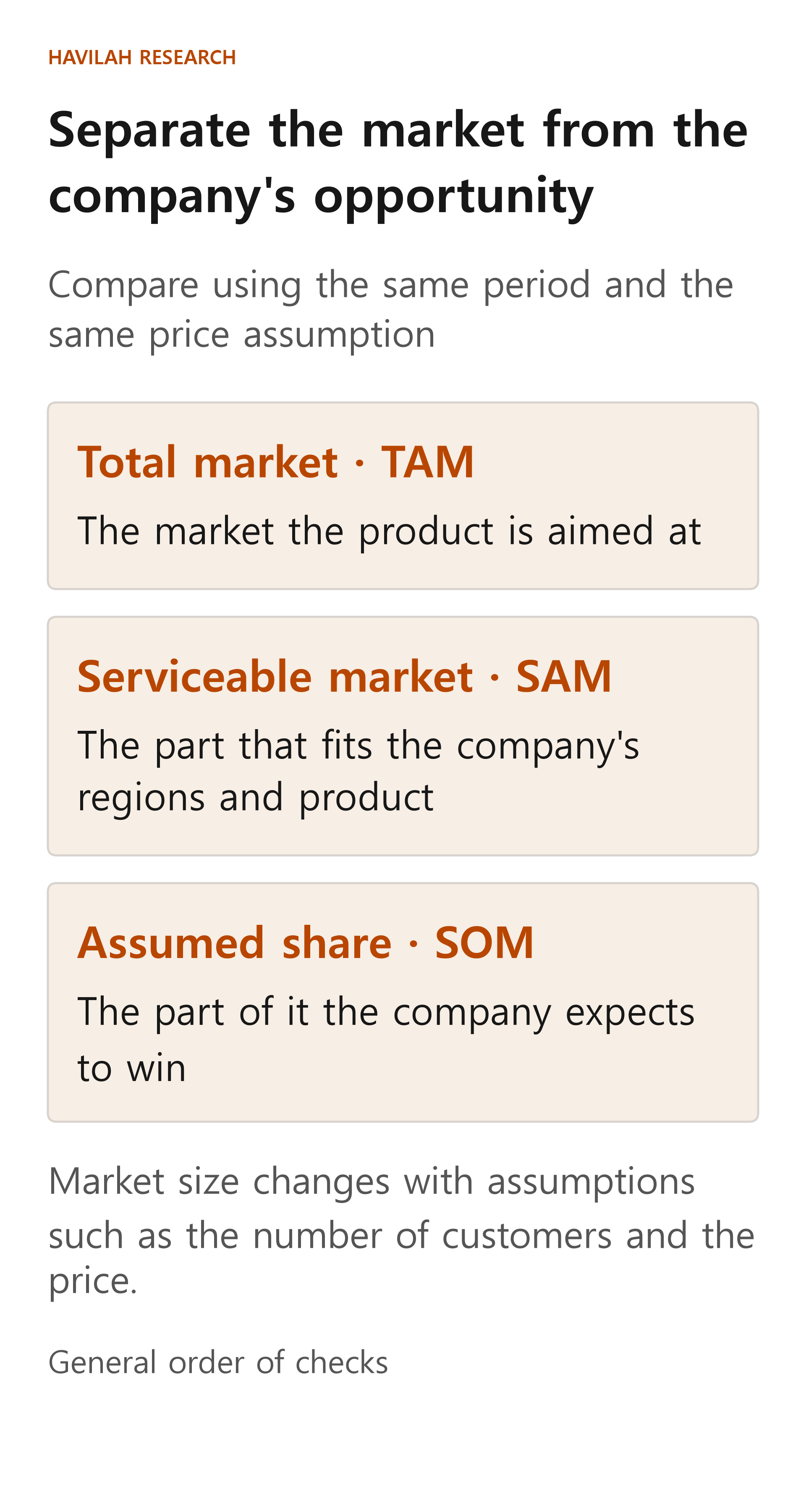
When people describe market size, you may see three abbreviations. TAM (total addressable market) is the whole market that a product or service is aimed at. SAM (serviceable available market) is the part of that market the company can serve, given conditions such as its product and the regions it covers. SOM (serviceable obtainable market) is the part within the SAM that the company estimates it can win over a given period.
In the hypothetical example above, the total $1 million is the TAM, the $400,000 the company can reach is the SAM, and the assumed $40,000 is the SOM. All three were calculated for the same 1-year period. Each company may draw these boundaries differently and use different assumptions, so look at how the numbers were built rather than at the labels.
What to check first when the numbers get big
Check whether the number of potential customers really refers to people who need the product. It also matters whether the amount each customer pays is a one-time payment or repeats every year. If you do not separate money a market brings in over several years from spending in a single year, you may end up comparing the market size with revenue in the wrong way.
A market size that a company publishes is also an estimate. If its assumptions about price, the number of people able to buy, competitors and sales regions turn out to be wrong, the result changes. Doing business in a big market does not, on its own, make a company's revenue or profit grow.
Narrow down your questions when you invest
Start by checking which customers the company serves and what problem it solves for them. Then look at whether those customers can actually pay, and whether they have a reason to choose this product instead of a competitor's.
Finally, try the calculation again with a different expected number of customers and a different price. For example, if the hypothetical company wins 200 shops instead of 400, its assumed annual revenue at the same price of $100 a year becomes $20,000. Changing the assumptions like this shows more clearly which conditions the company's growth story depends on.