
The fact that revenue has grown is not enough to tell whether a company is good. You need to look at who pays it money, and what costs it pays to earn that money.
When you analyze a complicated company for the first time, try drawing its business as a map on a single page. If you link products, customers, revenue and costs in turn, you will see which numbers you still need to check.
What does it sell, and who pays?
Suppose a hypothetical company rents out booking-management software to small shops. The customers are the shops, and they pay through a subscription, with a fee every month. For this company to receive more money, it needs more customers or a higher fee per customer.
On the other hand, revenue can fall if customers leave or move to a cheaper plan. Even with the same number of customers, if the contract charges for what customers use, revenue can change with usage.
A real company may have more than one business. Apple's 2025 annual report shows revenue by product, such as iPhone and Mac, separately from services revenue. It is a good idea to start by working out how important each part is, using the categories the company itself discloses.
What should you subtract from the money customers pay?
Suppose the hypothetical company has 100 customers, and each pays $100 a month. Assuming the number of customers and the fee stay the same for all three months, the service is provided every month and it is recorded as revenue in the same period, revenue for the three months is $30,000.
100 customers × $100 per customer per month × 3 months = $30,000.
Assume it costs $40 a month to support each customer, and that other operating costs, which stay the same, come to $12,000 over the three months. Customer support costs for the three months are $12,000. If we simplify by assuming there are no operating expenses other than these two, operating income is $6,000.
$30,000 - customer support costs of $12,000 - other operating costs of $12,000 = $6,000.
Operating income is the revenue a company earns from its main business minus the related costs. The $6,000 in this example is different from net income, which is what remains after interest and taxes are subtracted, and from the actual cash balance.
How much does profit change when customers leave?
For the same hypothetical company, assume that 20 customers leave before the three months begin, and the remaining 80 pay the same fee for the three months. The support cost of $40 per customer per month and the other operating costs of $12,000 for the three months do not change.
Revenue is 80 customers × $100 × 3 months, or $24,000, and customer support costs are 80 customers × $40 × 3 months, or $9,600. Operating income is $24,000 - $9,600 - $12,000 = $2,400.
The number of customers and revenue fell by 20%, but operating income fell by 60%, from $6,000 to $2,400. This is because some costs stayed the same. In reality, costs can fall or even rise depending on the situation, so do not apply these numbers directly to another company.
Where should you look in actual filings?
Check the products and customers in the company's business description, then look at revenue and costs in the financial statements. The same Apple report shows research and development expenses and selling, general and administrative expenses, in addition to revenue from products and services. To find out which costs move with the number of customers or sales volume, you need to read further into the explanations the company discloses.
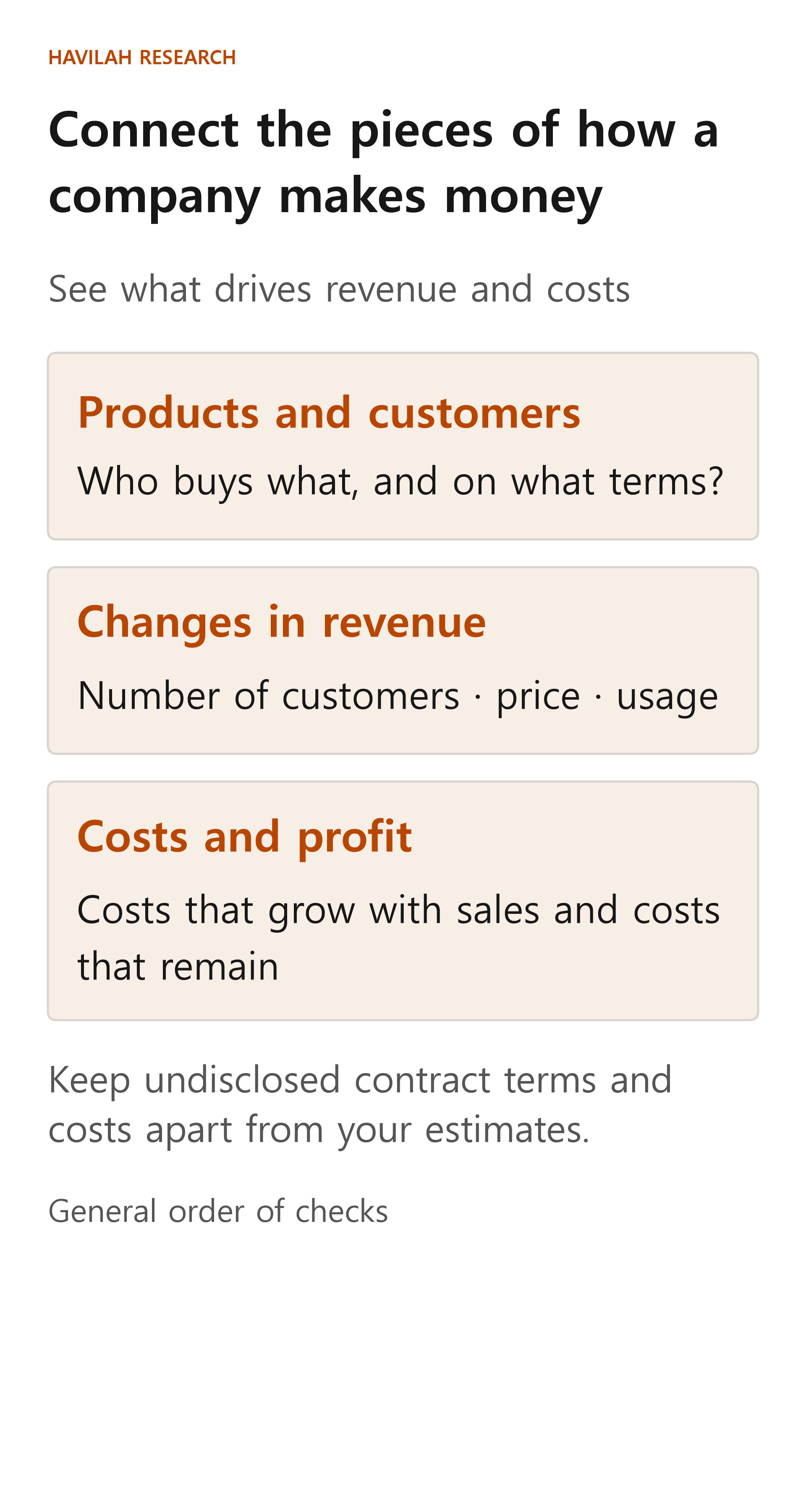
To put it on one page, just link the following questions. What does the company sell, who pays, and which of these makes revenue change: the number of customers, price or usage? Then write down which costs rise along with revenue, and which costs are hard to cut quickly.
Leave contract terms and costs that are not in the filings as blanks. Completing this map will not tell you the fair value of the shares right away, but it gives you a starting point for finding the cause when results change.