
Does a shop always earn more the more it sells? If the money spent each time it sells one item is greater than the selling price, selling more could make the loss bigger.
When you assess a company's growth potential, you need to look not only at total revenue but also at how much of the costs one product or one customer can cover.
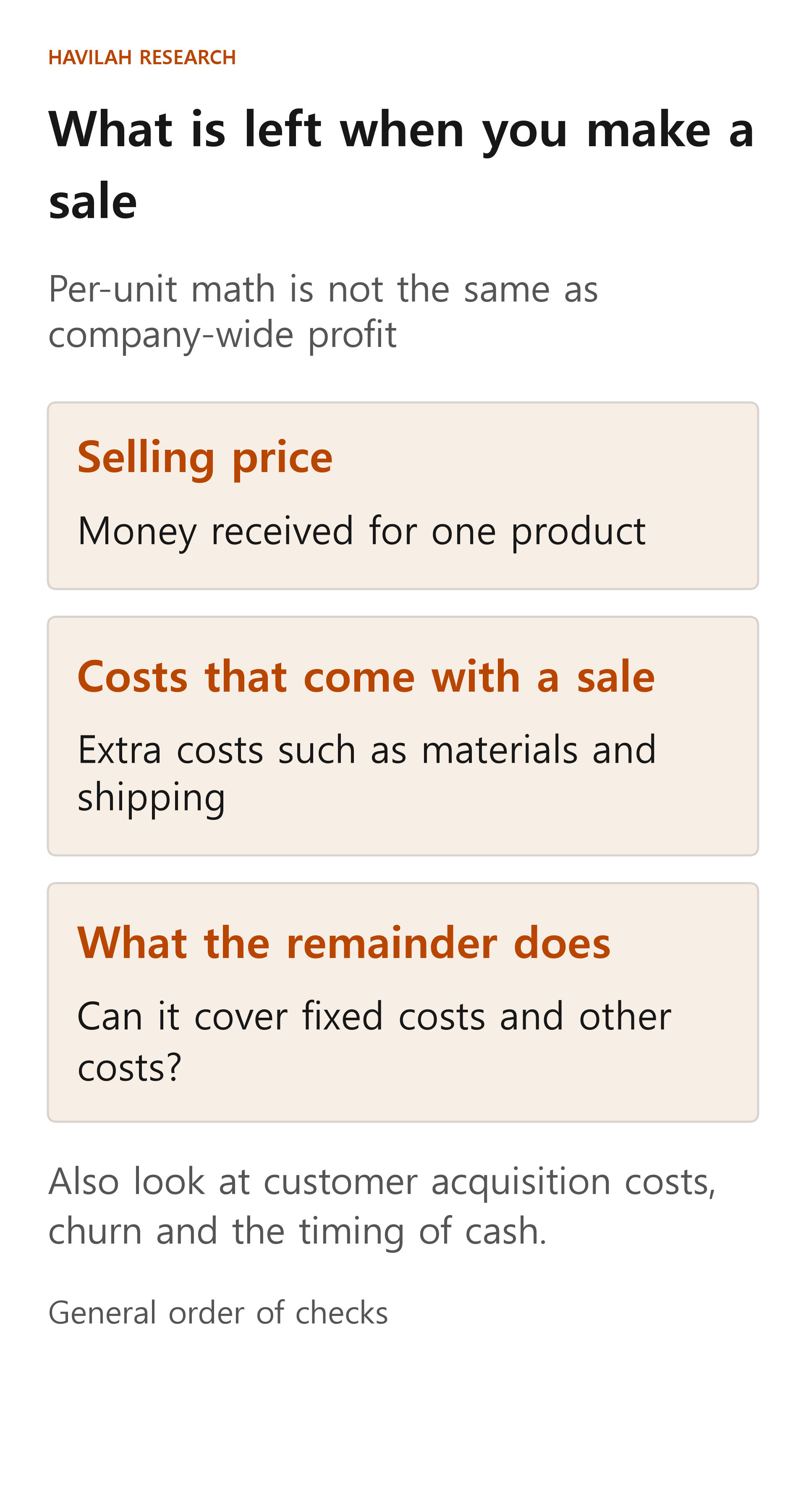
How much is left from selling one unit?
A hypothetical shop sells a product for $100. Assume that each additional unit it sells costs an extra $60 for materials, shipping and so on.
$100 - $60 = $40.
Here, the $40 is what is left from the money received for the product after subtracting the costs that vary with sales volume. This is called the contribution margin. It goes first toward covering costs that stay the same even when sales volume changes in the short term, such as the shop's rent.
The $40 contribution margin is not the same as the company's net income. There may still be costs that have not been subtracted, such as staff salaries, rent, interest and taxes. Which costs actually vary with sales volume also needs to be checked for each company and each period.
Fixed costs remain even when you sell a lot
If this shop sells 20 units a month and the contribution margin per unit calculated above stays at $40, the total is $800. If you simply assume the shop's other costs for the same month are $1,000, it is $200 short.
20 units × $40 = $800.
$800 - $1,000 = -$200.
This hypothetical calculation assumes that the price and the extra cost per unit stay constant, and that the $1,000 includes all the remaining costs. For a real company, prices, costs and the number of staff needed can all change as the business grows.
Conversely, if the $100 price and the $60 extra cost hold steady and the other costs are $1,000, simple arithmetic shows the shop has to sell 25 units to cover those costs as well. $1,000 ÷ $40 = 25 units. This is called the break-even point. The calculation does not include any time lag between sales and costs, or any additional investment.
How much does it cost to bring in a customer?
A subscription service may spend money on advertising or sales to win one customer. The cost of gaining a customer like this is called the customer acquisition cost, or CAC for short.
Suppose a hypothetical company spent $120 to gain one customer. If that customer pays $40 a month and serving the customer costs an extra $16 a month, $24 is left each month.
$120 ÷ $24 = 5 months.
If the company receives the same amount each month, pays the same extra cost and the customer keeps using the service, simple arithmetic says it takes 5 months to cover the cost of gaining that customer. If the customer leaves after 3 months, under these assumptions the company does not fully cover the acquisition cost. If cash actually comes in and costs go out at different times, the point at which the cash is recovered changes too.
This period does not mean the company as a whole will become profitable within 5 months, because costs such as development and office expenses are not included in this calculation. Companies can define customer acquisition cost, and the profit used to recover it, in different ways, so check what each calculation covers.
What should you look at when you invest?
Check whether selling an additional product costs more than its price, and which costs rise along with sales volume. For a subscription business, look at the customer acquisition cost together with how much the company keeps from each customer before that customer leaves.
If the company does not disclose the numbers, you cannot do a precise calculation. In that case, it is a good idea to check the revenue, costs and customer retention data that are disclosed, and to note separately the items you cannot know. Even if the math for one customer looks good, you have to check separately whether it can also cover the costs of the whole company.