
A company's products are selling well and its revenue is growing. But what if a large part of that revenue comes from one customer? If that customer cuts its orders, the company's total revenue could be badly shaken.
That is why you need to check not only whether the product looks good, but also who buys it and how much they buy.
When one customer's orders fall
Suppose a hypothetical parts company sold $10 million in total last year. Of that, $4 million went to one customer. That customer's share is $4 million ÷ $10 million, or 40%.
Now assume that this year the customer's orders fall 25% from last year, while sales to other customers stay the same. Revenue from the large customer falls by $1 million.
$4 million × 25% = $1 million.
If nothing else changes, the company's total revenue falls from $10 million to $9 million. Total revenue is down 10%. A 25% drop in one customer's orders does not mean the company's total revenue falls 25%.
This is a hypothetical calculation that assumes no change in other customers' orders, prices, exchange rates or the timing of when revenue is recorded in the accounts. In reality, the company might sell more to other customers or cut costs, or, on the other hand, suffer further damage. You also cannot work out the change in profit from the change in revenue alone.
Direct customers and end users can be different
A parts company sometimes sells its products to a distributor, which then resells them to many manufacturers. In that case, the large customer named in the report may be the distributor the company deals with directly. From that number alone, you cannot conclude that the end users are concentrated in one company.
Monolithic Power Systems, a real semiconductor company, said in its 2025 annual report that its three largest direct customers by revenue were all distributors and that together they accounted for 54% of revenue. The company explained that factors such as the distributors' inventory management and financial condition could affect their orders.
This example reflects that company's situation in 2025. This percentage alone does not tell you how many end customers buy through those distributors. Start by checking whether the direct customers are distributors or end users.
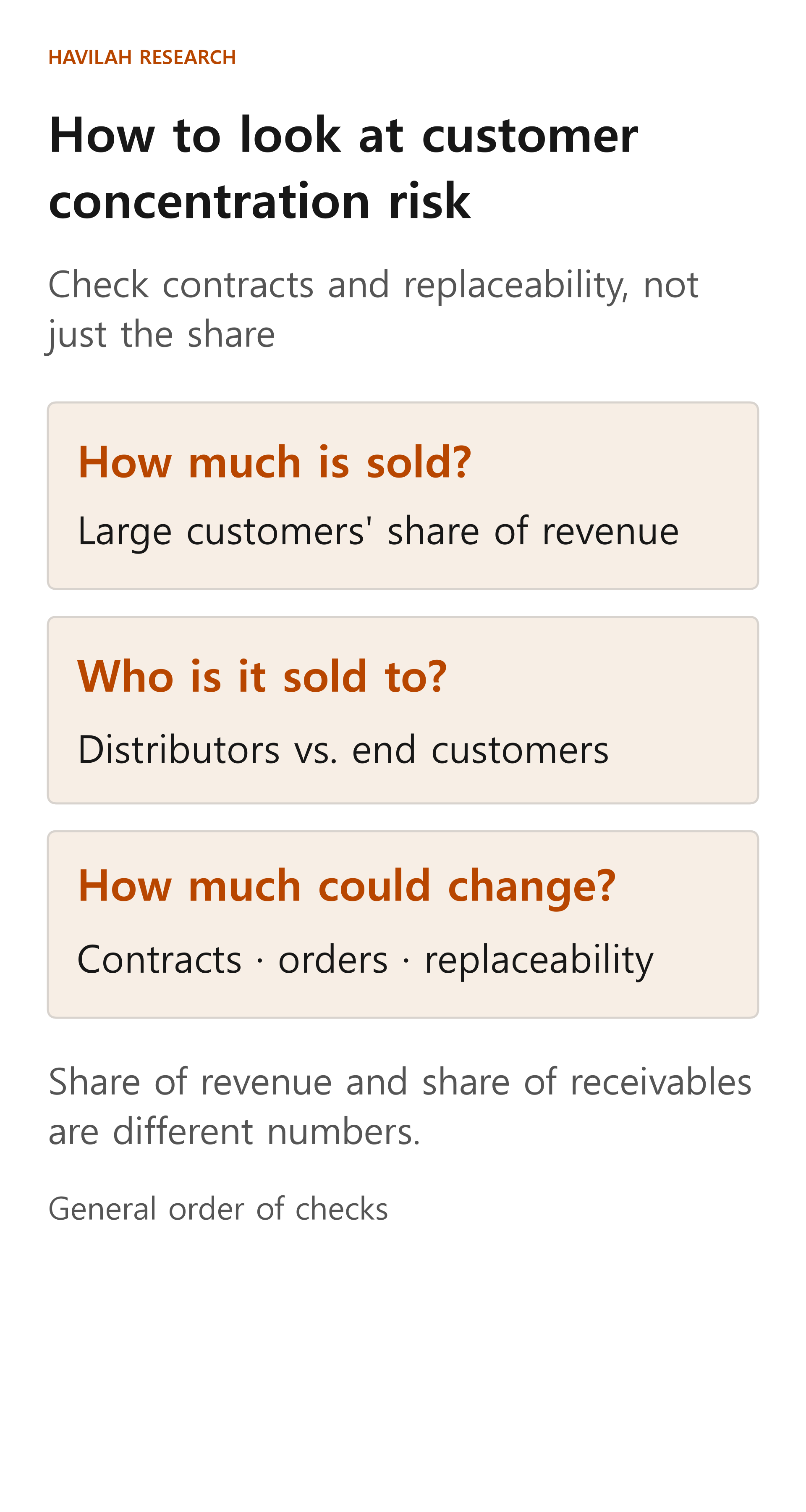
Is a large customer always a bad thing?
Orders from a large customer can help a company produce steadily and grow its business. The real questions are how easily that customer could cut its orders or switch to another supplier, and how long it would take the company to find new customers.
Look at when contracts end, whether there are minimum purchase commitments, and whether prices can be renegotiated. Even with a long-term contract, the outcome can change depending on the cancellation terms and the actual order volume. Do not guess at contract terms that have not been disclosed.
If a customer bought goods on credit and has not yet paid for them, whether the company can collect that money also matters. A customer's share of revenue and its share of the amounts not yet collected are different numbers.
What should you look for in filings?
Look for the share of major customers or distributors in the business description, risk factors and notes to the financial statements in the annual report. Customer names may not be disclosed, and they may appear as Customer A and so on. Also check whether sales to the same customer under different names are added together, and whether a customer is a distributor.
Work out the effect if a large customer's revenue fell, and think about how long it would take to find replacement customers and what fixed costs the company would still have to pay. Customer concentration does not automatically mean an investment will fail, but it is a clue to how badly the company could be shaken if something unexpected happens.