
A company that collects a fee every month may receive money next month as well. Does that mean its revenue is already locked in?
It does not, because customers can end their contracts or cut back their usage. When you look at recurring revenue, you need to look not only at new customers but also at how long existing customers stay and how much they pay.
Stretching a monthly fee to a full year
Suppose a hypothetical service has 100 customers who each pay $10 a month. Assuming no discounts, taxes or mid-month changes, the monthly fees add up to $1,000.
$1,000 × 12 months = $12,000.
This amount assumes the current monthly fees stay the same for twelve months. A measure that converts the size of current contracts into a yearly figure like this is called ARR, short for annual recurring revenue.
But the $12,000 is not money that has already been paid in, or money the company is certain to earn. If customers leave or change their plans a month from now, the actual result will be different. ARR also needs to be kept apart from the actual revenue the company records period by period under accounting standards.
Companies calculate ARR in different ways. Some leave out overage fees for usage beyond what the contract covers, while others annualize some usage-based revenue and include it. Even when the name is the same, check what is included and the date it is measured on.
What happens when existing customers leave?
Suppose 10 of the hypothetical service's 100 existing customers leave during one month. Since 10 of the original 100 customers left, the customer churn rate for this period is 10%. The churn rate counts only existing customers who canceled, and we assume no accounts were merged.
If 10 new customers sign up in the same month, the number of customers at the end of the month is back to 100. The total number of customers is the same, but the company has still lost 10 existing customers. If winning new customers costs a lot, it is hard to judge the business as stable from the customer count alone.
On the other hand, even if some customers leave, the money coming from existing customers can grow if those who remain move to more expensive plans. Keeping customers and keeping revenue are two different things.
Look separately at customers who started at the same time
If you lump together customers who joined last year and those who joined this month, it is hard to see how many of the older customers are still there. So you can group customers who joined at the same time and follow how the group changes over time. A group of customers like this is called a cohort.
For example, if 80 of the 100 customers who joined in January are still there in June, 80% of the original group has stayed. New customers who joined in the meantime are not added to these 100. This is a hypothetical example to aid understanding, and the basis on which a real company counts and discloses its customers may be different.
Contracts and usage are not the same thing
If customers pay a fixed amount each month under contract, it is relatively easy to see how much the company will receive while the contract lasts. But later payments can change depending on the renewal and cancellation terms.
With a service that charges for what customers use, revenue changes when usage changes, even if the customers stay. Check whether the contract has a minimum spend and how usage above that level is charged. The fact that customers are still there does not by itself mean revenue will stay the same.
What should you check when you invest?
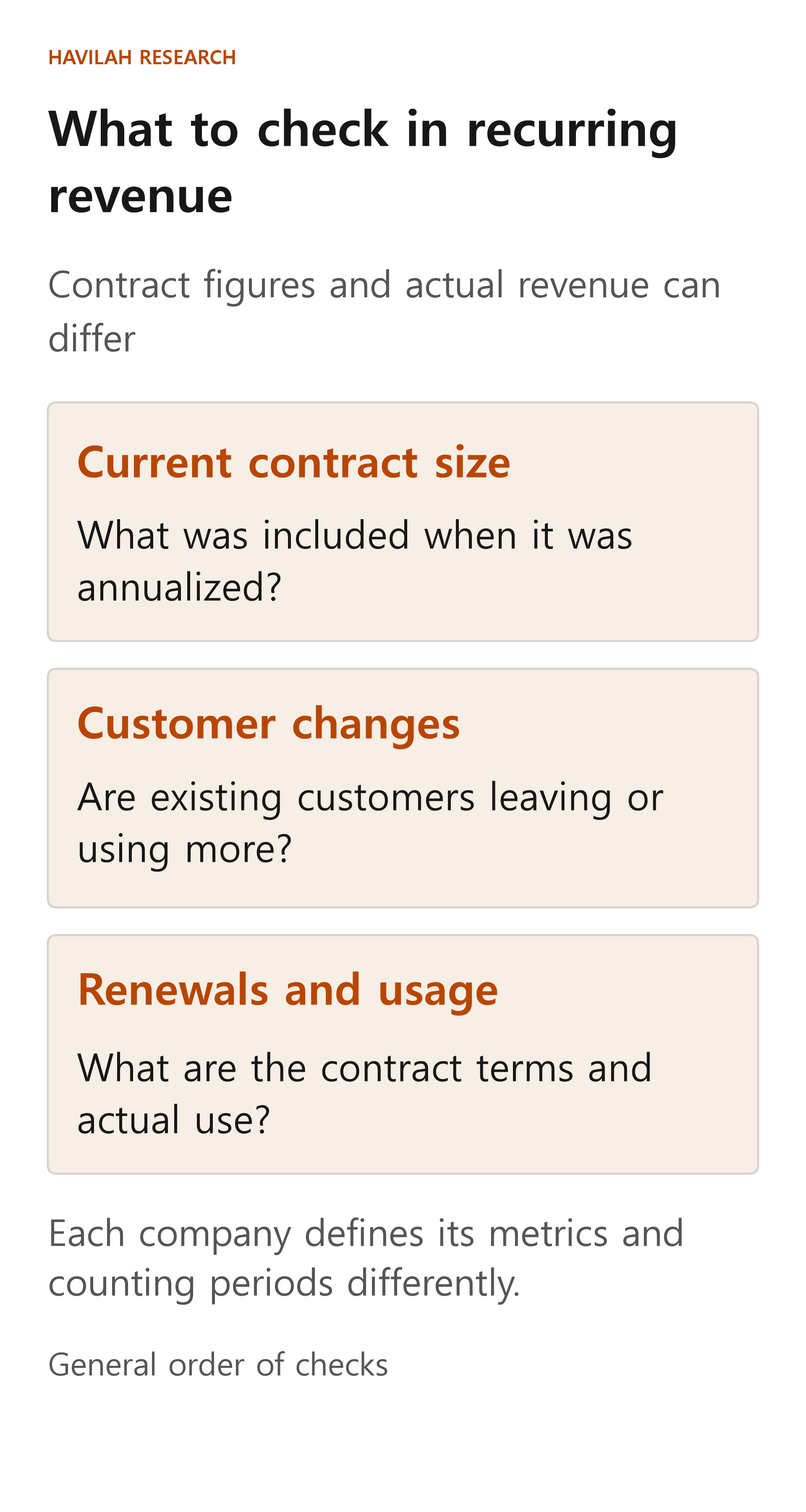
In the company's report, first check what its ARR includes, whether it counts customer churn by number of customers or by amount of money, and which periods it compares. It also matters whether you can look at existing customers separately, without new customers.
Recurring revenue is a useful clue for understanding a business. But you can only judge how far to rely on the number when you look at it together with contract length and renewal terms, how quickly customers leave, and actual revenue and costs.