
A company announces that it has signed a large 3-year contract. A big contract can help the business in the years ahead. But the announced amount does not immediately become this year's revenue or profit.
You need to look separately at how binding the contract is, what the company still has to do, and when it gets paid.
The contract amount is not this year's revenue
Suppose a hypothetical service company signs a contract to provide the same service every year for 3 years and receive $12,000 in total. Assume the contract is valid, the service is provided evenly each year, and there are no other adjustments.
$12,000 ÷ 3 years = $4,000 a year.
In this simple example, the company records $4,000 as first-year revenue after it has provided the first year of service under the contract. The remaining $8,000 relates to the 2 years of service it has not yet provided. If the company's fiscal year does not line up with the contract's start date, revenue for a given fiscal year has to be worked out separately, based on the service provided in that period. This result assumes the whole contract stays valid and prices do not change.
For real contracts, when revenue is recorded depends on how the service is delivered to the customer and what terms the contract contains. Dividing the contract amount by the number of years does not work for every business.
RPO: the promises still to be kept
In company reports you may see the term RPO, short for remaining performance obligations. It means the amount allocated to promises in a company's customer contracts that it has not yet fulfilled. Put simply, it is a measure of the amount the company expects to recognize as revenue in the future for goods or services under contract that it has not yet delivered.
In the simple contract above, if the company has finished the first year of service and recorded $4,000 as revenue, the amount for the remaining 2 years is $8,000. In this example, we assume the remaining $8,000 is the work still to be performed under the contract. If the contract is changed or canceled, the actual result can be different.
Money that customers have paid in advance is sometimes included in the remaining obligations. So if you simply add RPO and the money received in advance together, you may count the same amount twice. Check the notes to the company's financial statements to see what each item includes.
The scope of backlog can differ from company to company
Backlog usually refers to the amount of work a company has received orders or contracts for but has not yet completed. But companies can differ in which orders they include, which contracts they leave out and how they calculate the amount.
Having an order does not mean it will all be completed on the original terms. Deliveries can be delayed, and orders can be changed or canceled. For example, Jacobs Solutions in the United States explained in a quarterly report that customers might cancel contracts, and said that its backlog does not necessarily represent future revenue.
When the company expects to recognize the revenue also matters. Even for the same $10,000 of backlog, the effect on this year's results differs depending on whether most of it comes from contracts to be carried out this year or from contracts spread over several years.
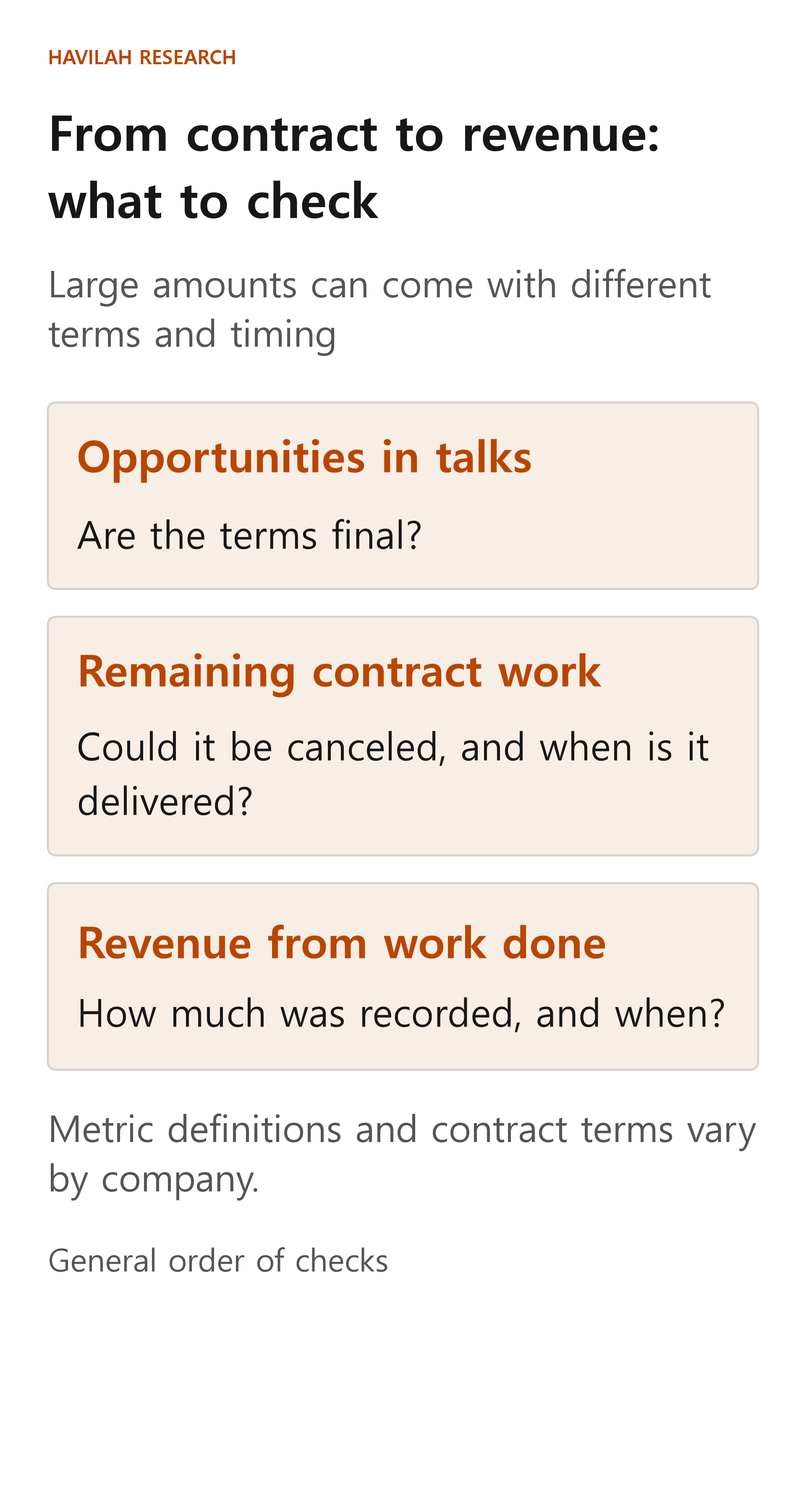
Opportunities under negotiation are less certain than contracts
Companies sometimes group together the deals they might win in the future and call it a pipeline. This can include talks and proposals that have not yet become contracts. What is included differs from company to company, so do not treat it as the same kind of number as firm orders.
A memorandum of understanding or a press announcement does not mean revenue is certain either. Check whether there is a binding order, whether the final price and quantity have been set, and whether there are cancellation rights or other conditions. If the terms have not been disclosed, leave them as something you have not been able to confirm.
Final checks when you invest
First, check whether the contract amount covers the whole contract period, and whether the work already done is separated from the work still to come. Then look at the cancellation terms, when revenue is expected to be recorded, and the cost of carrying out the work.
A large contract is a good starting point, but you also need to see whether the company can do the work on time and get paid. Even when revenue comes in, profit may not be as large as you expected if costs are high.