
The same company's profit appears as 100 on one screen and as 130 on another. Which one is wrong? First you need to check whether the two numbers refer to the same period and were calculated on the same basis.
The numbers on investment information websites are convenient, but they are only a starting point. For any number that matters to your investment decision, make a habit of opening the company's original release and filings to check it.
Numbers with the same name can be calculated differently
Besides profit calculated under the applicable accounting standards, a company sometimes also announces a profit figure in which certain items have been adjusted. Numbers prepared under U.S. accounting standards are called GAAP figures, and the figures a company adjusts on its own are commonly called non-GAAP figures.
Suppose a hypothetical company reports net income of $1 million under accounting standards for a period. It also shows adjusted net income of $1.3 million, adding back $300,000 of restructuring costs. Assume that this cost is the after-tax amount and that there are no other adjustments. In this example, $1,000,000 + $300,000 = $1,300,000.
This does not mean that one of the two numbers must be wrong. But they are not the same number. The company may argue that leaving out some costs makes its ongoing business easier to understand, but that does not erase the fact that the restructuring costs were actually incurred. You also need to check whether such adjusted costs keep coming back.
When a company presents adjusted figures, it shows how they differ from the comparable figures under accounting standards. In the table that explains the difference between the two numbers, look at which items were added or subtracted. Each adjustment may involve taxes or other conditions, so with real data, do not assume that you can simply add the items up as in this example.
Start by lining up the period and the units
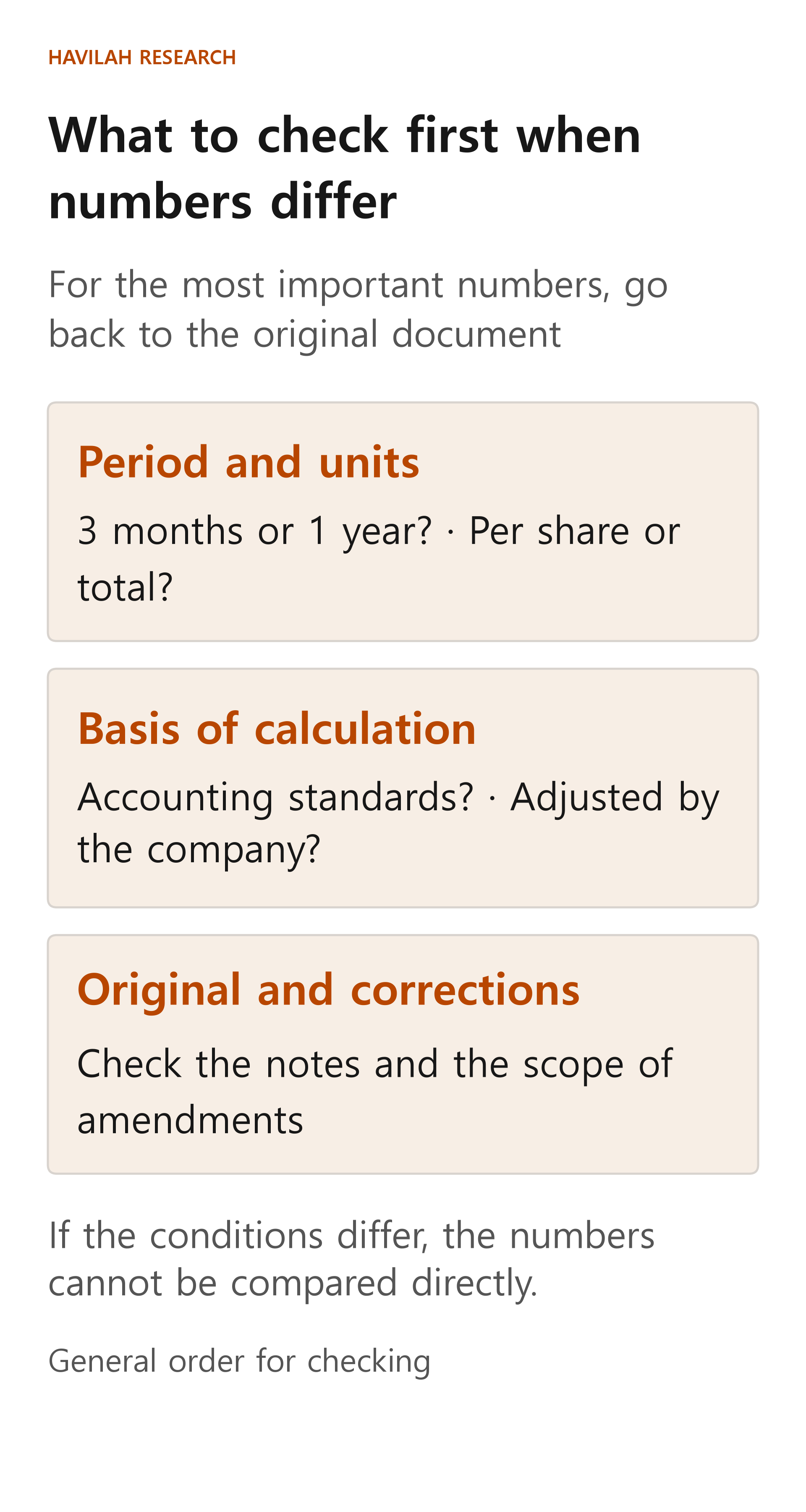
One source may show profit for 3 months and another profit for 1 year. One may be in dollars and the other in millions of dollars. When numbers differ, first check the period, the units, and whether the figure is for the whole company or per share.
Read the notes below the tables as well. Important conditions may be written there, such as when the company began including a business it acquired, or whether the figures for earlier periods have been restated. If the conditions for comparison do not match, do not simply divide one number by the other to calculate a growth rate.
A company may also correct its earlier numbers
If errors are found in financial statements a company published earlier, the company may later correct the numbers and publish them again. In U.S. company filings, a conclusion that earlier financial statements should no longer be relied on can be announced under Item 4.02 of an 8-K. At that point, the corrected numbers may not all be final yet.
A document with /A at the end, such as a 10-K/A or a 10-Q/A, is an amended version of an earlier filing. However, an amendment does not necessarily reprint the whole original report. Read the part that explains what was changed, and if you need information that was not amended, check the original report as well. Nor should you conclude that every earlier number was wrong just because an amendment has come out.
If a profit figure you noted earlier has been corrected, redo your calculations with the new number, and record the original number and the reason for the change. If a notice has been issued but the corrected amounts are not available yet, do not use the old numbers as if they were final; wait until they are confirmed.
When you use a number, record its source and conditions with it
When you write a company's profit in your analysis notes, do not record the number alone. Also write down which company and which period it is for, what the units are, whether it is a figure under accounting standards or an adjusted figure, and which table of which report you checked it in. If a correction comes out later, it will then be easier to find which of your judgments need a second look.
To sum up: when numbers differ, first check that you are comparing the same thing. If a difference still remains, read the notes and the amendments in the filings, and do not use a number with an unclear basis directly in your decisions.