
You hear that a company's share price has gone up. Before you invest, there is a question you need to answer first: what does this company sell, and who pays for it?
You have to understand the business before you can see why revenue grew and what risks may lie ahead. Knowing the company's name or one famous product is not enough.
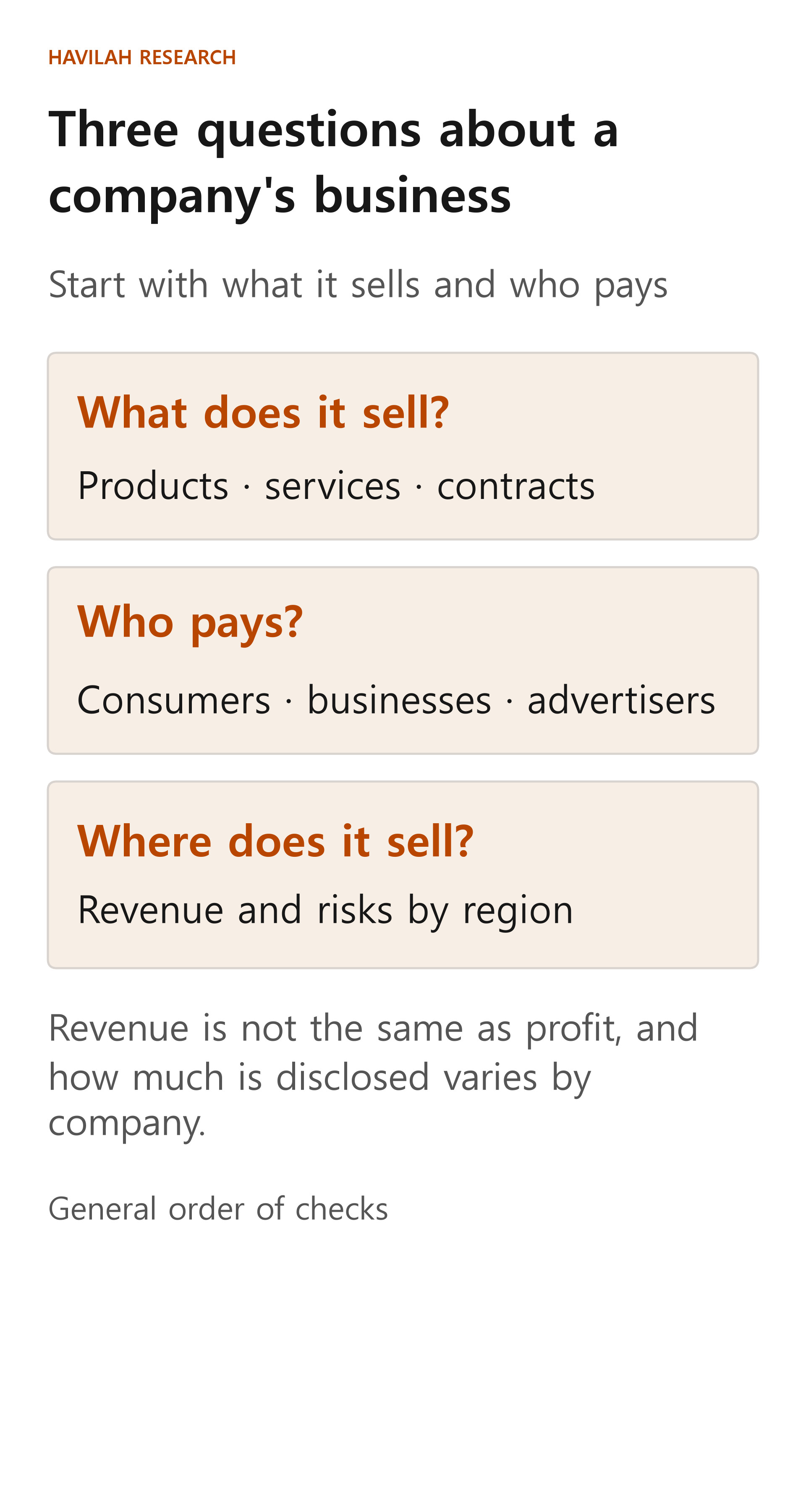
What does a company sell to earn its revenue?
Revenue is the income a company earns by providing goods or services. A company may be paid each time it sells an item, or it may collect a fee every month. Some businesses earn a commission whenever another company's products are sold.
Take a hypothetical company that does business in Korean won (KRW), used here as an example currency. It sells a machine for KRW 1 million, and each business that uses one pays it a maintenance fee of KRW 100,000 a year. If it sells 10 machines and collects the maintenance fee on all 10 in the first year, its first-year revenue, by simple arithmetic, is KRW 11 million.
Machine sales of KRW 10 million + maintenance fees of KRW 1 million = KRW 11 million.
The next year, even if the company sells no new machines, it still earns KRW 1 million in maintenance revenue as long as all 10 existing maintenance contracts stay in place. On the other hand, if customers cancel their contracts or the company lowers its price, maintenance revenue changes too. This example is simplified: both kinds of revenue are counted in the year they arise, and there are no refunds, taxes or similar items.
Splitting revenue by type like this makes it easier to tell money that comes in once from a single sale apart from money that keeps coming in for as long as a contract lasts. But the fact that money comes in repeatedly does not guarantee that the contract will continue or that the business will make a profit.
Real companies sell many products and services at once
Apple's report for fiscal 2025 shows revenue separately for products such as iPhone, Mac and iPad, and for services. That year, iPhone revenue was $209,586 million and total revenue was $416,161 million.
iPhone revenue ÷ total revenue is about 50.36%. This means the iPhone made up a large share of revenue at the time. It is the actual revenue share for fiscal 2025. It does not mean that half of the company's profit came from the iPhone, or that the share will stay the same in later years.
Apple also reports services revenue separately. The company said that advertising, the App Store and cloud services contributed to the growth in services revenue that year. Whether products sell well and whether use of services grows can be connected, but the two do not always move at the same pace.
Look at the customers who pay, too
The people who use a product and the customers who pay the company directly can be different. For example, if a company offers an app free to consumers and charges advertisers for ads, you need to look at both the number of users and how much advertisers spend.
If a company sells to other businesses, check what problem those customers buy the product to solve and how long their contracts last. If revenue is concentrated in a few large customers, the company could be hit hard when one of them cuts its orders or ends its contract. If revenue by customer is not disclosed, do not make up numbers to fill the gap: leave it as something you have not been able to confirm.
Where products are sold matters too
Even for the same product, competitors, regulations and exchange rates differ depending on where it is sold. Sales can rise in one region while they fall in another.
Apple's fiscal 2025 report splits revenue by region into the Americas, Europe, Greater China, Japan and Rest of Asia Pacific. These regions are defined by the company, so check the definitions in the report rather than guessing from the names which countries each one covers.
Revenue and profit are not the same
Even if sales grow, profit can fall if costs grow faster. The hypothetical machine company above also has to pay for materials, staff salaries and administrative costs. The KRW 11 million in revenue is the amount before any costs are subtracted, so you cannot call it profit.
When you study a company, try writing its revenue by product, the customers who pay and the regions where it sells on a single page. Then think about which sales would have the biggest effect on the whole company if they rose or fell. If a number you need is not in the filings, it is a good idea to keep your estimates and the facts you have confirmed clearly apart in your notes.