
When you read an article saying that a famous investor has bought a stock, you may feel like buying it too. But if you do not know when that person bought it or whether they still hold it, you cannot know whether you would be investing at the same price and on the same terms.
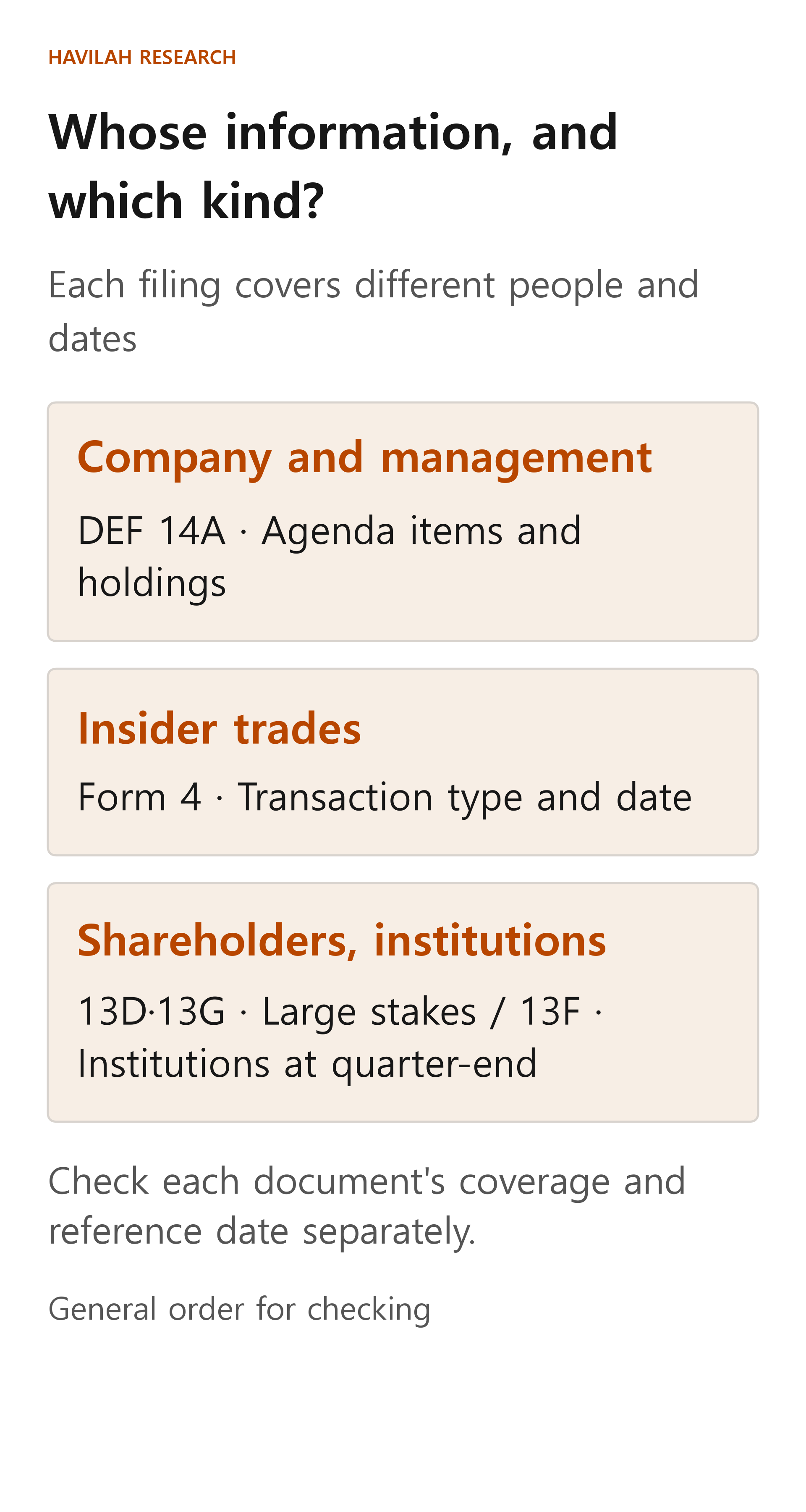
In U.S. filings, you can look up a company's management, its major shareholders and the holdings of certain institutional investors. However, each document covers different people and refers to a different date.
This lesson focuses on the filings that apply to U.S. companies. Some of these forms may not apply to the non-U.S. companies we looked at in the previous lesson, so check the documents they actually file.
Look up management and shareholder meeting agenda items in the DEF 14A
Shareholders can vote on important company matters. The DEF 14A, often called the proxy statement, is the final document a company sends to shareholders when it asks them to cast their votes. It lets you see what is being voted on, such as the election of directors.
This document also gives information on executive pay, the shareholdings of directors and officers, and the holdings of certain major shareholders. Search for the company, open the DEF 14A, and read the pay tables, the share ownership table and the footnotes together. It is important to check which date the amounts and share counts refer to.
A large pay package alone does not tell you whether management runs the company well or badly. You also need to look at what performance the pay is based on and under what conditions stock awards become final (vest).
Check insider trades in Form 4
Certain officers and directors of a company, among others, report their trades in the company's shares on Form 4. The document shows the transaction date, the number of shares, codes indicating the type of transaction and so on.
For example, P means a purchase and S means a sale. Shares received from the company as stock compensation, or shares used to pay taxes, may be shown with other codes. You need to read the explanations next to the table and the footnotes as well to know what actually happened.
The fact that an executive sold shares does not by itself prove that the company's outlook is poor. The person may have needed money for personal reasons, or the sale may be linked to compensation or to a trading plan set up in advance. Conversely, a purchase is no guarantee that the share price will rise.
Filings by holders of large stakes: 13D and 13G
When a person or a group beneficially owns more than 5% of a certain class of registered voting shares, it files a 13D or, if it meets the requirements, a 13G. Beneficial ownership is not limited to shares held in an account in the person's own name. The power to vote the shares or to sell them can also be part of it.
A 13D helps you see who holds how much and for what purpose the shares were acquired. A 13G is a shorter report used when certain eligibility requirements are met. When you compare the two, also check the class of shares, the reference date and whether any amendments were filed later. You cannot assume that every large shareholder wants to change how the company is run.
Institutional investors' holdings are listed in the 13F
A 13F is a document in which institutional investors that meet certain requirements report the reportable securities they held at the end of a quarter. It is easier to find if you search for the name of the investment firm rather than the name of the company.
This list is not a real-time trading screen. For example, suppose an institution filed a report on May 15 that was prepared as of March 31. Adding the 30 days of April and the 15 days of May, 45 days have passed since the reference date. The institution may have bought or sold shares in the meantime.
A 13F also does not show everything that institution has invested in. Short positions are not reported on a 13F. So the fact that a stock appears in the report does not tell you the institution's overall risk or its current view.
What to check last when you look at the numbers
First, distinguish a report's reference date from its filing date. When you compare share counts, also check whether anything that changes the number of shares, such as a stock split or a merger, has happened. Nor can you conclude that someone bought more just because the value of a holding has grown. The share price may have risen while the number of shares stayed the same, so that only the amount increased.
Filings are a starting point for working out what other investors may be thinking. If you do not know why they bought or what they hold now, do not simply copy them; check the company's business and finances yourself and judge whether it fits your own investment criteria.