
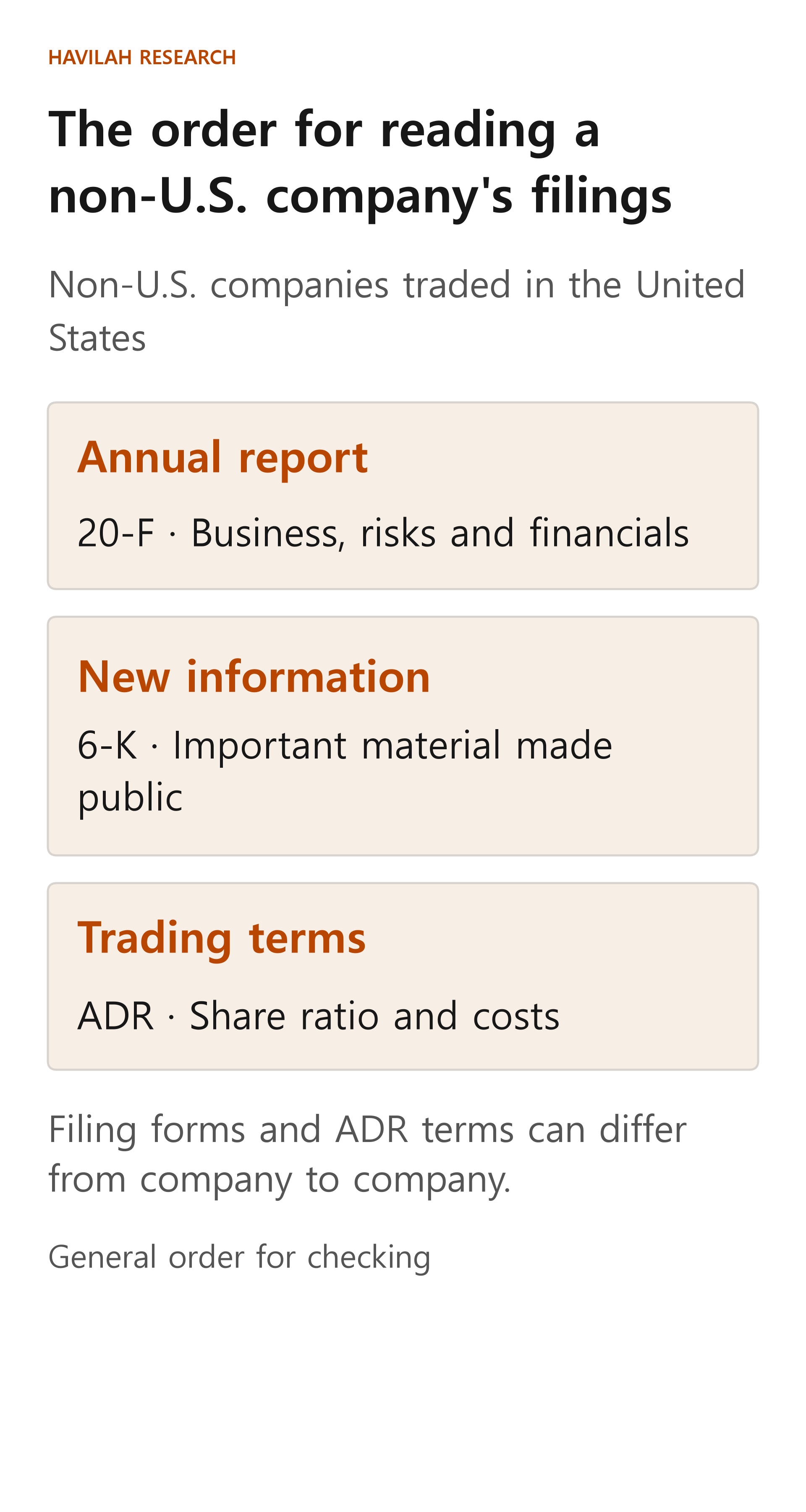
Not every company traded on the U.S. stock market is a U.S. company. Companies based outside the United States can also trade on U.S. markets. When you look for information on such companies, you may see the 20-F and 6-K instead of the 10-K and 10-Q you learned about earlier.
A different document name is no reason to give up on your analysis. First find out what business the company is in and what risks it faces, and then look at what has happened recently.
The 20-F is a report for reviewing a year of business
Under U.S. disclosure rules, non-U.S. companies that meet certain requirements can file their annual report on Form 20-F. It is your starting point for looking at the company's business, risk factors, financial statements and more. Form 20-F is also used for other purposes, so when you open one, first check that it is an annual report.
Once you have found the company and opened its annual 20-F, read the business description to see what it sells and where it makes its money. In the risk factors, see which difficulties the company considers important; in the financial statements, look at the money it earned and spent during the year and at its financial condition. Do not assume that its accounting standards and reporting currency are the same as other companies'; check them in the document.
Not every non-U.S. company listed in the United States uses the same forms. Some may use other reports or report on the forms designed for U.S. companies. The first step is to find the documents the company has actually filed.
Use the 6-K to check what came out afterward
After reading the annual report, you also need to check whether any new information has come out since. Certain non-U.S. companies use Form 6-K to provide important information they have made public in their home country, material they have sent to their shareholders and the like, so that it is also available in the United States.
A 6-K may contain results, or it may concern some other important event. Not every 6-K is a quarterly financial report in a standard format, as a U.S. company's 10-Q is. Look at the title and open the attachments first to see which period and which event the document is about.
For example, if you learned about the company's main products and risks from its annual report, you can look through later 6-K filings for new earnings releases or important changes in the business. Also tell apart the date a report was posted from the period covered by the results in it.
What is an ADR?
When you trade shares of a non-U.S. company in the United States, you may come across the name ADR. An ADR (American depositary receipt) is a certificate issued by a U.S. depositary bank that represents rights to the shares of a non-U.S. company. The depositary shares that the certificate represents are called ADS (American depositary shares), and in practice the terms ADR and ADS are sometimes used interchangeably.
One ADR is not necessarily the same as one original share. It may represent several shares or only a fraction of one share. This ratio differs from stock to stock, so check it in the deposit agreement or the company's filings before you make any comparison. Nor is every U.S.-traded security of a non-U.S. company an ADR.
When comparing prices, look at the ratio and the exchange rate together
Let's take a hypothetical European company as an example. Assume one share in its home market costs EUR 30, and one ADR represents two of those shares. If EUR 1 can be exchanged for $1.10, the converted value of the two underlying shares is as follows.
EUR 30 per share × 2 shares × $1.10 per EUR = $66.
If the ADR's market price is $67, it is $1 away from the amount calculated under these assumptions. That does not mean you can immediately make $1. You also need to check the actual timing of the trades and the exchange rate, trading costs, market liquidity, and any costs or restrictions involved in converting the shares. Actual prices change constantly, and there is no guarantee that they will equal the calculated amount.
Trading in dollars on a U.S. market does not remove the effect of exchange rates either. Changes in the currency of the region where the company does business, or in the price of the original shares, can also affect the ADR's dollar price. If your home currency is not the U.S. dollar, the exchange rate at which you convert dollars into your home currency also affects your investment result.
What should you check before you buy?
First read about the business and risks in the company's annual report, and check what has changed in its recent filings. For an ADR, also look at its ratio to the original shares, the fees the depositary bank may charge and how you can exercise voting rights. Fees may be deducted from dividends or charged separately; check the deposit agreement and your broker's information for the specific method.
Being able to buy in dollars is convenient, but that is a separate question from what business the company actually runs. Do not assume that a company will make the same disclosures as a U.S. company just because it trades on a U.S. market. It is best to make your investment decision after you have checked the rights you will hold and the costs as well.