
You hear that "a company's revenue rose sharply." It sounds like good news, but that sentence alone is not enough to decide whether to buy the stock. You need to know what the company sold to grow its revenue, whether its costs rose as well, and what risks lie ahead.
News can be a starting point for finding the questions you want answered. After that, check the numbers and explanations yourself in the reports and presentations the company has published.
Start with the reports the company files itself
The U.S. Securities and Exchange Commission (SEC) makes the filings that companies submit available through a public system called EDGAR. A filing (disclosure) is a document a company submits to inform investors about its business, its financial condition, major events and similar matters.
When you look into U.S. companies, three documents come up again and again.
| Document | In plain terms | What to look for |
|---|---|---|
| 10-K | Annual report | The year's business, risks and financial statements |
| 10-Q | Quarterly report | The quarter's financial condition and management's explanations |
| 8-K | Major-event report | Major events announced without waiting for the next regular report |
A 10-K contains audited annual financial statements. The quarterly financial statements in a 10-Q are usually unaudited. Keep this difference in mind, and check which period the numbers cover.
Being listed in the United States does not mean every company uses the same forms. Some companies based outside the United States file Form 20-F as their annual report. First find out which forms the company uses to report.
Where should you look in a real report?
As an example, take the fiscal 2025 10-K that Apple filed on October 31, 2025. It covers the fiscal year that ended on September 27, 2025. A fiscal year is the 12-month period a company uses to group and report its results, and it does not have to match the calendar year from January to December.
Near the front of the report, Item 1, Business, is where you see what the company does. Item 1A, Risk Factors, describes the risks the company considers important. The section that brings the financial statements together contains the income statement, which shows revenue, costs and so on; the balance sheet, which shows assets and liabilities; and the cash flow statement.
You do not need to understand every sentence at first. If you can simply find "What does it sell?", "What risks does it mention?" and "Where are the financial statements?", you will have a map for researching the company. This report is an example from one point in time, so if you are making an investment decision now, you also need to find the reports and filings that came after it.
Check the period and basis behind every number
Suppose a hypothetical company that reports in Korean won (KRW) grew its revenue from KRW 25 billion last year to KRW 30 billion this year. The increase is KRW 5 billion, and the growth rate measured against last year's revenue is as follows.
KRW 5 billion ÷ KRW 25 billion × 100 = 20%
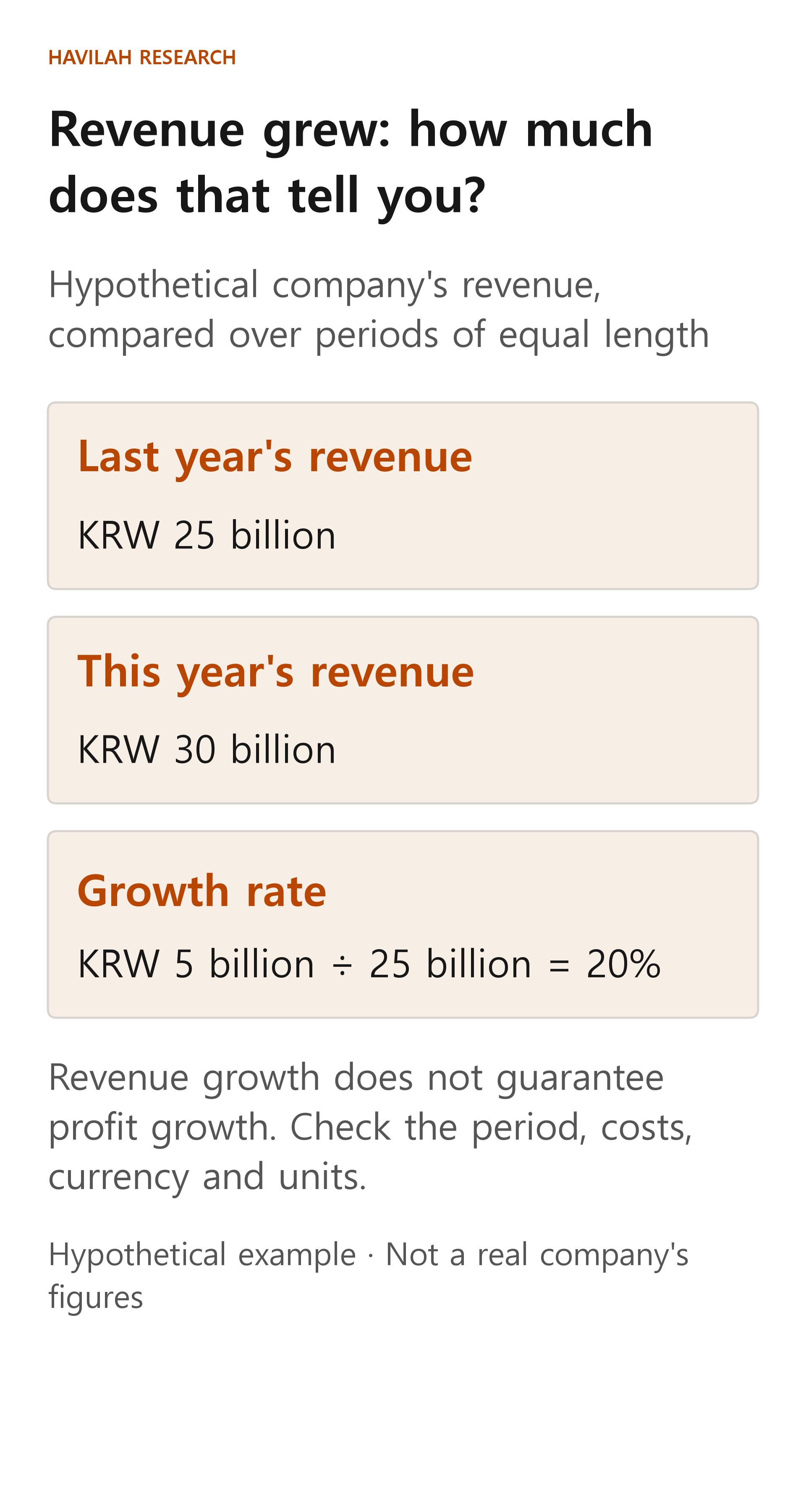
The statement "revenue rose 20%" is correct, but it does not let you say that profit also rose 20%. If the costs of materials or labor grew faster, profit can shrink even as revenue grows. Revenue is the amount a company earns from its sales; profit is what remains after the related costs and other items are subtracted.
Comparing 3 months of revenue directly with a full year of revenue, or comparing numbers in different currencies as they stand, can also lead you to the wrong conclusion. First check the period, the currency and the units of the numbers in a table. The figures above are a hypothetical example for illustration, not Apple's actual results.
How should you treat company announcements, news and social media?
A company's investor relations materials can include earnings releases, presentation slides for investors and management's outlook. They are a good way to grasp the key points quickly, but an outlook is a forecast that has not happened yet. Check the period and definition of the numbers in a release as well, and compare them with the corresponding report.
News helps you understand other companies and the state of the industry, and it can help you find new questions. But a short headline summary may differ from the conditions stated in the original. If an article includes numbers, check which company and which period they come from.
Treat claims you see on social media with even more care. Look at who wrote them, whether there is an original source, and whether facts are kept separate from opinions. Rather than deciding to buy on the strength of one convincing screenshot, it is better to find the company's filings and compare.
Once you have the documents, write down your questions
Pick one company and find its latest annual report, along with the quarterly and major-event reports filed after it. The date a document was filed and the period in which the results actually happened can differ, so record both.
Next, find what the company sells in the business description, what it worries about in the risk factors, and where revenue and costs appear in the financial statements. Filings are an important starting point, but that does not mean you can believe everything a company writes exactly as written. You need to check it against other parts of the report and against later announcements.
Starting with the next lesson, we will go through the company and financial concepts you need to read these documents, one at a time.