
The risk in trading stocks is not only that prices fall. You might buy with borrowed money and lose more than you expected, or be fooled by a scam message into handing over your account details.
Before you press the order button, first check where the money for the trade comes from and whether your account is safe.
What changes when you buy with more than your own money?
Margin trading means borrowing money from your broker to invest. A partial-payment trade, where a broker offers one, lets you pay only part of the purchase price when you place the order; you must settle the rest by the set settlement date. The names and terms differ, but both let you trade a larger amount than the money you have right now, so they call for care.
Here is a hypothetical example. Suppose your home currency is the Korean won (KRW). You combine KRW 5 million of your own money with KRW 5 million of borrowed money and buy KRW 10 million worth of stock. Assume there is no interest or other cost, and no forced sale along the way.
If the value of the stock falls 60%, the KRW 10 million becomes KRW 4 million. Even if you sell the shares and raise KRW 4 million, you are KRW 1 million short of repaying the KRW 5 million you borrowed. In effect, you lose all of the KRW 5 million you put in and still need KRW 1 million more.
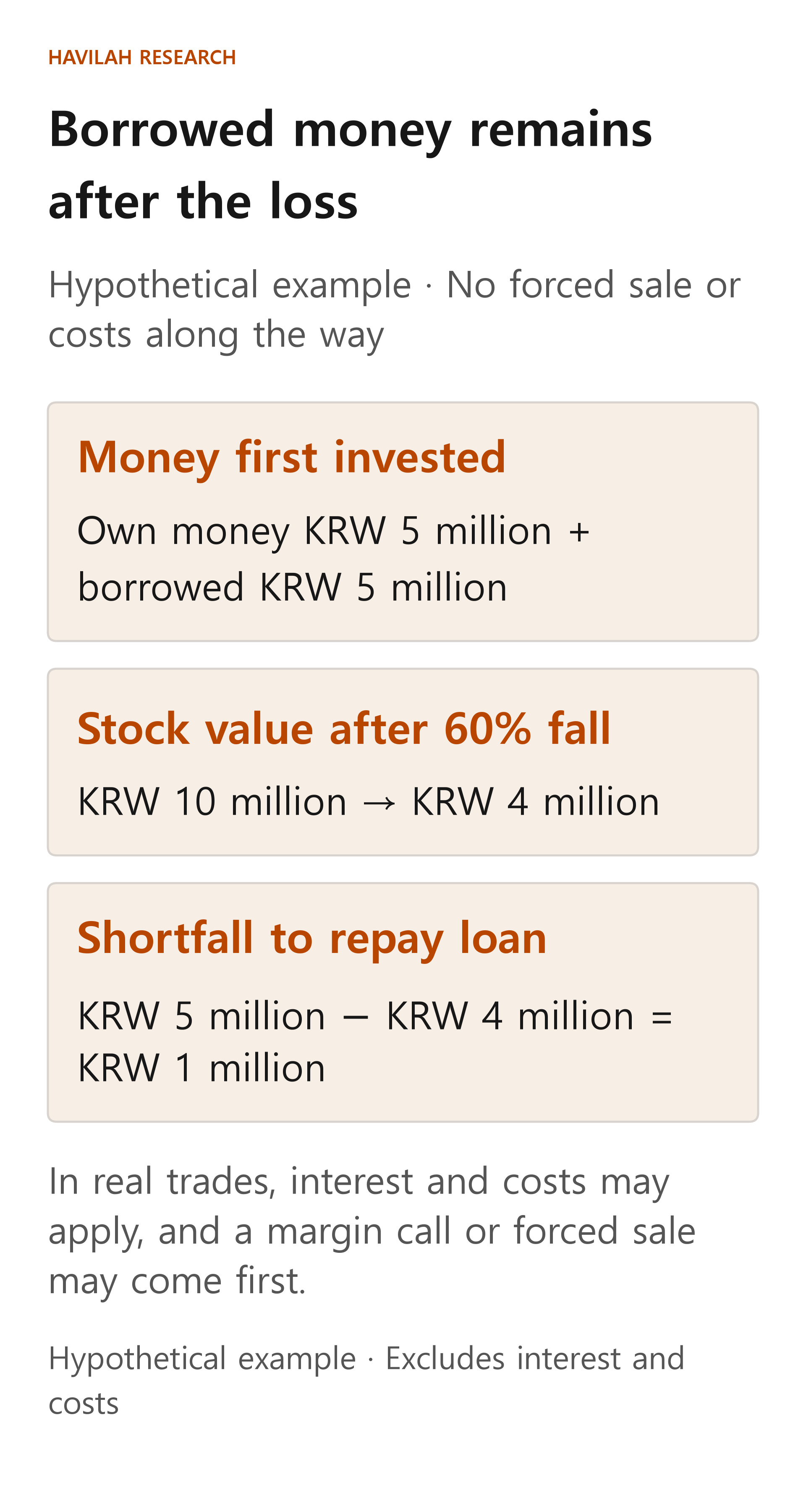
This calculation is an example to show how the loss works. In practice, if you fail to meet the collateral requirements your broker sets, your shares may be sold at a time you did not choose. Interest and costs may also be charged on the amount you borrowed. In other words, before you have lost all of your own money, you may be required to deposit more money (a margin call) or to sell.
With a partial-payment trade too, if you cannot pay the shortfall by the settlement date, the shares you hold may be sold under your broker's agreement and rules. If you want to trade with cash only, check the trade type on the order screen and the amount you need for settlement. Ask your broker about the margin requirements and forced-sale conditions of each service.
Check the U.S. day-trading rules for each account too
Day trading means buying and selling the same stock on the same trading day. In particular, in a margin account at a U.S. broker, you may need to keep enough collateral for the positions you hold during the trading day. You cannot assume that cash accounts and margin accounts, or the services of U.S. brokers and brokers in your country, come with the same terms.
The U.S. Financial Industry Regulatory Authority (FINRA) has replaced the existing pattern day trader designation and the $25,000 minimum equity requirement with a new intraday margin standard. The new rule took effect on June 4, 2026, but brokers are allowed a transition period until October 20, 2027. So you need to check for yourself which standard your broker still applies.
If your account does not have enough collateral, you may have to take further action, and a broker's own terms may be stricter than the regulatory minimum. Do not assume that this rule applies unchanged to every cash account at a broker in your country.
Be suspicious of messages that guarantee returns
If someone contacts you out of the blue and promises "guaranteed high returns with no losses" or pushes you to "send the money right now", stop and check. Some people pretend to be celebrities or real financial firms.
Do not rely on the links or phone numbers in the message to check. Check again through the company's official app or official contact details you have looked up yourself, and before you send money to a personal account the other person asks you to use, verify who you are dealing with and what the product is.
Never give your passwords or verification codes to anyone. Use a different password for each account, and if your broker offers it, set up authentication with two or more steps. If you suspect a suspicious trade or a leak of your information, contact your broker right away through official contact details you have checked yourself and ask how to protect your account.
Inheritance of U.S. assets is also worth understanding in advance
For a person who dies while neither a U.S. citizen nor a U.S. resident for U.S. estate tax purposes, assets located in the United States can include shares of companies set up under U.S. law. Residence for estate tax purposes is judged not only by the address on record but by things like whether the person actually lived there and whether they had a definite intention of moving away later. Simply holding the shares in an account with a broker in your country does not by itself make that issue go away.
The IRS explains that an estate tax return may need to be filed for such a person if the total fair market value of their U.S.-situated assets at the time of death is more than $60,000. Fair market value is usually the price that a buyer and a seller with no special relationship to each other could agree on. When deciding whether the filing threshold is met, certain past taxable gifts may also have to be added. Going over this threshold does not automatically mean tax is due on the whole amount above it. The actual filing and tax depend on factors such as residence, citizenship, the type of assets, deductions and any applicable treaty.
As your holdings grow, it is a good idea to check how the products you hold are actually issued and structured, and which documents your family would need. If the inheritance rules of both the United States and your country need to be looked at together, explain your situation to a professional who handles international inheritance and check with them.
Last checks before you place an order
First, check that the money you are about to trade with is not living-cost money you will need soon, and whether the order is paid in cash or includes borrowed money. Check the stock, the number of shares and the order price again too.
If your reason for trading is someone's guarantee of profit or an urgent request to send money, stop for a moment. After the trade, check the execution details, and separately review the tax and inheritance issues of foreign assets you plan to hold for a long time. The first step is to invest with money you have prepared, on terms you understand.