
When you sell U.S. stocks at a profit, it is easy to think the matter ends the moment you sell. But depending on the country where you live for tax purposes, you may need to add up the year's gains and losses on foreign stocks and check whether you have to report them in a tax return.
This lesson looks at individuals who directly trade ordinary stocks listed abroad. Tax on dividends was covered in the previous lesson; here we look at the gains and losses that arise when you sell shares.
Tax rules depend on where you live and on any tax treaty between your country and the United States, so check the rules that apply to you with your tax authority or a qualified adviser. To show how such a calculation works, the worked example in this lesson follows South Korea's rules for residents, as described at the time of writing. It is an illustration only, not the rule in your country.
What is a capital gain?
When you sell shares, the amount left after subtracting what you paid to buy them and any allowable transaction costs from the sale proceeds is your capital gain. If you sell for less and lose money, that is a capital loss.
For example, suppose your home currency is the Korean won (KRW). You buy a hypothetical stock for KRW 5 million and sell it for KRW 8 million, and the allowable transaction costs come to KRW 100,000. Your gain is KRW 2.9 million.
KRW 8 million − KRW 5 million − KRW 100,000 = KRW 2.9 million
These won amounts are hypothetical, to make the idea easier to follow. In practice, if your gain has to be calculated in your home currency, you need the transaction records from the purchase and the sale, the exchange rates that apply and the allowable costs. If you simply take your gain in dollars and multiply it by a later exchange rate, the result can differ from your actual gain or loss in your home currency.
Add up the year's gains and losses, not just one stock
You may have made a gain on one stock but sold another at a loss in the same year. Combining gains and losses in one calculation like this is called netting. Whether and how you can net them depends on your country's rules. Under the South Korean rules used in this example, gains and losses on taxable shares sold in the same year are calculated together.
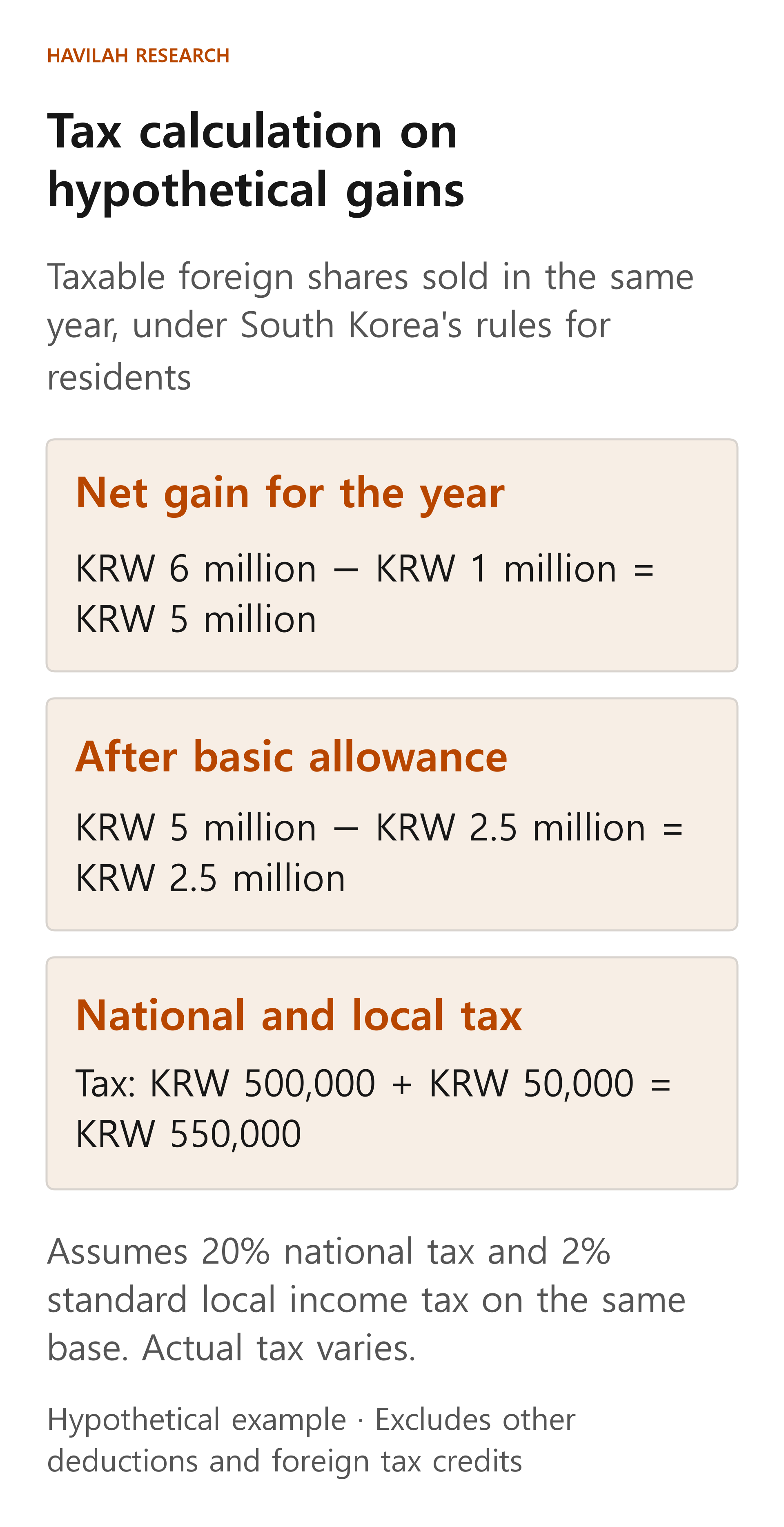
Suppose that in a hypothetical year you sold Stock A for a gain of KRW 6 million and Stock B for a loss of KRW 1 million. Assume both are amounts in won that already reflect allowable transaction costs, and that there are no other stock trades or deductions.
KRW 6 million − KRW 1 million = KRW 5 million
In this example, the combined capital gain is KRW 5 million. If you used two brokers, do not rely on one broker's screen; check that year's trades in every account together.
A paper loss on shares you have not sold yet is not the same as the realized capital loss used in this calculation. Nor can every loss necessarily be combined. Under the Korean rules in this example, domestic shares that are not subject to capital gains tax cannot be netted against foreign shares. Check which gains and losses your own country's rules let you combine.
How are the basic allowance and the tax calculated?
A basic allowance (also called a basic deduction) is a fixed amount subtracted when the tax is calculated. Whether there is one, and how large it is, depends on where you live. Under the South Korean rules in this example, ordinary capital gains on shares receive a basic allowance of KRW 2.5 million a year, for domestic and foreign shares combined. It is not KRW 2.5 million for each broker you use.
In the hypothetical case above, assume no deduction has already been used elsewhere and that the KRW 2.5 million basic allowance applies to the whole KRW 5 million.
- Combined capital gain: KRW 5 million
- Basic allowance: KRW 2.5 million
- Taxable amount: KRW 5 million − KRW 2.5 million = KRW 2.5 million
The taxable amount (the tax base) is the amount the tax rate is applied to. If a capital gains tax rate of 20% applies to the foreign shares in this example, the national tax is KRW 500,000. If local income tax is also charged on the same KRW 2.5 million tax base at the standard rate of 2%, that is KRW 50,000, so the two taxes come to KRW 550,000 in total.
Your actual tax can differ depending on your country of tax residence, any tax treaty with the United States and your personal situation, such as the type of shares, allowances already used, other taxable transactions and tax credits. This example leaves out any credit for foreign tax paid and any other deductions.
When do you file, and what should you prepare?
Whether you have to report gains on foreign shares, and how and by when, depends on your country's tax rules. Check your tax authority's guidance for the year in question against your own trades to confirm whether you need to file and the exact deadline.
Collecting any capital gains reports your broker provides for foreign shares, together with the transaction history of each account, will help with the calculation. Whether brokers provide such reports, and what they cover, can differ from broker to broker, and you need to check trades across several brokers yourself. For trades near the end of the year, also check which tax year they belong to, based on the trade and settlement records and the rules that apply.
Do not decide whether you need to file just because you expect no tax to be due; check your gains and losses and the filing requirements. If you paid tax abroad or have other taxable transactions in your country, there may be more items to look into.
Watch for temporary special rules
Tax rules can also include temporary special measures, such as a deduction that reduces the tax on gains for a limited period if you meet certain conditions. If one applies where you live, read its conditions before you sell, because the details decide whether you benefit.
Check which holdings qualify, for example only shares held before a certain date, and whether you must sell them through a particular type of account. If there is a limit on the amount that qualifies, check whether it is based on the sale amount or on the gain, and whether it applies per person across all your brokers.
Check what you must do with the money from the sale, and for how long. A scheme may require you to reinvest the proceeds in specified investments and keep them invested for a minimum period. Taking the money out early could cancel the benefit or mean paying back the tax you saved.
Check which date counts. A benefit that changes with the timing of a sale may be based on the date the trade settles rather than the date the order was filled. For U.S. stocks, the trade date and the settlement date are different, so if you sell close to a deadline such as the end of the year, check the cutoff time your broker gives for settling in time.
Also check whether buying other foreign investments in other accounts during the same period could reduce the benefit.
Temporary measures end on a set date, and they can be changed or extended. Before relying on one, confirm the current details with your tax authority and in your broker's documentation for the scheme.
Consider investment decisions and tax together
Even when a share price rises, your actual return shrinks once trading costs and taxes are taken into account. But if you buy or sell based on tax alone, you may miss changes in the business or the risks of the investment.
When you sell, first be clear about your reason for the trade, and keep your broker's records once it is done. Checking the year's combined gains and losses across all your accounts, and any allowances, also prepares you for filing your return. If a product's structure or your personal situation is complicated, take your transaction records to a qualified tax adviser.