
A U.S. company paid a dividend of $100, but only $85 arrived in your account. Where did the missing $15 go?
Tax may have been taken out before you received the dividend. This is called withholding. But the same rate does not apply to every investor or every product. This lesson focuses on individuals who live outside the United States and receive ordinary dividends from U.S. companies.
Tax rules depend on where you live and on any tax treaty between your country and the United States, so check the rules that apply to you with your tax authority or a qualified adviser. The worked example in this lesson uses a 15% U.S. withholding rate, the treaty rate that can apply to residents of South Korea, as described at the time of writing. It is an illustration only, not necessarily the rate that applies to you.
The dividend and the amount you receive are different
A dividend is money a company pays to its shareholders. Even after the company declares and pays a dividend, if tax is deducted first, the amount that reaches your account is smaller than the dividend before tax.
For example, assume a hypothetical dividend of $100, a U.S. withholding tax rate of 15% and no other costs.
- Dividend before tax: $100
- Tax withheld in the United States: $100 × 15% = $15
- Amount after U.S. tax: $100 − $15 = $85
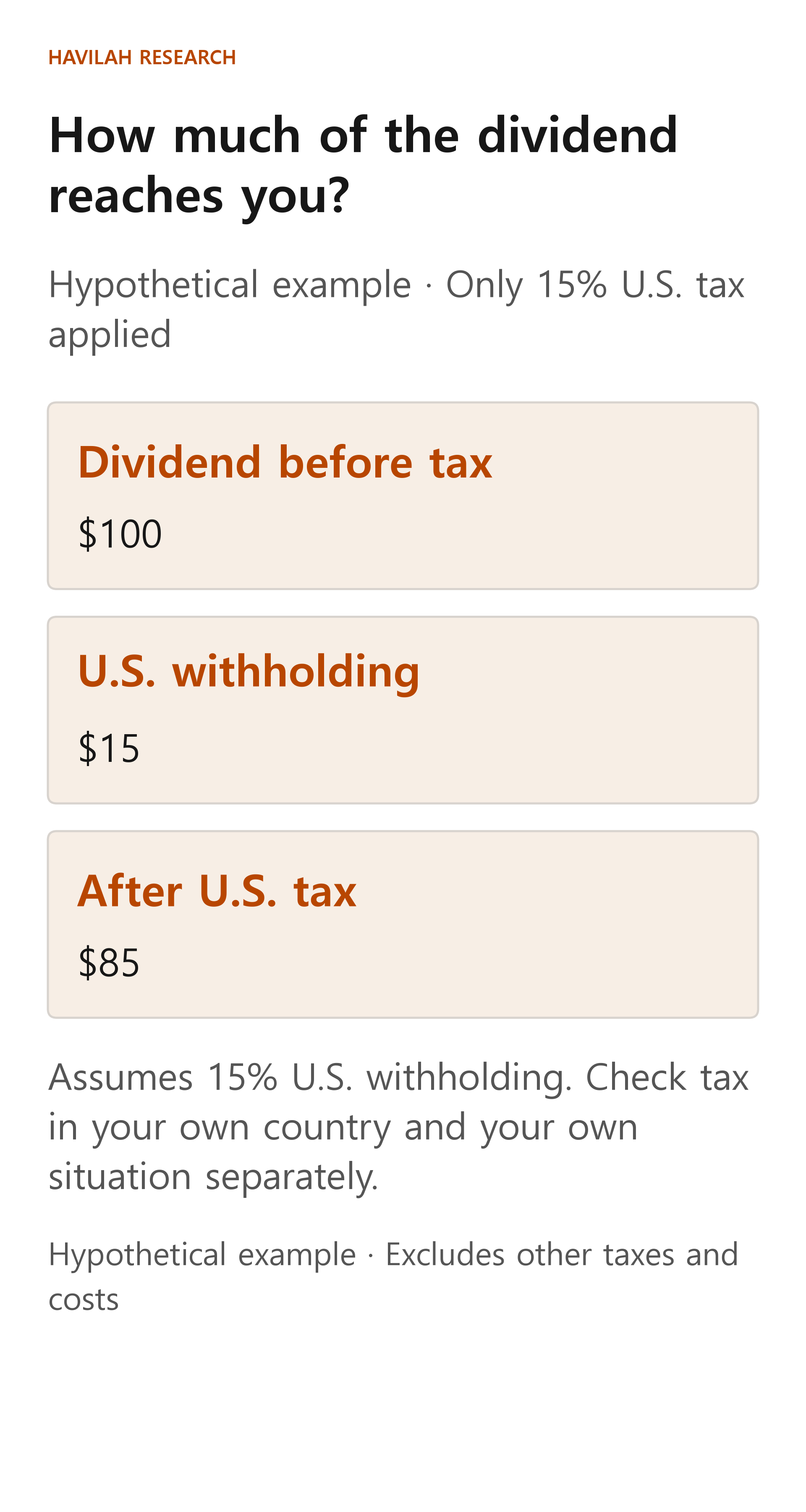
Under this assumption, $85 is the amount left after U.S. tax. You cannot assume it is the final amount once tax in your own country and any other costs are taken into account.
Why might a lower rate such as 15% apply?
The United States generally withholds 30% on U.S.-source dividends paid to nonresident aliens, but a lower rate may apply if a tax treaty covers you and you have provided the required documents.
A tax treaty is an agreement between two countries that sets out how each may tax income. Whether your country has a tax treaty with the United States, and what it says about dividends, depends on where you live. In this lesson's example, the dividend article of the tax treaty between South Korea and the United States sets a general limit of 15% of the dividend on dividends received by a resident of the other country. So 15% can apply to ordinary U.S. dividends received by an individual resident in South Korea who is entitled to the treaty's benefits. Check the treaty and conditions that apply to you.
The key words are "can apply". The result can differ depending on where you are resident for tax purposes, the actual type of income, the product's structure and the state of your documents. Do not assume that a reduced rate such as 15% applies to every distribution just because you bought the shares on a U.S. exchange. U.S. citizens and people treated as U.S. residents under U.S. tax law are also outside the scope of this explanation.
What is Form W-8BEN?
Form W-8BEN is the form an individual who is a foreign person under U.S. tax law uses to certify their status and the information needed to claim tax treaty benefits. The investor gives it to the payer or withholding agent that asks for it. You do not send this form to the IRS (the U.S. tax authority) yourself.
Brokers may differ in how they collect this information when you open an account and how they renew the form. It is a good idea to ask your broker which steps were completed for your account and whether a valid form is currently on file.
The form generally stays valid from the date it is signed until the last day of the third calendar year after that, but there are exceptions, and it can become invalid earlier if information on it, such as your status or residence, becomes incorrect. In that case, the IRS instructions say to notify the withholding agent within 30 days of the change and to provide a new W-8BEN or another form that suits your situation.
There are things to check in your own country too
Having tax withheld in the United States does not always settle whether you need to report the dividend in your own country. Depending on your country's rules, the dividend may need to be looked at together with your other interest and dividend income.
Check how your country treats dividends from abroad: whether there is an annual threshold for investment income that changes how it is taxed or whether it must be reported, and whether foreign income on which no local tax was withheld has to be reported even below such a threshold. If a broker or another institution in your country handles the payment for you, local withholding may be handled differently. If tax can also be withheld in your country, a statement could show 0 additional local tax because the foreign tax was already taken into account. So do not conclude from a 0 alone that no local withholding was applied; ask your broker how the payment and any withholding were handled.
Also check whether, when you file a return, your country gives a credit for foreign tax paid lawfully under a tax treaty and the other country's tax law, and what conditions and limits apply. Such a credit does not mean you automatically get back all the tax you paid abroad. Whether you owe more tax at home also depends on your own income and withholding records. Check the details with your tax authority or a qualified adviser.
What should you check when you receive a dividend?
In your broker's transaction history, first check the dividend before tax, the U.S. tax withheld and the amount actually paid into your account. In the hypothetical example above, with 15% applied to $100, these three items are $100, $15 and $85.
Next, check the status of the tax forms for your account, along with the other interest and dividends you received over a 1-year period. Keeping records of whether tax was withheld in your country and of the tax you paid abroad will help you decide whether you need to file a return.
Look at the tax on dividends separately from the tax on gains from selling shares. Especially if an investment product's structure or your residence status is complicated, show the details to your broker or a qualified tax adviser and check with them.