
You bought a U.S. stock and made a profit in dollars, but when you look at it in your home currency, you made less than you expected. Why?
U.S. stock prices are quoted in U.S. dollars. When you measure your performance in your home currency, the rate for converting dollars into that currency matters as well as the change in the share price. Even with the same stock, the returns in the two currencies can differ depending on when you buy and when you value it.
An exchange rate is the price of one currency in another
Suppose your home currency is the Korean won (KRW). A USD/KRW exchange rate of KRW 1,400 per dollar means that, at this rate, $1 is counted as KRW 1,400. So $1,000 converts to KRW 1.4 million.
If the rate falls to KRW 1,300 per dollar, the same $1,000 is counted as KRW 1.3 million. The dollar amount has not changed, but the amount shown in won is KRW 100,000 lower.
If, instead, the rate rises to KRW 1,500 per dollar, $1,000 is counted as KRW 1.5 million. The prices and exchange rates in this lesson are hypothetical numbers to help you understand. When you actually convert currency, check the rate that applies and the costs.
A 10% rise in the share price can mean a different return in your currency
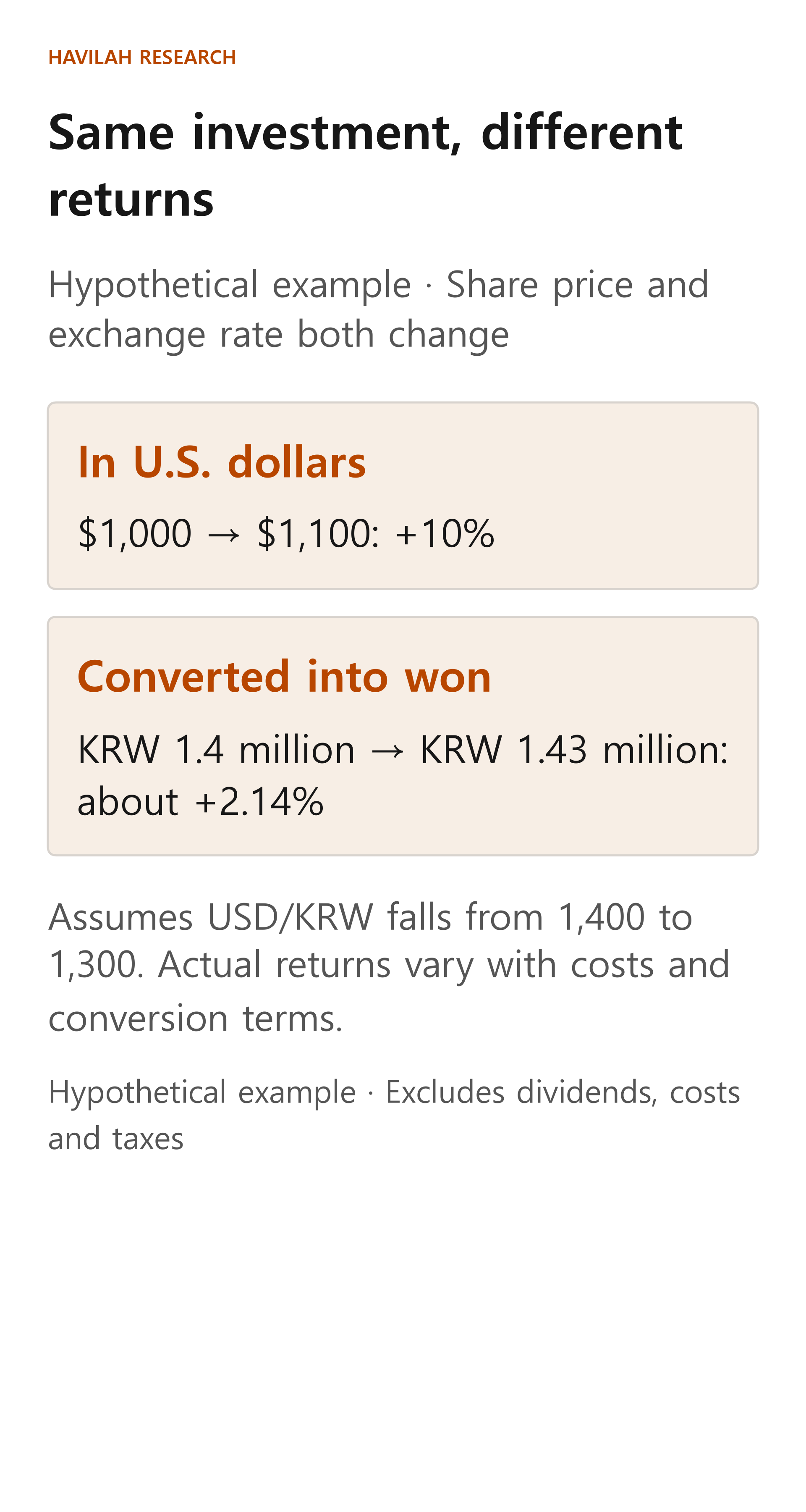
Suppose you bought 10 shares of a hypothetical U.S. stock at $100 a share. The exchange rate at the time was KRW 1,400 per dollar, so the $1,000 you spent is equal to KRW 1.4 million. Assume there are no extra deposits or withdrawals, dividends, conversion spreads, fees or taxes.
Later the share price rises to $110, so your 10 shares are worth $1,100. In dollars, that is a gain of $100, or 10%.
But what if, at the same time, the exchange rate has fallen to KRW 1,300 per dollar?
- At the start: $1,000 × KRW 1,400 = KRW 1.4 million
- Later: $1,100 × KRW 1,300 = KRW 1.43 million
- Difference in won: KRW 1.43 million − KRW 1.4 million = KRW 30,000
Your return in won is KRW 30,000 ÷ KRW 1.4 million × 100, or about 2.14%. The share price rose 10%, but each dollar was now converted into fewer won, so the gain shrank.
If the rate falls further, you could have a loss in your home currency
With the same $1,100, if the rate is KRW 1,200 per dollar, the value in won is KRW 1.32 million. Compared with the starting value of KRW 1.4 million, that is KRW 80,000 less, a loss of about 5.71%. In dollars the share price is still up 10%, but the result in won is different.
Nor does a rising exchange rate always mean a gain. For example, suppose the same $1,000 from the start falls to $900, while the exchange rate rises from KRW 1,400 to KRW 1,500. The later value in won is $900 × KRW 1,500 = KRW 1.35 million. That is KRW 50,000 less than the starting KRW 1.4 million, a loss of about 3.57%.
In this case the change in the exchange rate reduced part of the loss but did not make up for the whole fall in the share price. When you invest in foreign stocks, the exchange rate is one more variable that can make your results bigger or smaller.
Do not simply add the two percentage changes
In the first example, the multiplier for the share price change is 1.10. The multiplier for the exchange rate is 1,300 ÷ 1,400, or about 0.9286. Multiply the two and subtract 1 to get your return in won.
1.10 × (1,300 ÷ 1,400) − 1 ≈ 0.0214
As a percentage, that is about 2.14%. Nothing was rounded along the way; only the final result was rounded to two decimal places. If you round the rise in the share price and the fall in the exchange rate separately and simply add them, you can end up with a different answer from the exact one.
Market value is not the same as the amount you actually convert
If you have not sold the shares, their value in your home currency is a market value calculated from the share price and the exchange rate at that moment. It is not money you have already received in your home currency. Even if you sell the shares and hold the dollars, the value of that dollar cash in your home currency keeps changing until you convert it.
When you actually convert, check the rate your broker applies, which is separate from the reference rate shown on the screen, as well as the conversion costs and any discount terms. Trading commissions, taxes and dividends can also affect your actual result. The calculations above leave these out, so they cannot be taken as your actual gain or loss.
When you check how a foreign stock has performed, first look at how much the share price changed in dollars. Then check the result in your home currency, including the exchange rate and costs. The currency you measure in can change the answer.