
Suppose your home currency is the Korean won (KRW), and the money you invested has grown from KRW 10 million to KRW 10.45 million. Knowing that you made KRW 450,000 is not enough to tell how good the investment was. You also need to look at how much you put in at the start and how long it was invested.
In this lesson, you will calculate a return and see how the same rate of return can lead to different results depending on how the money grows.
A return is measured against the money you first invested
A return (rate of return) is the percentage you gained or lost compared with the amount you invested. If you put in KRW 10 million and it became KRW 10.45 million, you made KRW 450,000. Your return is:
KRW 450,000 ÷ KRW 10 million × 100 = 4.5%
If, instead, KRW 10 million became KRW 8 million, you lost KRW 2 million, so your return is −20%. These are hypothetical calculations with no extra deposits or withdrawals, fees, taxes or dividends.
In real investing, looking only at how much the share price rose is not the whole story. Dividends you received also count toward your return, and you need to look at costs such as trading commissions and taxes to know what you actually keep. With foreign stocks, your return in U.S. dollars and your return converted into your home currency can differ, depending on the exchange rate.
How do simple and compound interest differ?
Start with a hypothetical deposit that earns the same return every year. Assume KRW 10 million earns 10% a year, with no extra deposits, withdrawals or taxes for 3 years. The numbers are only for understanding; they are not the interest rate of any real product.
With simple interest, interest is paid only on the principal, the money you first put in. Each year you get 10% of KRW 10 million, which is KRW 1 million. If you keep the interest separately and no interest is paid on it, then after 3 years the principal plus the interest you have collected comes to KRW 13 million.
With compound interest, the interest earned so far is added to the principal before the next interest is calculated. The deposit becomes KRW 11 million after 1 year, KRW 12.1 million after 2 years and KRW 13.31 million after 3 years.
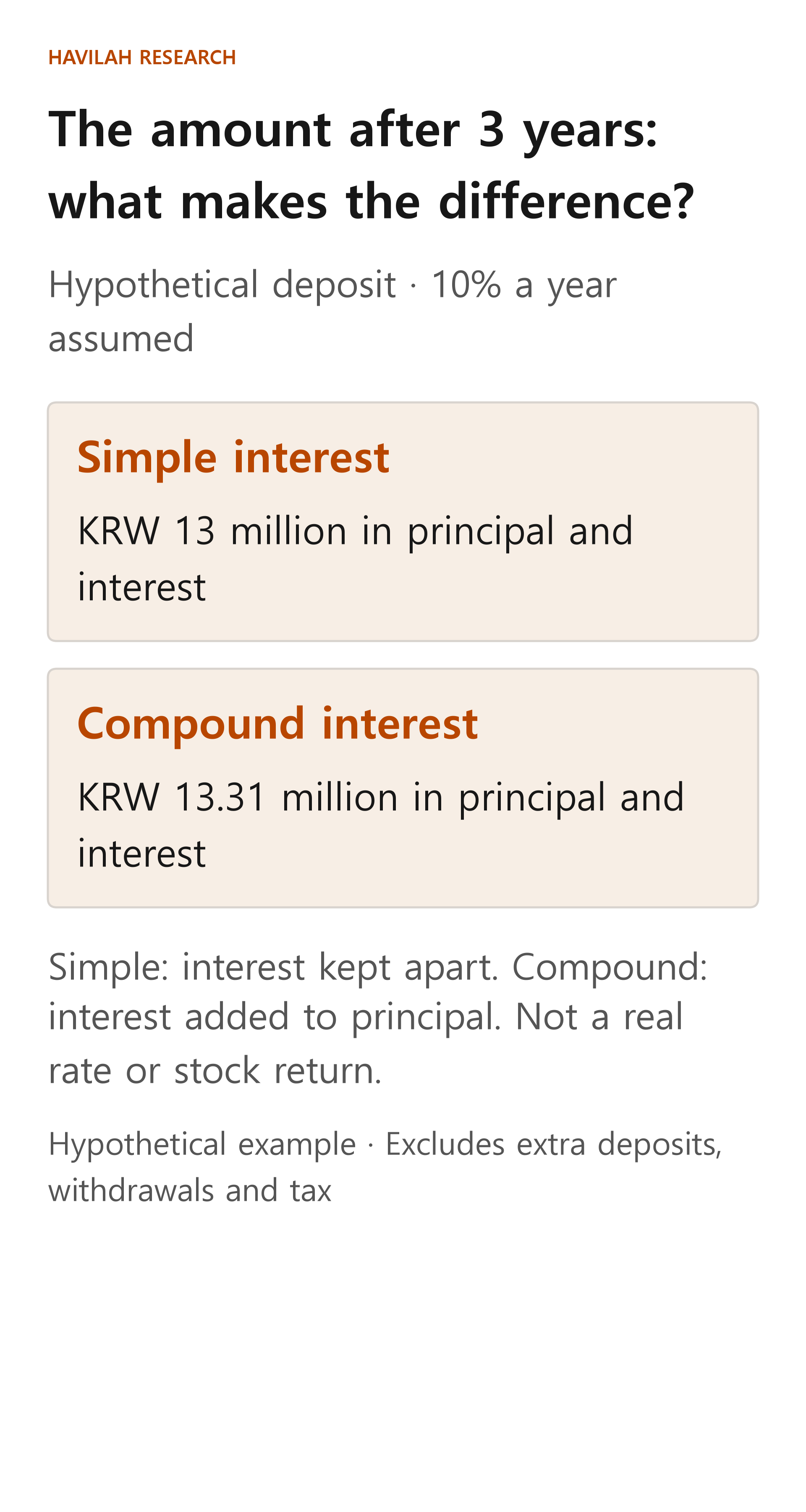
The difference is KRW 310,000. It is small at first, but it grows because the interest you earned earlier is included in the next calculation. Keep in mind that with real deposits the result can differ depending on how often interest is paid, taxes and the product's terms.
Stocks are not like deposits that pay a set rate of interest. Nobody can guarantee that a share price will rise 10% every year. Still, you can think of the idea of compounding this way: the value of what you invested changes, and if you leave your gains invested or reinvest the dividends you receive, later returns apply to that changed amount. In the same way, losses shrink the amount you have invested from then on.
Returns that go up and down are multiplied, not added
Now suppose a hypothetical KRW 10 million rises 10% in the first year and falls 5% the next year. There are no extra deposits or withdrawals, dividends or costs.
- First year: KRW 10 million × 1.10 = KRW 11 million
- Second year: KRW 11 million × 0.95 = KRW 10.45 million
Comparing the starting KRW 10 million with the final KRW 10.45 million, the return over the whole 2 years is 4.5%. The 5% fall in the second year is calculated on the KRW 11 million at the end of the first year, not on the original KRW 10 million.
Even when a rise and a fall are the same percentage, you do not end up back at the original amount. If KRW 1 million falls 20%, it becomes KRW 800,000. A 20% rise from there gives KRW 960,000. To get back to KRW 1 million, it has to gain KRW 200,000 on a base of KRW 800,000, which takes a 25% rise. As you saw in the previous lesson, this is because a fall and a recovery are measured from different base amounts.
An annualized return is a number that helps you compare
When investment periods differ, the total return alone makes comparison hard. This is where the annualized return comes in. It is the yearly rate you would get if you assumed the investment earned the same return every year and ended at the same final amount from the same starting amount.
In the hypothetical case above, KRW 10 million became KRW 10.45 million after 2 years, so the annualized return is:
Square root of (1,045 ÷ 1,000) − 1 ≈ 0.02225
As a percentage, that is about 2.23% a year. On a calculator, take the square root of 1.045, subtract 1 and multiply by 100. This is slightly different from 2.25%, which is the total return of 4.5% simply divided by 2. The annualized return is a calculation in which each year's result becomes part of the base amount for the next year.
The 2.23% here does not mean you actually earned 2.23% each year. The actual path was +10% in the first year and −5% in the second. It is only a number for comparing results, on the assumption that the return was steady, and it certainly does not mean the same return will continue in the future.
What to check when you apply this to a real account
First, decide the start and end dates you want to compare, and check the value of your investment on both dates in the same currency. If you received dividends, work out whether you reinvested them or are holding them as cash. Whether costs and taxes are included also changes the return.
If you added or withdrew money along the way, simply dividing the final balance by the starting balance will not show your investment performance properly. You need to record the dates and amounts of deposits and withdrawals separately and use a calculation that takes them into account. For example, if you put in KRW 10 million, then added KRW 5 million and your balance is KRW 15 million, you did not make 50% from investing.
Always read a return together with what it is measured against, over what period, and how costs, deposits and withdrawals were treated. In the next lesson, we look at what else to check when you review your investment results.