
"This money is for the long term." You buy with that in mind, but 1 year later you need the money for a move. If share prices are down at that point, could you afford to wait?
Before you invest, it is easy to think only about how much a stock might rise. But you also need to decide when you will need the money and how big a fall you could cope with.
1. Base your time horizon on when you will need the money
Your investment horizon (time horizon) is how long you have until you use the invested money for its goal. For example, moving costs you must pay in 1 year and retirement savings you have no plans to touch can wait for different lengths of time.
If the date you need the money is close, it may be hard to wait for prices to recover after a fall. If you do not know when you will need the money, also consider that you might need it sooner than you expect.
On the other hand, even if you can stay invested for a long time, there is no guarantee that losses will disappear. Depending on the company or product, the price may not get back to its earlier level even after many years.
2. Look at losses as an amount and as a percentage
Suppose your home currency is the Korean won (KRW). You invest KRW 10 million, and later the value of the investment falls to KRW 8 million. Even though you have not sold, its value at current prices has dropped by KRW 2 million. That is a 20% fall from the amount you started with.
Now ask yourself: with KRW 2 million gone, could you still cover your living costs and planned expenses? Would you feel so anxious that you want to sell right away? How much you can afford to lose, and how much stress you can handle, differ from person to person.
Writing down a loss limit does not mean you will definitely be able to sell at that level. If prices move fast or trading becomes difficult, your loss can be bigger than expected. The number you set is a checkpoint, not a guaranteed floor.
3. Check how far the value has fallen from its peak
Suppose a hypothetical account that started with KRW 10 million was recorded at the four points in time below. There were no extra deposits, withdrawals or fees. Prices at other times were not observed.
| Point observed | Account value |
|---|---|
| Start | KRW 10 million |
| Day 30 | KRW 12 million |
| Day 90 | KRW 8.4 million |
| Day 270 | KRW 12 million |
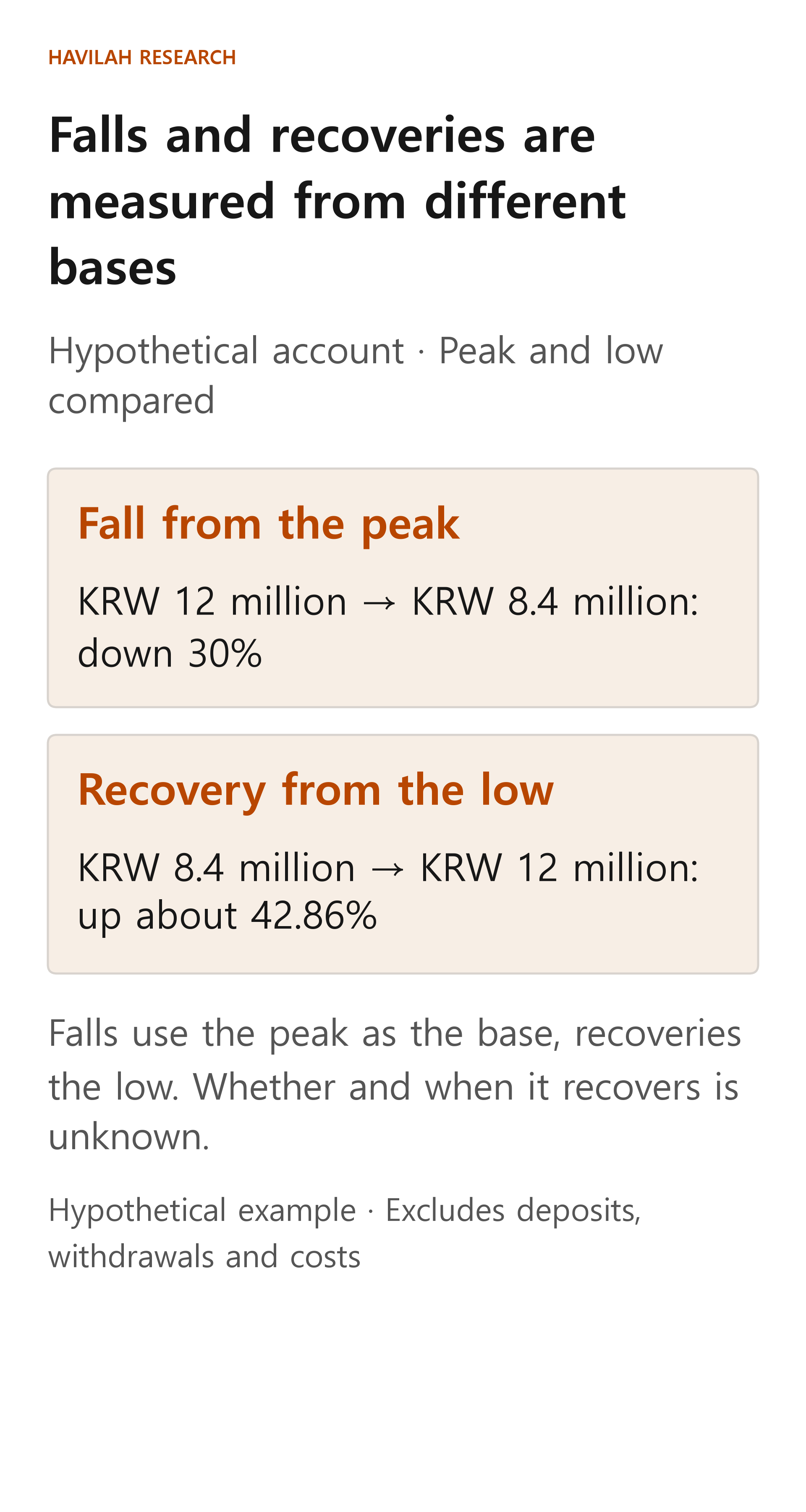
From KRW 12 million on day 30 to KRW 8.4 million on day 90, the value fell by KRW 3.6 million. The percentage fall is KRW 3.6 million ÷ KRW 12 million × 100 = 30%. Note that the calculation uses the previous peak of KRW 12 million as its base, not the KRW 10 million first invested.
How far the value falls from a peak to a later low is called a drawdown. The largest drawdown observed over a given period is called the maximum drawdown. In the four records above, the maximum drawdown you can see is 30%. If the value was lower on a day that was not recorded, the actual drawdown could have been bigger.
4. If it falls 30% and then rises 30%, is it back where it was?
No. A 30% rise from KRW 8.4 million adds KRW 2.52 million, which brings it to KRW 10.92 million. That is still short of the previous peak of KRW 12 million.
For KRW 8.4 million to get back to KRW 12 million, it has to grow by KRW 3.6 million. KRW 3.6 million ÷ KRW 8.4 million × 100 is about 42.86%. The percentages differ because the fall is divided by KRW 12 million, while the recovery is divided by the smaller KRW 8.4 million.
In this example's records, 240 days pass between the peak on day 30 and day 270, when the same amount is seen again. From the low observed on day 90 to day 270 is 180 days. The answer depends on where you start counting. These records alone cannot tell you whether the account recovered earlier in between.
This is a hypothetical path for illustration. Nobody can know how long a real recovery will take, and the value may never return to its previous peak. Nor does the largest drawdown you observed in the past put a limit on how much you could lose in the future.
5. Write a few notes before you invest
First, write down what this money is for and when you will need to take it out. If there is no fixed date, think about roughly when you might need it and whether you might need it sooner than planned.
Next, take the amount you plan to invest and work out what a 10%, 20% and 30% fall would each mean as an amount in your home currency. Write down how each loss would affect your daily life and plans, and how long you could wait even if prices do not recover.
Finally, decide in which situations you will review your plan. If the date you need the money moves closer, or you suffer a loss that is hard to bear, you can reconsider how much you invest and how you have planned your money. But do not assume that a trade will always go through at a price you set in advance.