
Suppose your home currency is the Korean won (KRW) and you have KRW 9 million in the bank. Is it all right to invest all of it?
Having money in your account is not the same as being able to leave it invested for a long time. If you put next month's living costs, or a large payment you will soon have to make, into stocks, you may have to sell when you need the money, even if prices are down at that moment.
1. First, sort your money by when you will need it
The first money to set apart is your living costs: money that keeps going out, such as rent, food and transportation. Also check your credit card bill and any loan repayment dates that are already fixed.
Next come planned expenses: money for things like a move, tuition or taxes, where you can roughly expect the date and the amount. Even if they do not come up every month, set them apart in advance if you will have to pay them at some point.
Finally, think about an emergency fund for the unexpected. This is money for situations whose timing is hard to predict, such as a sudden medical bill or a drop in income. Also check how you keep it, so that you can take it out quickly when you need it.
2. Work out what is left, using a hypothetical example
Suppose a person has KRW 9 million in cash that they can use right now. Other accounts and future pay are not included in this calculation. The three items below are separated so that they do not overlap.
| Item | Hypothetical amount |
|---|---|
| Cash now | KRW 9 million |
| Living costs and fixed repayments due soon | KRW 2 million |
| Planned expenses set aside | KRW 1.2 million |
| Money kept as an emergency fund | KRW 3 million |
The money you need to keep right now is KRW 2 million + KRW 1.2 million + KRW 3 million = KRW 6.2 million. Subtracting this from the cash leaves KRW 9 million − KRW 6.2 million = KRW 2.8 million.
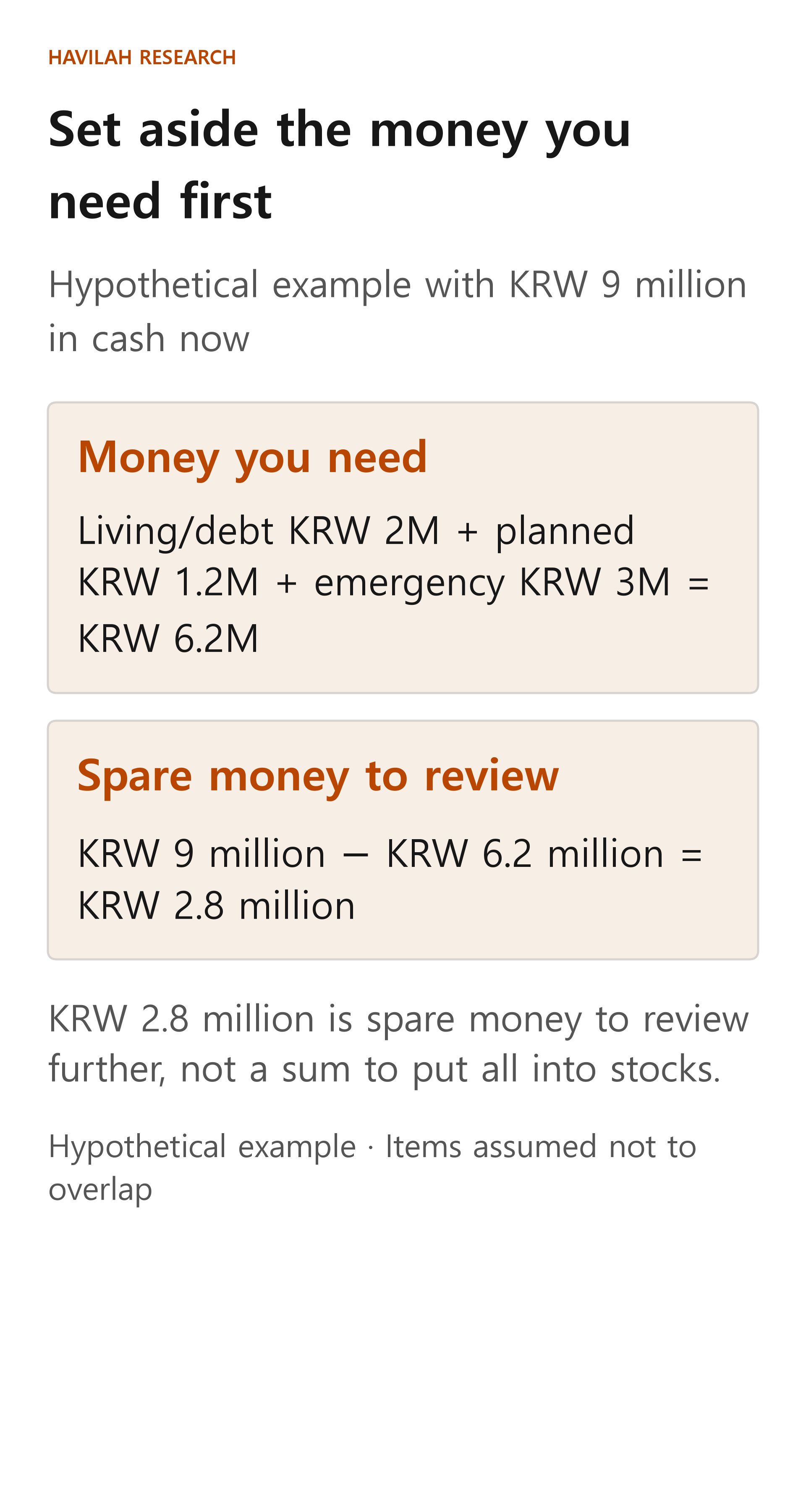
This KRW 2.8 million is spare money to look at more closely. It does not mean you should put all of it into stocks. First check whether you have left out any expenses or debts, and whether you might still need some of it.
It is also important not to subtract the same expense twice. For example, if next month's card bill is already included in the KRW 2 million and you add it again to the KRW 1.2 million of planned expenses, the money left over will come out smaller than it really is.
3. The right emergency fund differs from person to person
Someone with a steady income and someone whose income changes a lot from month to month do not need to set aside the same amount. People also differ in whether they support family members, how likely they are to face sudden expenses and whether they can get help from elsewhere.
What matters is not following a fixed number but checking whether, in your situation, you could cope with an unexpected expense. If you do not have enough yet, you do not have to fill the fund all at once; you can build it up separately, a little at a time.
If you keep your emergency fund in stocks, prices may be down just when you need the money. For money you may have to use in a hurry, first check how soon you can take it out and whether the amount you put in can lose value.
4. Work out monthly investing money separately
The lump sum you have now and the spare money you will have each month are separate calculations. Do not add money you have not received yet to the cash you have now.
For example, suppose the money that actually comes in each month is KRW 3 million, that month's living costs and regular repayments are KRW 2.1 million, other everyday spending is KRW 500,000, irregular expenses you put aside come to KRW 200,000, and you add KRW 100,000 to your emergency fund.
KRW 3 million − KRW 2.1 million − KRW 500,000 − KRW 200,000 − KRW 100,000 = KRW 100,000. In this example, you have KRW 100,000 to spare each month. The KRW 9 million above is the cash you had when you did the calculation, and this KRW 3 million is assumed to be one month's new income that arrives after that.
Actual spending can vary from month to month. If your income is irregular, instead of insisting on investing the same amount every month, you can wait until the money comes in, check the expenses you need to cover, and then adjust the amount.
5. What is left is not automatically money for stocks
Money you will need to spend soon leaves you little time to wait if share prices fall. Even money you will not need for a long time is not protected from losses. Also think about how large a drop would put a strain on your daily life or your peace of mind.
If you have high-interest debt, it is also important to look at its repayment terms and costs before you invest. The return you hope for from a new investment is not guaranteed, but the cost of the debt can keep running under the terms of the loan.
If your result comes out at 0 or less, or is not enough to cover your planned expenses, you do not have to invest right away. Sort out your living costs and the money you need, and calculate again later. Finding an amount you can keep invested for a long time matters more than the amount you start with.