
Now let's connect the whole process of buying and selling stock in an account in one go. You will not place a real order. The numbers and the company are assumptions made for illustration.
At the start, assume your account holds $1,000 that has settled and is free to use. You hold no stocks, and there are no other trades or costs. You have already converted your home currency into dollars.
1. Decide what to buy and at what price
You want to buy shares of hypothetical Company A. On the order screen, you check the company name, the share class and the trading currency, then decide to buy 5 shares at $100 a share or less.
Here the buy limit price is $100 and the order quantity is 5 shares. The maximum cost of the shares before commissions is 5 shares × $100 = $500. In practice, you also need money to pay the commission.
A limit order caps the price so that you do not pay more than the price you set. In exchange, there is no guarantee that all 5 shares will be filled. Before you send the order, also check the direction (buy or sell) and the order's time limit.
2. When part of the order is filled, look at what is left
Assume that 3 shares of the hypothetical order are filled at $100 each, and 2 shares have not been filled yet. The shares you actually bought cost 3 shares × $100 = $300.
You do not want to buy the remaining 2 shares, so you ask to cancel them. After pressing cancel, you check the status; in this example, assume the cancellation of the 2 remaining shares has been completed. Until a cancellation is completed, the remaining quantity could still be filled, so do not treat the matter as closed just because you sent the request.
Your fill history shows 3 shares. Canceling the rest of the order does not make the 3 shares that were already filled disappear.
3. Work out your dollars after the purchase
In this example, assume the trading commission is 0.1% of the trade amount and that the commission on each trade is rounded to two decimal places in dollars, that is, to the nearest cent. Actual commissions and rounding methods can differ from broker to broker.
The buy commission is $300 × 0.001 = $0.30. Subtracting the cost of the shares and the commission from the $1,000 you started with gives the following.
$1,000 − $300 − $0.30 = $699.70
This is the hypothetical balance after the purchase and the commission. Until the cancellation has been processed, money may be held back for the remaining order, so check the amount available to order and the amount available for withdrawal on the screen separately.
4. Sell later and work out your gain or loss
Assume that some time later, you sell all 3 shares you hold and the sale is filled at $105 per share. Let's look at the result once the trade has settled and the sell commission has been taken into account.
| Item | Hypothetical calculation | Amount |
|---|---|---|
| Cost of the shares bought | 3 shares × $100 | $300 |
| Buy commission | $300 × 0.1% | $0.30 |
| Proceeds from the shares sold | 3 shares × $105 | $315 |
| Sell commission | $315 × 0.1%, rounded | $0.32 |
Before commissions, the difference is $315 − $300 = $15. After subtracting both the buy and the sell commissions, $15 − $0.30 − $0.32 = $14.38 remains.
Including the dollars you had at the start, the hypothetical balance after settlement is $699.70 + $315 − $0.32 = $1,014.38. That is $14.38 more than the $1,000 you started with, which matches the calculation above.
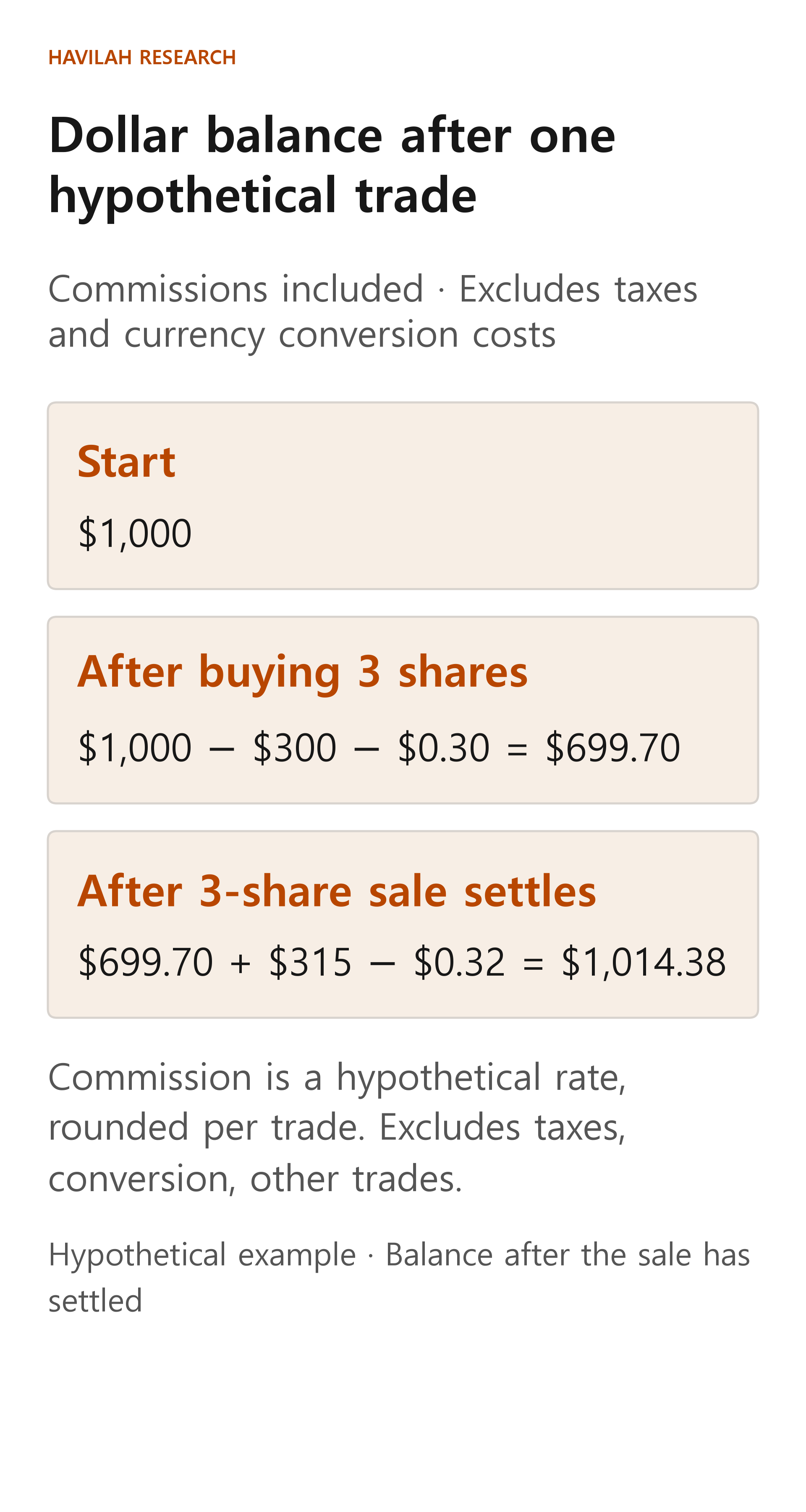
This calculation is an example in dollars that leaves out taxes, currency conversion costs, other trades and other cash movements. Your actual gain or loss measured in your home currency can differ, depending on exchange rates and costs. If the share price had moved the other way, you could have made a loss.
5. What should you check right to the end?
Placing a sell order is not the same as actually selling. Check the quantity and price of the sell fill, then look at the expected settlement date and the record showing the commission. Standard settlement for U.S. stocks is usually the next settlement business day after the U.S. trade date, but you need to check separately how the trade is actually being processed in your account.
The amount you can use to buy other stocks and the amount you can withdraw to your bank may also differ. If you want to convert your dollars into your home currency and take the money out, look at the conversion and transfer terms together.
When you review a trade, it helps to write down why you bought, what price and quantity you originally wanted, and how many shares were actually filled and at what price. That will help your next decision more than looking only at whether the result was good.