
You sold some U.S. stock, and the sale amount now appears in your account. But the screen says you can use it to buy other stocks, not withdraw it to your bank. Why is that?
Because the moment your shares are sold is not the moment the exchange of money and shares is completed. You also need to tell apart the amount you can use for purchases and the amount you can take out right now.
1. A fill and settlement are different steps
A fill means the trade has been agreed, with its price and quantity set. Settlement is the process in which the shares and the money for that trade actually change hands.
For example, if a sale of 10 shares is filled at $50 per share, the sale proceeds before commissions are 10 × $50 = $500. At this point, a trade to sell $500 worth of shares has been agreed. The shares and the money are settled afterwards.
Seeing a number in your account does not mean you can withdraw it right away. Check the fill record, the settlement status and the amount available for withdrawal, one by one.
2. What does T+1 mean for U.S. stocks?
T stands for the day the trade is filled (the trade date). Most U.S. stock trades normally settle on T+1. That means they settle on the next settlement business day after the trade date. Exceptions and settlement delays can occur, so also check the status of each trade.
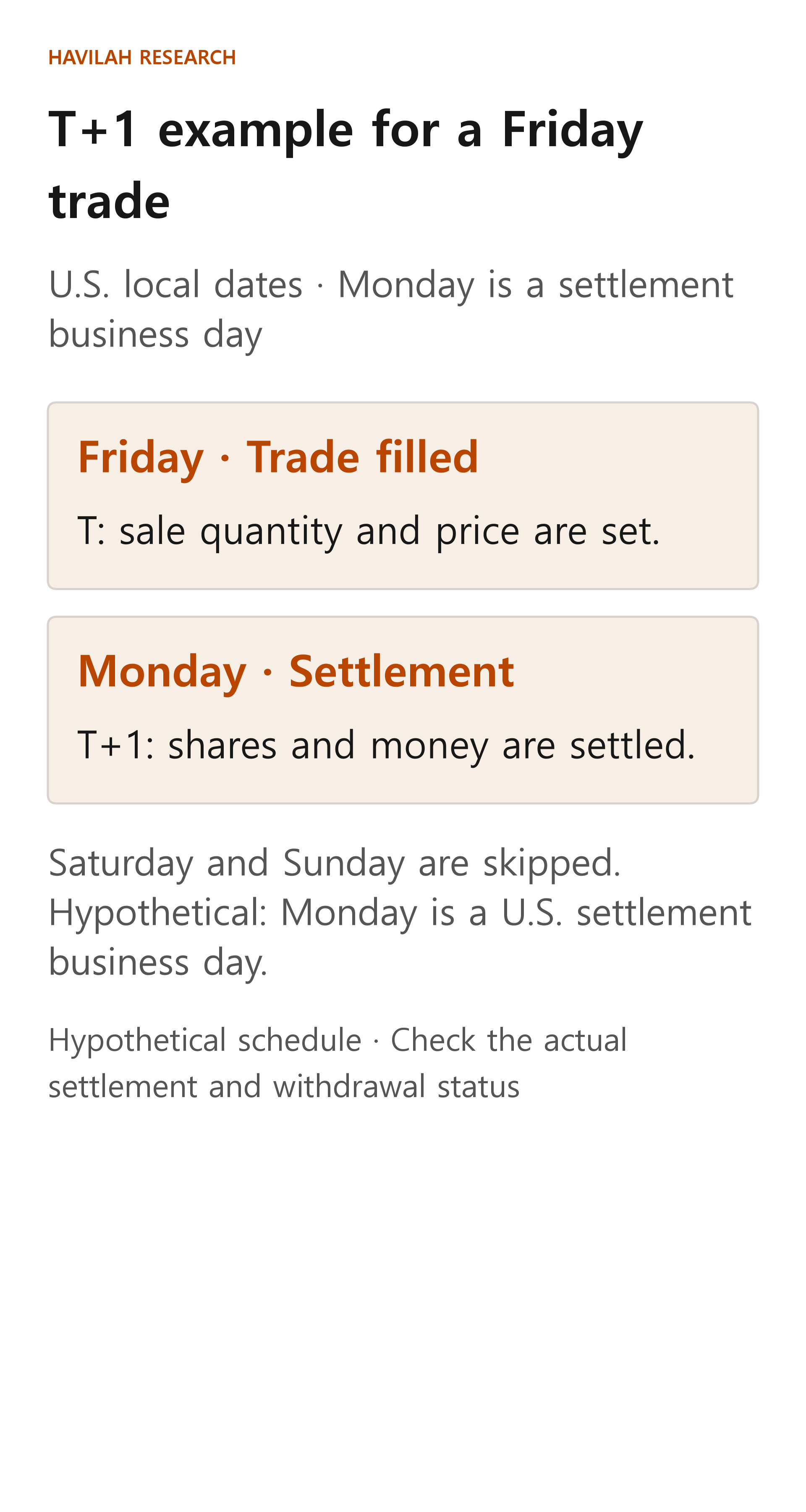
Suppose a trade is filled on a Friday by the U.S. calendar, and the following Monday is a U.S. settlement business day. Saturday and Sunday are skipped, so Monday is T+1. If that Monday were a settlement holiday, you would need to check which day is the next settlement business day.
When you trade U.S. stocks from outside the United States, the date where you live and the U.S. trade date can differ because of the time difference. Rather than simply counting "tomorrow" on your local calendar, it is more accurate to check the U.S. trade date and the expected settlement date shown on the trading screen.
3. Money you can reinvest and money you can withdraw may differ
Depending on the broker, you may be able to use a certain amount to buy other stocks even before your sale proceeds have settled. That does not mean you can move the same amount to your bank right away. Which money can be used to buy in which market, and when you can convert and withdraw it, depend on the account and the service.
Suppose that in a hypothetical account, the $500 from the sale you just made appears in the amount available for purchases. If it is not yet reflected in the amount available for withdrawal, go by the withdrawable amount shown on the screen at that point. If you have other cash or unsettled trades, the actual numbers will be different.
Moving dollars to a foreign currency account at your bank is also a different procedure from converting the dollars into your home currency and then moving the money to an account in your home currency. Check when conversion is possible, the exchange rate and the transfer terms, and even after settlement, check that the account shows the money as available to withdraw.
4. In a U.S. cash account, also check how your purchases are paid for
At a U.S. broker, a cash account is one in which you pay the full price of your purchases without borrowing from the broker. If you use sale proceeds that have not yet settled to buy new shares, a problem can arise if you sell those new shares again right away.
For example, suppose that in a U.S. cash account with no other cash, you sell Stock A on a Monday and buy Stock B the same day with the proceeds. The proceeds from A normally settle on the next settlement business day. If you sell B before then, restrictions may apply because you traded with money that had not yet settled.
This explanation is an example to help you understand the rules of a U.S. cash account. Do not apply the same names and conditions as they are to an account with a broker in your country; check the amount available for purchases and any trading restrictions in your own account.
5. Check these things before you withdraw
First, check that the sell order was actually filled and the amount it was filled for. Next, look at the expected U.S. settlement date for that trade and its settlement status. Finally, check the amount available for withdrawal in the currency you want, and the transfer terms.
Weekends, holidays in the United States and in your country, the time difference, and processing times for currency conversion or at your broker can all make the actual timing differ from what you expected. If you do not understand an amount or a date on the screen, check the details of what is available to withdraw and contact your broker.
In the next lesson, we will connect the account, currency conversion, ordering and settlement you have learned about into one hypothetical trade.