
You have deposited money in your home currency into your brokerage account so that you can buy U.S. stocks. In this lesson, suppose your home currency is the Korean won (KRW); the KRW amounts are only an example, and the same ideas apply to other currencies. You look up the exchange rate and see that $1 is KRW 1,400. So if you convert KRW 1.4 million, will you receive exactly $1,000?
Not necessarily. The reference price you looked up can differ from the price actually applied when you convert. If the rate applied when you buy dollars is higher than KRW 1,400, KRW 1.4 million will get you less than $1,000. First, let's look at what to check on an exchange rate screen.
1. An exchange rate is the price of swapping one currency for another
A USD/KRW exchange rate of 1,400 means that $1 is priced at KRW 1,400. So $10 would be KRW 14,000. When the rate applied to your dollar purchase goes up, you need more won to buy the same number of dollars. Some currencies are usually quoted the other way round, as dollars per unit of your currency (EUR/USD, for example), so check which way your broker quotes the rate before you compare numbers.
But not every exchange rate you see on a screen is the same price. The reference rate is the benchmark price used to compare exchange rates. The prices actually applied when you buy dollars, and when you sell dollars you hold, can differ from that reference.
Converting money into dollars in a brokerage account usually works differently from exchanging money for banknotes you take away. When you compare rates, be careful not to mix up the prices for buying and selling banknotes with the price applied in your account. Check the applied rate on your own broker's currency conversion screen.
2. There is a gap between the reference price and the actual price
The following is a hypothetical example to help you understand. It is not a real exchange rate or any particular broker's fee.
| When you buy $1 | Assumed price |
|---|---|
| Reference rate used for comparison | KRW 1,400 |
| Applied rate before any discount | KRW 1,414 |
| Difference between the two | KRW 14 |
In this example, the difference between the reference rate and the applied rate is KRW 14 per dollar. A price gap like this is called the spread. In practice, both the reference and the size of the gap can vary by company, by conversion method and by time of day.
If you buy $1,000 with no discount, you need 1,000 × KRW 1,414 = KRW 1,414,000. That is KRW 14,000 more than the KRW 1,400,000 you get when you calculate the same amount at the reference rate. This difference is your conversion cost measured against the reference price.
This does not mean you add another KRW 14,000 on top of KRW 1,414,000. The applied rate of KRW 1,414 in this example already includes that difference. If a transfer fee or another fee is shown separately, check it on its own.
3. What does an exchange rate discount reduce?
An advertised "90% exchange rate discount" does not mean that 90% is taken off, say, KRW 1 million of your money. In the example below, assume it reduces the difference between the reference rate and the applied rate before the discount by 90%. Check the service's own terms for what the discount actually covers and how it is calculated.
The hypothetical difference is KRW 14 per dollar. If 90% of it is removed, 10% remains.
KRW 14 × 10% = KRW 1.4
So the discounted rate for buying dollars is KRW 1,400 + KRW 1.4 = KRW 1,401.4. Let's compare how much it costs to buy the same $1,000.
| Hypothetical purchase of $1,000 | Calculation | KRW needed |
|---|---|---|
| Before the discount | 1,000 × KRW 1,414 | KRW 1,414,000 |
| After a 90% discount on the difference | 1,000 × KRW 1,401.4 | KRW 1,401,400 |
The difference between the two amounts is KRW 12,600. Even after the discount, a gap of KRW 1.4 from the reference rate remains, which adds up to KRW 1,400 on $1,000. Here we assumed there are no separate fees.
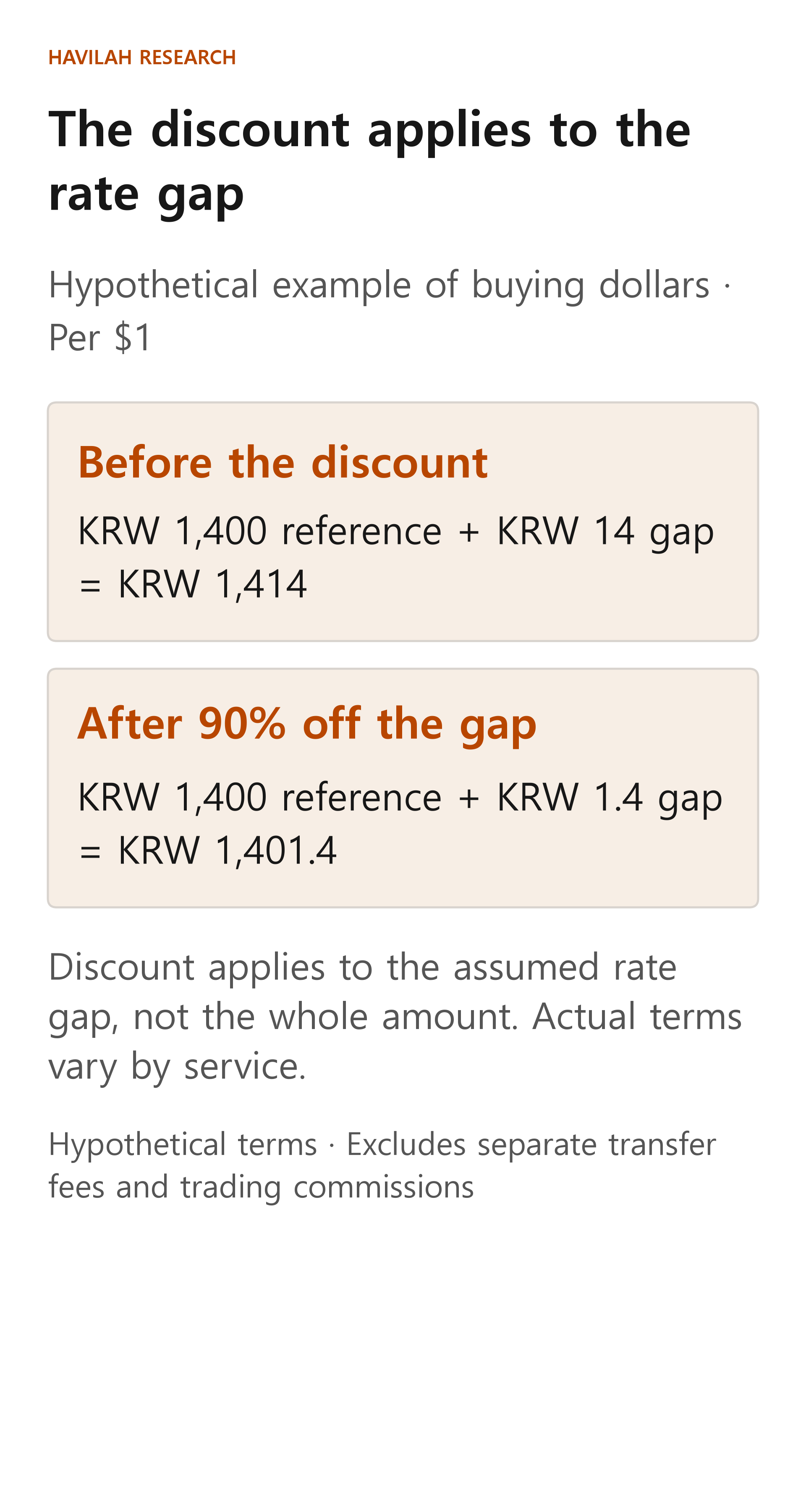
A high discount percentage does not automatically remove other costs, such as transfer fees or the trading commission on your stocks. The discount period, the currencies covered, the hours and whether it applies to automatic conversion can also differ. Rather than the advertised number, look at the final applied rate together with any separate costs.
4. Check the rate again when you convert back to your home currency
If you sell U.S. stocks for dollars and then convert those dollars back into your home currency, the rate for selling dollars applies this time. If the prices applied when you buy and when you sell are different, a gap can open up over the round trip even if the exchange rate has not moved.
Let's continue the same hypothetical example. Assume the reference rate stays at KRW 1,400, and that when you sell dollars you get KRW 1,398.6, which is KRW 1.4 per dollar below the reference. If you sell $1,000, you receive KRW 1,398,600.
That is KRW 2,800 less than the KRW 1,401,400 you paid earlier to buy $1,000. This example includes no stock trade, and neither conversion has a separate fee. The calculation shows only the gaps applied on the purchase and on the sale. The actual amount after a real round trip depends on how the exchange rate moves and on the service's terms.
5. What should you check before you place an order?
Depending on the broker, you may convert to dollars first and then place your order, or you may use a service that lets you order in your home currency and automatically converts the amount needed. Automatic conversion still has a cost. Check the service description to see whether the estimated rate on the order screen matches the rate and the timing used for the actual conversion.
Also check the hours when you can convert. Some services apply different costs to conversions made outside regular hours. The exchange rate can also change between the moment you look at the screen and the moment the conversion actually happens.
Finally, check the estimated amount before you convert, and afterwards compare the amount actually deducted in your home currency with the dollars you received, using your transaction history. If you already have dollars in the account, check whether this purchase needs a new conversion at all. Rather than counting your whole budget as money for shares, it is better to leave enough for the trading commission and other necessary costs.
Suppose you prepared $1,000 through the hypothetical conversion above. If you buy $1,000 worth of stock and the commission is 0.1%, the commission is $1,000 × 0.001 = $1. If the terms say the commission must be paid separately in dollars, spending the full $1,000 on shares leaves you $1 short. Check your broker's documentation for the currency in which the commission is actually deducted, and when.
Transfer costs may also need to be looked at separately. Suppose that, besides the KRW 1,401,400 spent on the conversion above, moving the money to another financial firm costs a hypothetical transfer fee of KRW 3,000. The two amounts then come to KRW 1,404,400. This does not mean that every transfer has a cost. Note also that this total does not include the trading commission on the stock.
Even after you convert, the value in your home currency keeps changing with the exchange rate. Even if the share price stays the same, the amount converted into your home currency can shrink if the dollar falls in value. In the next lesson, we will look at the ways to place a stock order once your dollars are ready.