
When you set out to buy stocks, every broker tells you its fees are low. Some say trading is free, and some offer a reward for opening an account. Should you simply pick the one with the biggest reward?
Your account is where you will deposit money, buy stocks and check your trading history from now on. The terms you will keep using matter more than a welcome offer. In this lesson, imagine you live outside the United States and are choosing an account for trading U.S. stocks.
1. Before the rewards, check which company you are actually dealing with
A brokerage account is an account you use to trade stocks and other securities through a broker. It also keeps a record of your cash and the securities you hold. The app is just the screen you use to operate that account. A familiar app name does not mean you have checked which company you are actually signing a contract with.
When you choose a broker in your country, check that it appears in your financial regulator's official register of licensed firms. Do not stop at the company name: compare the official website and contact details as well.
Some websites may copy the names and logos of well-known brokers. Rather than trusting a download link you received by text message or in a chat group, it is safer to find the app and the account-opening page through an official website you have already verified.
If you open an account directly with a U.S. broker, you also need to check its U.S. registration and the exact legal entity you would be contracting with. FINRA's BrokerCheck is a service for checking the registration and history of U.S. brokerage firms, among others. Do not assume that the same rules apply as for an account with a broker in your country.
This step is not about choosing which company is better at picking stocks for you. It is about confirming who you are trusting with your money and asking to carry out your trades.
2. Safekeeping of your money is not protection against falling prices
Money you have put into the account but not yet used to buy stocks is different from the stocks you have already bought and hold. The money you leave with a broker so that you can trade is called client cash held at the broker: it has been placed with the firm for safekeeping until you use it.
Find out whether brokers in your country must keep client cash separate from the firm's own assets. A rule like this is a safeguard that stops the money a company uses to run its business from being mixed with clients' trading money. Check separately how the shares you hold are managed and kept.
Because foreign stocks are traded and held across borders, other institutions besides your local broker may be involved, such as a securities depository and an overseas custodian (a firm that holds securities on behalf of others). Read your broker's documentation for foreign stocks to see how your shares are held, and how they would be returned or transferred if the firm ran into trouble. Even if you understand this structure, you cannot assume that a return would always be completed right away.
The most important distinction is this: even where client assets must be kept separate, that does not compensate you if the price of the stocks you bought falls.
The same caution applies to SIPC, which you may see mentioned in U.S. account materials. SIPC is a U.S. investor-protection organization that helps return customer assets when a member brokerage firm fails, for example through bankruptcy. It does not make up for investment losses caused by falling share prices. Nor should you assume that some protection applies to your account automatically just because you bought U.S. stocks through a broker in your country. Check who your contract is with, what is covered and under what conditions.
Look separately at services that automatically move idle cash into another financial product. A product with "cash" in its name is not necessarily a deposit, and it is not necessarily covered by the same protection. First work out whether your money simply sits there waiting or is invested in another product.
3. Check that the account supports the trades you plan to make
Two brokers may both offer "U.S. stock trading" and still differ in the details. Check whether they support the stocks you want to buy, the hours you plan to trade and the order types you will use.
For example, if you plan to invest a fixed amount once a month, it may matter whether you can set up recurring purchases or use fractional-share trading for the stocks you want. Fractional-share trading means buying a stock in units smaller than one share. Check which stocks are eligible and what conditions apply to placing orders and selling.
If you expect to use extended-hours trading often, check not only the hours available but also which stocks and order types are supported during those hours. As you learned earlier, longer trading hours alone do not mean your orders will be filled at the price you want.
It also matters whether the order history is easy to read. See whether the app clearly separates "order sent" from "order filled," and whether you can find out if an order was canceled and how many shares are still unfilled.
Also look at the terms for moving your shares to another broker later. Some of the stocks you hold, or fractional quantities, may not transfer as they are, and there may be costs. You do not need every feature from day one. Just check the features you need for the trades you plan to make.
4. A $0 commission is not a $0 total cost
A trading commission is the fee you pay a broker for handling your purchase or sale of shares. But when you trade foreign stocks, you cannot look at the commission alone. Costs can also arise from currency conversion, when you change your home currency into U.S. dollars, and from moving money or shares.
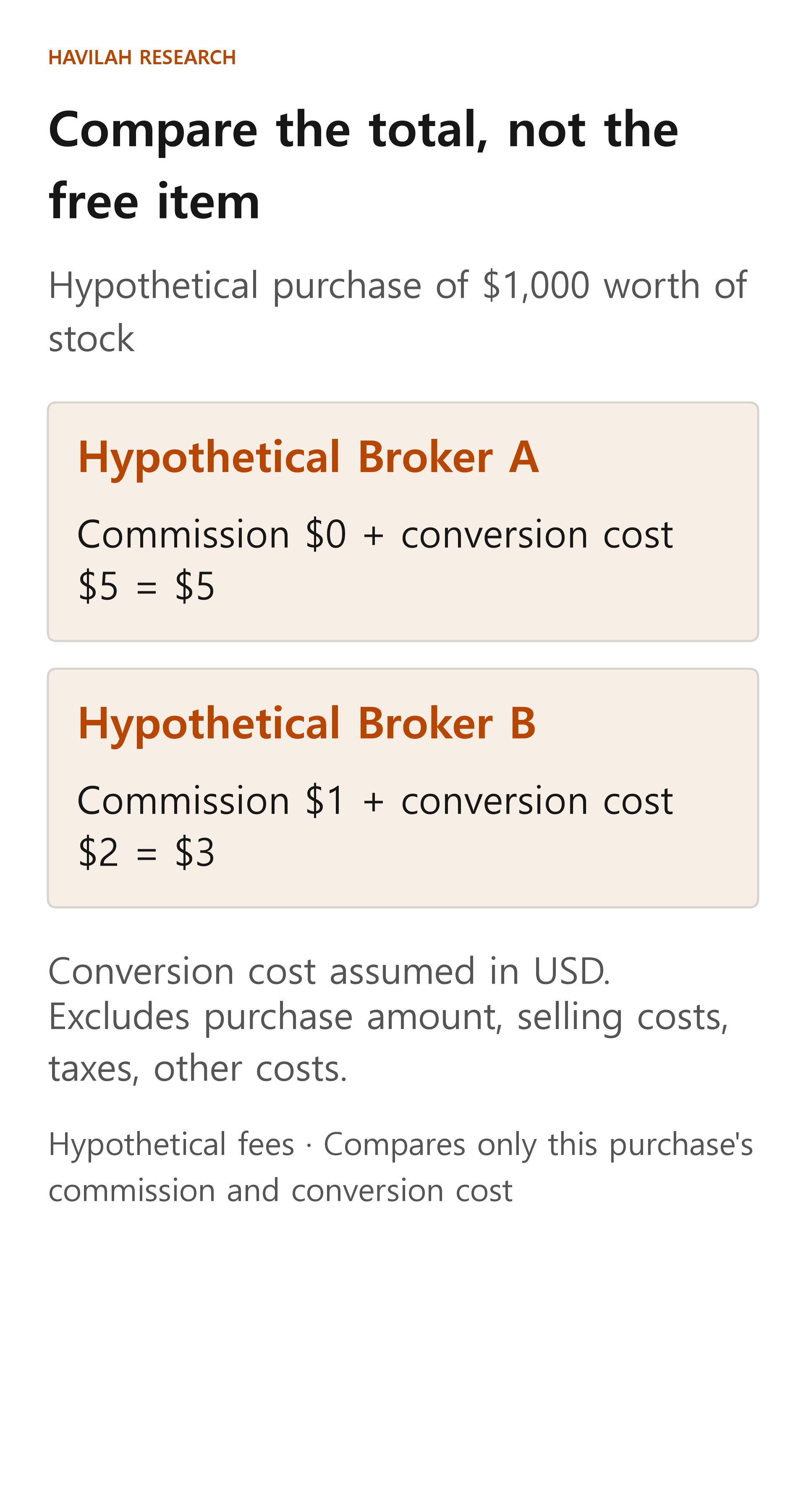
Suppose you make one purchase of $1,000 worth of stock at each of two hypothetical brokers. You buy the same stock at the same price, and you compare what this one trade costs, including currency conversion.
Assume the commission rate is 0% at Broker A and 0.1% at Broker B. Assume also that the conversion cost for this trade, expressed in dollars, is $5 at Broker A and $2 at Broker B. These are illustrative numbers, not any real broker's fee schedule.
| Cost of this purchase | Hypothetical Broker A | Hypothetical Broker B |
|---|---|---|
| Trading commission | $1,000 × 0% = $0 | $1,000 × 0.1% = $1 |
| Conversion cost in USD | $5 | $2 |
| Total of the two costs | $0 + $5 = $5 | $1 + $2 = $3 |
Here, 0.1% means 0.1 divided by 100, which is 0.001. So Broker B's commission is $1,000 × 0.001 = $1.
Broker A charges no commission, yet its total cost for this trade is $2 higher than Broker B's. This is why you should compare the total under the conditions you will actually use, rather than asking whether one item is free.
This calculation compares only the two costs of this purchase. The $1,000 paid for the shares themselves is not counted in the total. Other fees, taxes, and the costs of selling later and converting back are also left out. The conversion cost is an assumption already expressed in dollars, so you would need to check it again against the exchange rate actually applied.
What if both accounts already hold dollars and you do not need to convert this time? Under the same commission terms, only $0 at Broker A and $1 at Broker B remain. Which account comes out ahead depends on how you use it.
For promotional rates, read who qualifies, how long they last and which markets they cover. You only know what an account will cost over time if you also compare the fees that apply after the promotion ends. In the next lesson, we will calculate currency conversion costs in more detail.
5. Make sure you are buying with your own money before you start
When you open an account, you may be shown sign-up screens for several trading services. Signing up to trade foreign stocks and trading with borrowed money are separate choices.
At a U.S. broker, a cash account is one in which you pay the full price of the shares you buy without borrowing from the broker. A margin account lets you borrow money from the broker to invest. You pay interest on the borrowed money, and if prices fall, your losses can grow, or the broker can force a sale of the shares you hold.
At a broker in your country, the service names and the way you sign up may be different. If you want to trade only within your own cash at first, check whether you have agreed to any arrangement that lets you borrow, and what the "amount available to order" on the screen actually means. It is important not to assume that the large amount available to order shown on the screen is all your own money.
There is no need to sign up for a service you do not understand just because it seems convenient. Read how your purchases are paid for and what happens if the money runs short, then decide. Do not judge a local service simply by applying the U.S. labels "cash account" and "margin account" to it.
6. Choose an account you can check and get help with when you are stuck
Even if the app looks good and the costs are low, it is a problem if your trading history is hard to find or you do not know whom to contact when something goes wrong. Check when and how the broker answers questions about foreign stocks, and where you can download your trade statements.
A trade statement is the record of what you bought and sold, in what amounts, and what costs were charged. Rather than relying on memory or a one-line notification, you should be able to compare your actual records with the number of shares you hold.
When you compare candidate accounts, try answering the following questions in your own words.
| What to compare | Question to answer |
|---|---|
| Who you deal with | Is it a licensed financial firm, and did you reach it through official channels? |
| Safekeeping of assets | How are your cash and shares held, and what protection applies? |
| Trading support | Does it support the stocks you will buy, the hours you will trade and the order types you will use? |
| Total cost | Have you read all the costs involved, from conversion and buying to later transfers and sales? |
| Trading setup | Do you know whether you are trading with your own money or have a separate borrowing agreement? |
| Records and support | Can you find filled and canceled orders, and contact someone if a problem arises? |
There is no single account that is best for everyone. A good starting point is an account that supports the trades you need, whose costs and safekeeping arrangements you can understand, and that you can check with when problems arise. It is not too late to compare rewards after that.