
The screen showed $10.10. But after you bought 100 shares, your average purchase price was $10.16. Did you make a mistake?
Not necessarily. There may have been fewer than 100 shares available to buy at $10.10. In stock trading, the quantity shown next to a price matters too.
1. The price to buy and the price to sell are different
A quote is a price at which someone has offered to buy or sell a stock. The price offered by those who want to buy is called the bid, and the price offered by those who want to sell is called the ask.
The highest bid is the most that anyone is currently willing to pay. The lowest ask is the least that anyone is currently willing to sell for. Quote screens label them Bid and Ask, and the ask is also called the Offer.
Suppose a hypothetical stock has the following quotes. All quantities are in shares.
| Quote | Price per share | Quantity offered at that price |
|---|---|---|
| Highest bid | $10.00 | 100 shares |
| Lowest ask | $10.10 | 40 shares |
| Next ask | $10.20 | 60 shares |
In this table, $10.00 is not a price at which you can buy right away. It is a price at which someone else is waiting to buy. If you want to buy now, you need to look at the prices and quantities on the selling side.
Conversely, if you want to sell right away, look at the buying side. Which quotes you read depends on whether you are the one buying or the one selling.
If the large number on the screen is the last price, it means something else again. The last price is the price at which the most recent trade took place. It is not a promise that your order will trade at the same price now.
2. A cost is hidden in the gap between the two quotes
The difference between the lowest ask and the highest bid is called the spread. The spread in the table above is:
$10.10 − $10.00 = $0.10
If that feels abstract, imagine buying one share and selling it straight away. Assume the quotes stay the same, and that you buy one share at the ask of $10.10 and then sell it at the bid of $10.00.
$10.00 − $10.10 = −$0.10
Nothing changed in the company's business, yet you lost $0.10 per share. This is before trading commissions and taxes. It is why "commission-free" does not mean that buying and selling cost you nothing.
This is a hypothetical case of trading at two fixed quotes. In reality, quotes can change, and your order may also be filled at a better price than the quotes shown. The spread is an important clue for reading trading conditions; it is not a fixed fee charged in the same way on every trade.
3. Why does the average price go up when you buy 100 shares?
Let's go back to the first table. This is a separate situation from the one-share trade above. This time, you buy 100 shares using only the shares offered for sale in the table. Assume that no other orders get in ahead of you, that the quotes do not change and that no new shares are offered. Trading commissions and taxes are left out.
An order that sets no price limit and asks to trade at whatever price is currently available is called a market order. It is usually used when you want a quick fill, but the exact price you will get is not guaranteed.
Under these assumptions, if you buy 100 shares with a market order, you first buy the 40 shares at the lowest ask. The remaining 60 shares have to be bought at the next price.
| Order of fills | Price × quantity | Purchase amount |
|---|---|---|
| First 40 shares | $10.10 × 40 shares | $404 |
| Remaining 60 shares | $10.20 × 60 shares | $612 |
| All 100 shares | $404 + $612 | $1,016 |
To find the average fill price, divide the total purchase amount by the number of shares you actually bought.
$1,016 ÷ 100 shares = $10.16 per share
You cannot simply add $10.10 and $10.20 and divide by two, because you bought different quantities at the two prices. The 60 shares bought at the higher price count for more in the average.
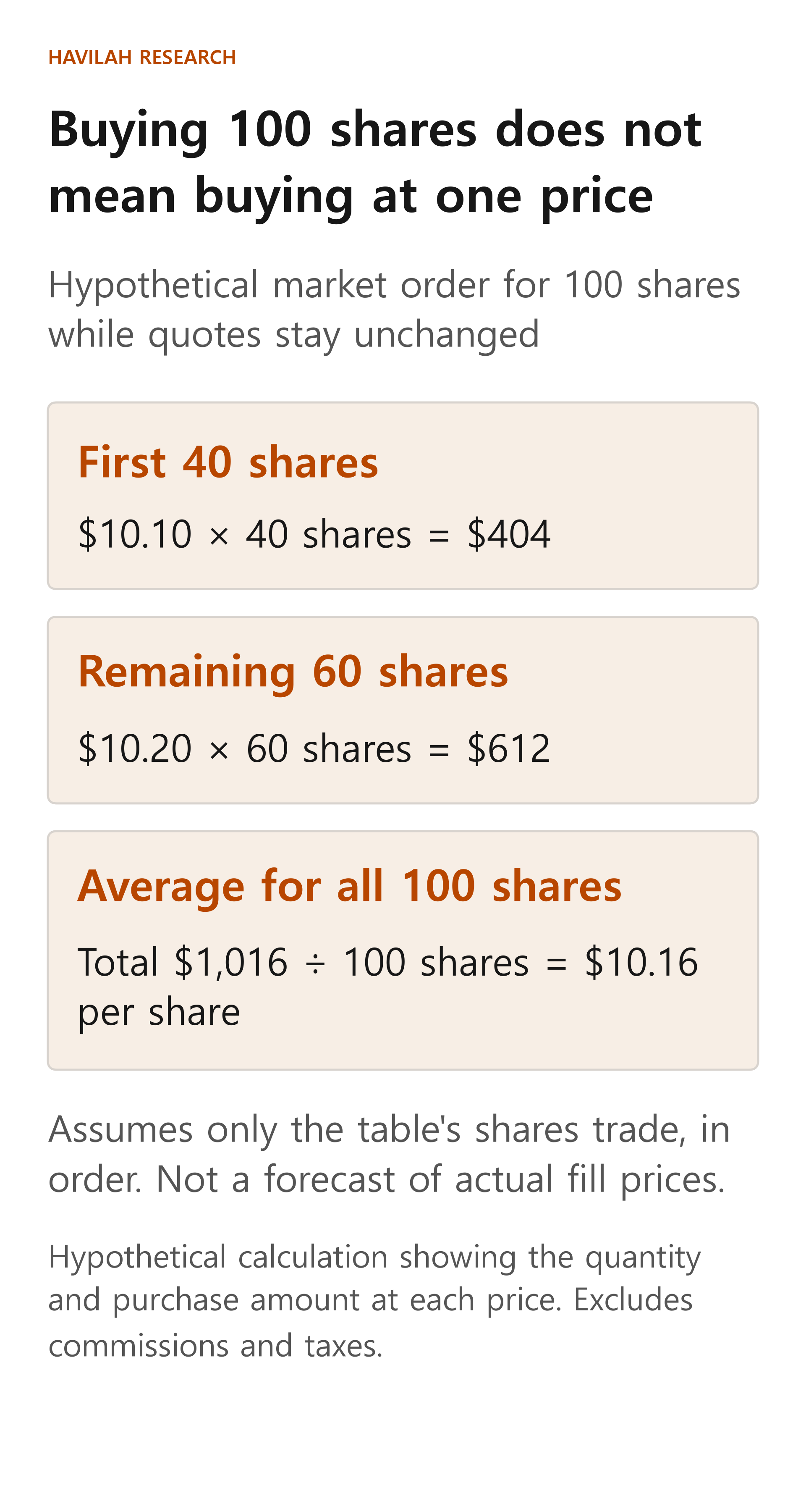
If you had assumed you could buy all 100 shares at the $10.10 you first saw, you would have expected to pay $1,010. The actual amount in this example, $1,016, is $6 more. The difference is not a broker's fee: it comes from buying some of the shares at a higher price.
In practice, orders for U.S. stocks can be sent to several trading venues, and they can also be filled against orders that are not shown on the screen. So you cannot use this table to predict the actual fill price exactly. It is an example that shows the principle: if you order more than the quantity available at the best quote, your order may be filled in parts at several prices.
4. If you set a price, is the quantity guaranteed too?
"I don't want to pay more than $10.10."
This is when you might consider a limit order. A buy limit order sets the most you will pay per share. If you set it at $10.10, you buy only at that price or lower. A sell limit order works the other way: it sells only at that price or higher.
Suppose the 100-share purchase above has not happened yet, and with the same original quotes you place a limit order to buy 100 shares at $10.10. Assume that partial fills are allowed and that your order arrives first.
In this case, you can buy the 40 shares offered at $10.10, but the 60 shares at $10.20 do not meet your price condition. So 40 shares are filled for $404, and 60 shares remain unfilled. Unfilled means that you placed the order but it has not been traded yet.
Whether the rest of the order keeps waiting, is canceled or expires at some point depends on the conditions of the order. Even if someone later offers to sell at $10.10 or less, other orders may be waiting ahead of yours, so you cannot say that your remaining order will definitely be filled.
A limit order is a tool for controlling the price you pay. It does not guarantee that you will buy the quantity you want, and it does not protect you if the price falls after you buy. The difference between a market order and a limit order is easiest to understand as a choice between buying quickly and sticking to a price limit.
5. Liquidity is how easily you can trade the quantity you want
Liquidity is how easily you can buy or sell a stock when you need to, without giving up much on price. When trading is active and there are plenty of shares bid and offered at nearby prices, trading is generally easy.
Conversely, when few shares are available, buying even a little more may mean accepting higher prices. When you need to sell in a hurry, you may have to accept a lower price. Even if you have analyzed a company's prospects well, poor trading conditions for getting in and out can change your investment results.
Do not conclude that liquidity is sufficient just because the spread is narrow. There may be only a few shares available at the nearest prices. Look at it together with the quantity you plan to order.
Also, the quotes on the screen are not a promise about the future. The orders shown can change or disappear, and new orders can come in. You cannot be sure that the share price will rise just because the quantity on the buying side looks large.
When you hear that "lots of people want to buy," think about specific terms rather than the number of people. How many shares they want to buy and at what price, whether they will accept higher prices, and how many shares are available to sell at that price: these are what affect actual trades.
6. What to check before and after you place an order
Before you place an order, do not look only at the last price; check the bid and the ask as well. Look at the time shown, too. If you do not know whether a quote is real-time or delayed, it is easy to judge current trading conditions by an old price.
Next comes quantity. Compare the number of shares you want to buy with the quantity offered at the current ask, and see how much larger your order is. Check the screen's explanation for the unit used to show quote quantities. The tables in this lesson use shares, but do not assume, without an explanation, that the numbers in an actual service use the same unit.
If you want to stick to a price limit, check the order type and the limit price. Also note that only part of the order may be filled, and read how long any remaining order stays valid.
After placing an order, check the quantity filled, the average fill price and the quantity still unfilled. Pressing the buy button is not the same as buying all the shares you wanted.
Company analysis helps you decide what to buy. Understanding quotes and orders helps you judge at what price, and how many shares, you can actually buy. Only when you read the quantity next to the price do the numbers on the screen connect to your own trade.