
Last week, the U.S. market opened at a certain time on your clock. This week, it does not open until an hour later. Has the U.S. stock market changed its trading hours?
Usually, it is because the time difference between the United States and your country has changed. Rather than memorizing one opening time on your own clock, you will find U.S. trading hours less confusing if you read them together with the local time in New York, the date and whether the market is closed that day.
1. The clock that counts is in New York
The regular trading session for stocks on the New York Stock Exchange and Nasdaq normally starts at 9:30 a.m. and ends at 4 p.m. U.S. Eastern Time. The regular session means the standard trading hours set by the exchange. It usually runs Monday through Friday, and market holidays and early-close days are set separately.
The key phrase here is "U.S. Eastern Time." Different parts of the United States keep different times. Do not simply plug in the local time of a friend who lives in the United States, or your own local time.
Eastern Time is the time used in New York, and it is written ET. If a U.S. exchange notice says "9:30 a.m. ET," it means 9:30 a.m. in New York. Your own time zone has its own name, too. The worked examples in this lesson use South Korea, whose time is called Korea Standard Time (KST).
It helps to picture clocks side by side, each writing the same moment in a different way. Trading that starts on a New York morning is seen in Korea, for example, on the night of the same day.
2. Your local timetable shifts with U.S. daylight saving time
For part of each year, New York moves its clocks forward by one hour. This is called daylight saving time (DST). It is easy to think it applies only in summer, but in fact it runs from spring into fall.
To find the session in your own time, convert the ET times using the time difference between New York and where you live: add the gap if your clock is ahead of New York's, and subtract it if your clock is behind. That gap shifts by one hour when the United States changes to or from daylight saving time. If your own country also changes its clocks, the gap changes on those dates as well. In the Korea example, Korea is 13 hours ahead of New York while New York is on daylight saving time, and 14 hours ahead when it is not, so you add that gap to the regular session times.
| New York's clock | Regular session opens in Korea | Regular session closes in Korea |
|---|---|---|
| Daylight saving time in effect | 10:30 p.m. | 5 a.m. the next day |
| Daylight saving time not in effect | 11:30 p.m. | 6 a.m. the next day |
Let's work out the opening time during daylight saving time for this example.
9:30 a.m. in New York + 13 hours = 10:30 p.m. the same day in Korea
For the close, it is easier to write 4 p.m. in 24-hour time, as 16:00.
16:00 + 13 hours = 29:00 → 5 a.m. the next day
A day has 24 hours, so we subtracted 24 hours from 29:00 and moved the date forward by one day. Without daylight saving time you add 14 hours, so the session opens at 11:30 p.m. and closes at 6 a.m. the next day. Do the same calculation with the time difference for where you live.
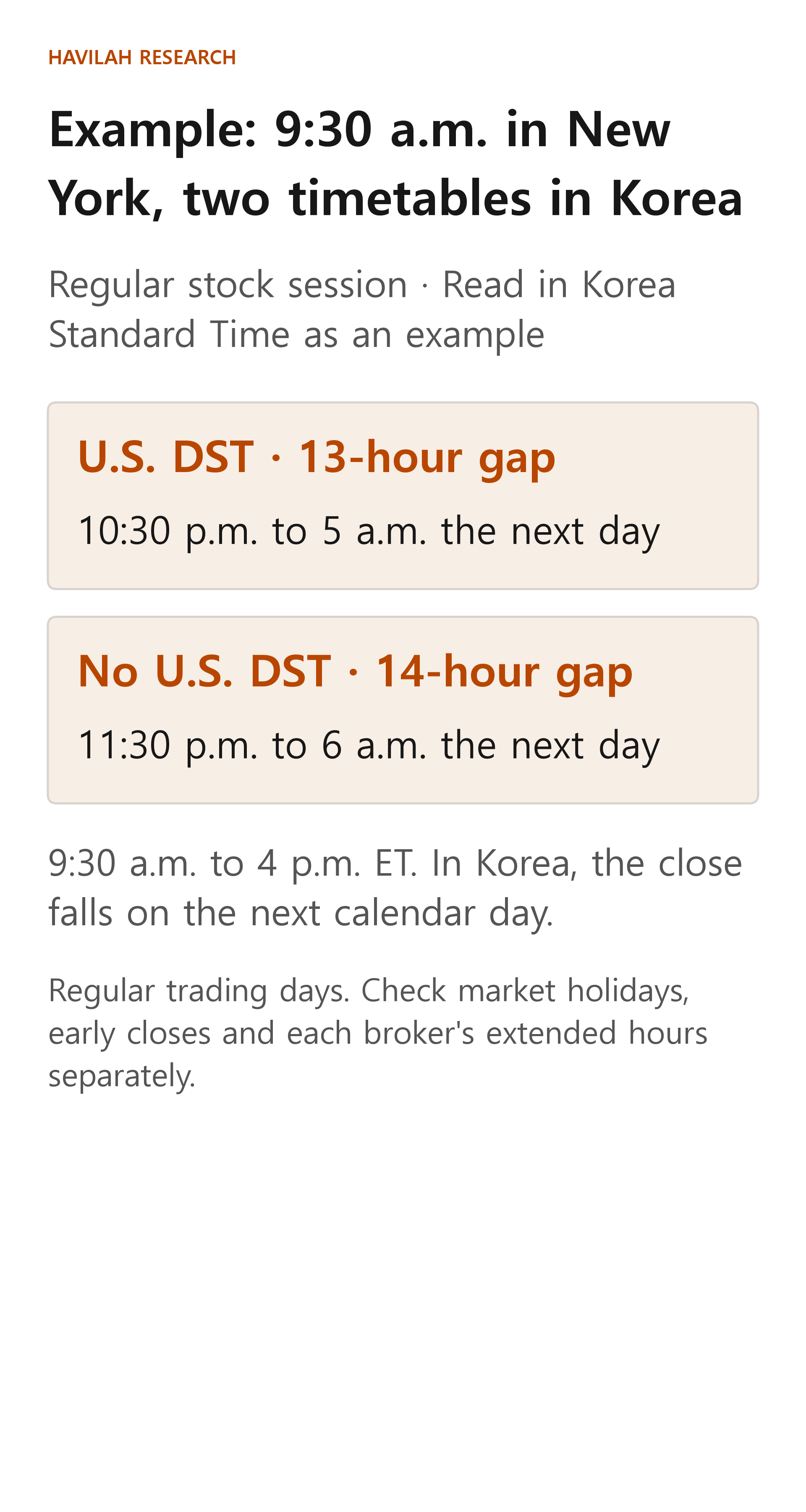
The U.S. regular session has not become any longer. In both cases it lasts 6 hours 30 minutes, from 9:30 a.m. to 4 p.m. ET. What moved by an hour is the start and the end as seen from your time zone.
3. Convert the date as well as the time
In the Korea example, the U.S. Friday session runs into early Saturday morning in Korea. That it is already Saturday where you are does not mean the United States is trading on a Saturday.
The 2026 schedule makes this clearer. That year, daylight saving time in New York starts on March 8 and ends on November 1, local dates. Under the current rule, it starts on the second Sunday in March and ends on the first Sunday in November, so the dates are not the same every year.
| U.S. regular trading day | Start time in Korea | End time in Korea |
|---|---|---|
| Friday, October 30, 2026 | Friday, October 30, 10:30 p.m. | Saturday, October 31, 5 a.m. |
| Monday, November 2, 2026 | Monday, November 2, 11:30 p.m. | Tuesday, November 3, 6 a.m. |
New York's clocks change on the Sunday in between, so from the following Monday the regular session, seen from Korea, starts an hour later. If you kept using the "10:30 p.m." alarm you set in October, in November you would be waiting an hour early.
It also helps to show your own city and New York side by side in your phone's world clock. In your schedule, write the "U.S. trading day" separately from the "start and end times in your time zone." Then, when you read a news story about how the U.S. market closed, you can easily tell which U.S. trading day it refers to.
Do not be thrown if you see EST or EDT instead of ET. EST is Eastern Standard Time, used when daylight saving time is not in effect, and EDT is the Eastern time used while daylight saving time is in effect. When people mean Eastern Time all year round, they usually write ET.
4. Some weekdays are holidays or early closes
Matching the time difference is not the end of it. U.S. exchanges can be closed on a day that is a normal weekday where you live. Your country's public holidays and U.S. exchange holidays do not follow the same calendar, either. Check U.S. stock trading days on the U.S. exchange calendar.
On the 2026 calendars of the New York Stock Exchange and Nasdaq, Thursday, November 26 (U.S. local date), is a market holiday for Thanksgiving. Even if a reader in Korea waits up for 11:30 p.m. that night, the regular session for that trading day will not open.
The next day, Friday, November 27 (U.S. date), the market opens, but the regular stock session closes early, at 1 p.m. ET. That is different from the usual 4 p.m. close.
Daylight saving time is not in effect on this day, so in the Korea example you add 14 hours.
November 27, 1 p.m. + 14 hours = November 28, 3 a.m. in Korea
Seen from Korea, it is a regular session of 3 hours 30 minutes, starting at 11:30 p.m. on November 27 and ending at 3 a.m. on the 28th. If you assume it will stay open until 6 a.m. Korea time as usual, you may miss orders you meant to handle before the market closed.
These dates are examples from the 2026 calendar. Do not copy them unchanged into the next year. Check all market holidays and early-close days on the exchange's calendar for the year in question. If an early-close notice lists separate times for stocks and options, read the line for the product you trade.
5. Being able to order in the app does not mean the regular session is open
Even when the regular session is closed, prices may move in your app and you may be able to press the order button. This is because some brokers support separate trading hours before and after the regular session, or accept orders in advance to be processed later.
Trading before the regular session is called pre-market trading, and trading after it is called after-hours trading. The hours, stocks and order types supported differ from broker to broker. If a broker offers a separate overnight trading service, check that service's conditions as well.
An advance order does not mean the trade happens right now. Check when the order will be sent to the market. Tell apart a notice that your order has been received from a notice that it has actually been filled.
It would be a mistake to look at another broker's timetable and assume your account works the same way. It is more accurate to check your own broker's guide for foreign stocks separately for "hours when trading is available," "hours when advance orders are accepted" and "operation on holidays." Also check whether the times in a notice are in your local time or in U.S. Eastern Time.
In the next lesson, we will look at how to read prices and quotes when you trade outside the regular session. For now, just remember that "the exchange's regular session hours" and "the hours when you can place orders in your app" may not be the same.
6. Check trading hours in this order
First, check the U.S. date, and look at the exchange calendar to see whether that date is a market holiday or an early-close day. Even if you have memorized the usual opening time, it is no use on a holiday.
Next, check whether New York is on daylight saving time, and convert 9:30 a.m. and 4 p.m. ET into your local time with the gap that applies on that date. In the Korea example, the regular session starts at 10:30 p.m. or 11:30 p.m. Korea time and ends on the next day. Write down the start and the end together with their dates.
Finally, check what kinds of orders your broker accepts at that time. Distinguish regular-session orders, orders for separate trading sessions and advance orders, and then check your fill history.
The answer to "What time does it open where I live?" does not come from a single clock. If you look at the U.S. trading day, daylight saving time and the trading conditions of your account together, you can avoid mistakes caused by getting the time wrong.