
When you search for a name in your broker's app, every result brings up a similar screen. There is a price, a chart and a buy button. But buying with the same button does not mean you own the same kind of thing.
Some are shares of a single company. Some are funds that hold many assets, and some are certificates that stand in for the shares of a foreign company. Before you compare prices, you need to know what you are buying.
1. Buying common stock makes you a shareholder of the company
Common stock is the basic form of company ownership we looked at in earlier lessons. When you buy a company's common stock, you become a shareholder of that company. If the company grows well, you may be rewarded through a rising share price or dividends, but you can lose money if the business gets worse or if you pay too much for the shares.
A dividend is money a company pays out to its shareholders. A company does not always pay one just because it made a profit, and receiving a dividend once does not mean you will receive the same amount next time.
Shareholders can usually vote on matters such as electing directors at a shareholders' meeting. This right is called a voting right. However, even within the same company, the number of votes per share can differ by class of shares, and some shares may have no vote at all. Do not assume that the rights are the same just because the company name is the same.
Investing in one company's stock means that your results depend heavily on how that company's business does. You need to look at what the company sells to make money, what competition it faces and whether it can handle its debt. "Is it a famous company?" is not enough.
2. An ETF lets you buy a slice of a fund
An ETF is a fund that you can buy and sell on an exchange like a stock. It pools investors' money and manages it in a set way. Some ETFs hold stocks, and others hold different assets, such as bonds. A bond is a security in which you lend money to a company, a government or another borrower in return for a promise to pay you interest and repay the principal.
Think of a stock ETF as a basket. The fund puts shares of several companies into the basket, and investors buy part of the basket. Buying one share of an ETF does not put separate shares of each company in the basket into your account.
For example, if you buy a hypothetical ETF that holds shares of companies A, B and C, the share price moves of all three companies affect the fund. But the result depends on whether the fund holds the three companies in equal amounts or puts most of its money into A. The weights we looked at in the previous lesson matter here too.
The basket comparison has its limits. An ETF does not always spread its money widely across many companies. Some products focus on a particular industry, and some are built to follow the moves of a single stock. You cannot assume that the risk is well spread just because "ETF" appears in the name.
So check the product description to see what it invests in, what performance it aims for, and what its top holdings and their weights are. Also look at the cost of running the fund. The costs the fund pays affect what is left for investors.
3. What does preferred stock get first?
Preferred stock is also stock in a company. Here, "preferred" does not mean that its price rises first or that it is a better investment. It usually means that it ranks ahead of common stock when dividends are paid, or when whatever is left after a company winds up is shared out.
For example, suppose a company runs into trouble, closes down its business and sells its assets. That does not mean preferred shareholders are paid first. Creditors, such as those who lent money to the company, are paid before shareholders. Preferred stock's place in line only matters if there is still money left to share among shareholders after that.
In other words, ranking ahead of common stock does not mean that your principal is guaranteed. Once those ahead in line have been paid, there may be no money left for preferred stock either.
U.S. preferred stocks are often designed to pay dividends in a set way. Even so, do not think of them like the fixed interest on a bank deposit. Depending on the terms of issue and the company's situation, dividends can be suspended, and the share price can also fall. Some types build up unpaid dividends and must settle them before any common stock dividend is paid; other types do not build them up. Even when unpaid dividends build up, there is no guarantee of when, or whether, you will get them.
Voting rights are often more limited than for common stock. So when you look at a preferred stock, do not read only the expected dividend: also check the dividend terms, what happens if payments are suspended and the voting rights. You cannot decide from the names alone whether common stock or preferred stock is better.
4. An ADR is a certificate that represents foreign shares
Not everything that appears on a U.S. stock trading screen is a U.S. company. There are also ADRs, which let you invest in the shares of European or Asian companies.
ADR stands for American Depositary Receipt. You can think of it as a certificate issued by a bank that holds shares of a company based outside the United States, so that the certificate represents those shares. Investors can buy and sell these certificates in the U.S. market, in dollars.
The key question is how many of the original shares one ADR represents. It may represent one share, several shares or a fraction of a share. Check how many original shares are linked to one certificate.
So even if the share price in the foreign market is EUR 20 and the ADR is $50, you cannot conclude from the price figures alone that the ADR is more expensive. The currencies are different, and the number of shares each one represents may be different too.
The way ADR holders receive dividends or pass on their voting instructions also depends on the deposit agreement. The deposit agreement is the arrangement that sets out, among other things, how the bank manages the certificates and handles dividends and votes. Do not assume the procedures are the same as when you hold the original shares directly. There may also be fees for managing the certificates or handling dividends.
5. Trading in dollars does not remove the effect of exchange rates
The structure of an ADR is easier to see with numbers. The following is a hypothetical case, not a real stock. Assume that one original share costs EUR 20 and that one ADR represents two original shares.
First, work out the euro value of the shares linked to one ADR.
EUR 20 × 2 shares = EUR 40
Now convert it into dollars. An exchange rate is the rate at which one currency is converted into another. Saying that EUR 1 is $1.25 means that EUR 1, expressed in dollars, is worth $1.25.
EUR 40 × $1.25 per euro = $50
But what happens if the share price is still EUR 20 while the value of EUR 1 falls to $1.10? The euro value of the two linked shares stays the same, but their value in dollars shrinks.
EUR 40 × $1.10 per euro = $44
The value went from $50 to $44, a drop of $6. Compared with the original $50, that is a 12% decrease.
(44 − 50) ÷ 50 × 100 = −12%
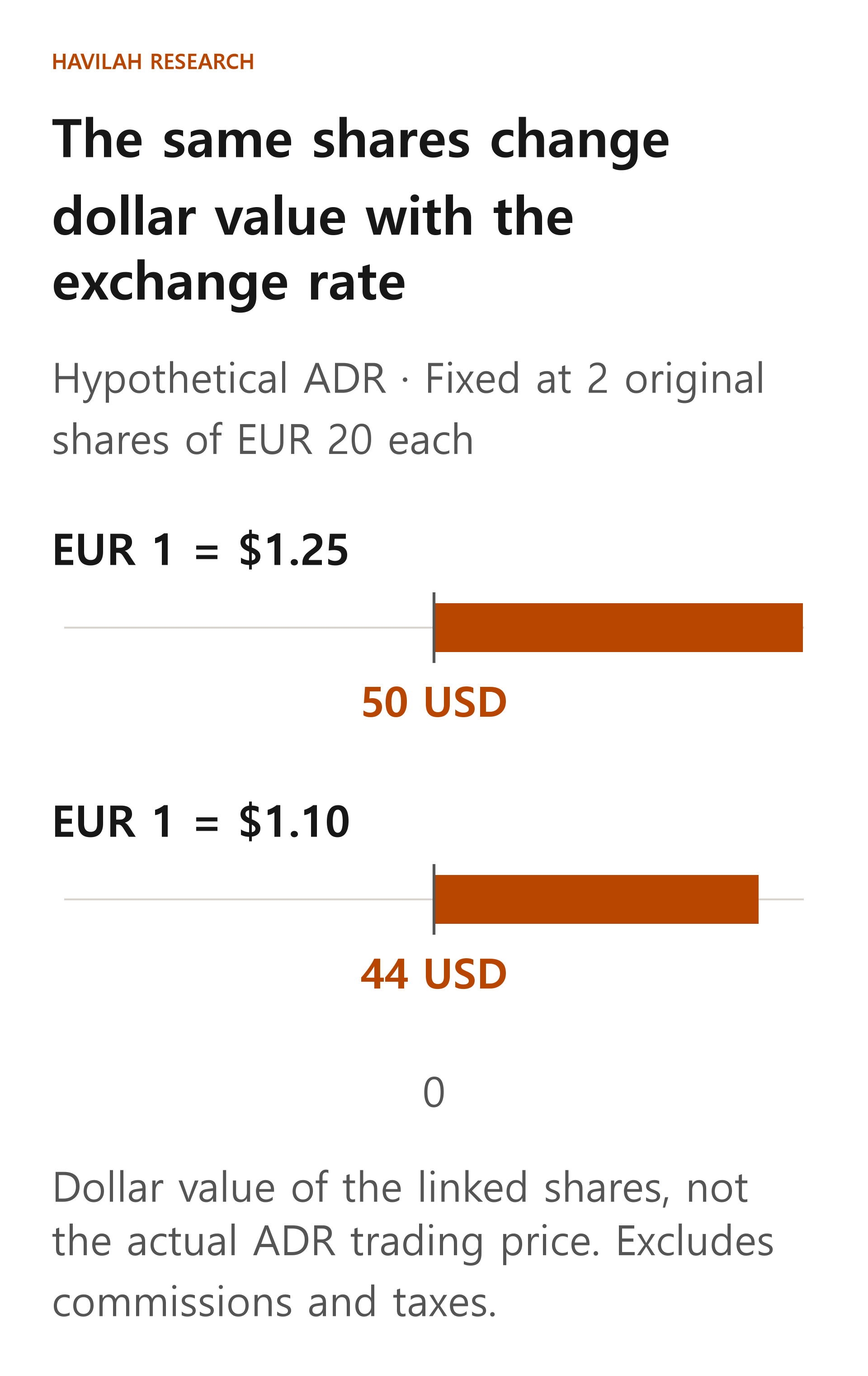
This calculation shows the dollar value of the linked shares. It does not mean that the ADR's actual trading price will be exactly $50 or $44. Prices can differ depending on trading conditions in the market and on supply and demand. Commissions and taxes are also left out of this calculation.
The point to remember is simple. Trading in dollars does not, by itself, make the effect of a foreign currency disappear. If your home currency is not the U.S. dollar and you later convert your dollars back into it, the exchange rate between the dollar and your home currency has a separate effect as well.
6. What to tell apart before you press the buy button
Separating the four types like this makes it clear what you need to check.
| Type | What you buy | What to check first |
|---|---|---|
| Common stock | Shares of one company | The business, the share class and its rights |
| ETF | Part of a fund | What it invests in, holding weights, objective, costs |
| Preferred stock | Company shares with preference terms | Dividend terms, order of payment, voting rights |
| ADR | A certificate representing foreign shares | The original company, shares per certificate, exchange rate, fees |
The categories in this table are not completely separate from one another. Preferred stock is also the stock of an individual company, and an ETF can hold preferred stock or ADRs. The table is a starting point for telling product structures apart on a trading screen.
Once you have found an actual security, first confirm its type in the product description from the company or the fund manager. Then read for two things: which assets' changes will move your money, and what rights you get.
If you cannot explain what you bought, there is no need to rush in just because the price looks cheap. Telling apart the business risk of common stock, what an ETF invests in, the terms of a preferred stock and the linked structure of an ADR is the first step in comparing products.