
"The U.S. stock market rose today."
The news says this, yet the stocks you own are down. Is the news wrong? No. The basket of stocks the news is looking at can be different from the stocks in your account.
A stock index is a number created to show how the market as a whole is moving at a glance. The S&P 500, the Nasdaq Composite and the Nasdaq-100 are well-known examples. Their names sound alike, but they differ in which stocks they hold and in how heavily each stock counts.
1. An index is a number that shows how a basket of stocks moves
Each company's share price moves in its own way. If you combine these moves into one number, it becomes easier to see whether a chosen basket of stocks went up or down overall. That is the job an index does.
Suppose a hypothetical index stood at 1,000 points yesterday and at 1,050 points today. It rose by 50 points, a gain of 5%.
(1,050 − 1,000) ÷ 1,000 × 100 = 5%
A point is the unit used to express the level of an index. An index level of 1,050 points does not mean that one share costs $1,050. The number depends on where the index started and how it is calculated.
So if one index is at 5,000 points and another is at 20,000 points, you cannot say that the second market is four times as expensive. To compare how markets moved, first look at the percentage by which each one changed over the same period. Of course, even if two indexes rose by the same percentage, that does not mean the companies they hold, or their risks, are the same.
2. Which companies it holds matters more than its name
The S&P 500 is an index built mainly around 500 large U.S. companies. It does not include every company in the United States. Companies listed on Nasdaq and companies listed on the New York Stock Exchange can both be included if they meet the selection criteria.
Nor does it simply take the 500 largest companies in order of size. It also applies criteria such as whether the shares trade actively enough and whether the company meets profitability requirements. So use it to see how large listed U.S. companies moved in general, but do not think of it as exactly the same as the whole U.S. stock market.
The Nasdaq Composite broadly includes the Nasdaq-listed stocks that meet the index's eligibility requirements. It can include foreign companies as well as U.S. companies. However, it does not include every product traded on Nasdaq. Fund products such as ETFs, which we will look at below, are excluded.
The Nasdaq-100 is different. It is built mainly around 100 large Nasdaq-listed companies, excluding financial companies. Financial companies are companies in the finance business, such as banks and insurers. The index is not a collection of 100 technology companies only: it can also include other sectors, such as retail and biotechnology.
| Index | What does it mainly show? |
|---|---|
| S&P 500 | How large U.S. companies move |
| Nasdaq Composite | The broad movement of eligible Nasdaq-listed stocks |
| Nasdaq-100 | Movement centered on large non-financial Nasdaq-listed companies |
If a news report just says "the Nasdaq," you need to check which index it means. The Nasdaq Composite and the Nasdaq-100 are not names you can swap for each other.
Also, the 500 or 100 in an index's name is only a starting point for understanding how many companies it holds. An index can include more than one class of shares of the same company, and its membership changes under its inclusion rules, so the actual number of stocks in it is not always exactly that figure.
3. The moves of large companies can count for more
When you combine the price changes of several stocks into one number, the share of the result given to each stock is called its weight. You can think of it as each stock's portion of the index.
You can give every company the same weight, or you can give more weight to companies with a larger market capitalization, which is the total value of all of a company's shares. As you learned earlier, market cap is the price of one share multiplied by the number of shares.
The S&P 500 starts from market cap but calculates weights using the number of shares that ordinary investors can actually trade. This is called a float adjustment. It differs from simply counting every share the company has issued.
The Nasdaq Composite also weights stocks by market cap. The Nasdaq-100 is based on market cap, but it applies adjustment rules so that too much weight does not pile up in particular companies. None of the three indexes gives every company the same weight.
Let's see the principle with a small example. We build a hypothetical index that holds only two companies. At the start, Company A's market cap is $8 million and Company B's is $2 million. Of the $10 million total, A makes up 80% and B makes up 20%.
Over the same period, A's share price rises 10% and B's falls 10%. Assume that the number of shares stays the same and that there are no dividends, no new share issues and no changes to the companies in the index. In this example, market cap is not adjusted in any other way.
A value that has risen 10% is 110% of the original, so you multiply it by 1.10. A value that has fallen 10% is 90% of the original, so you multiply it by 0.90.
| Company | Starting market cap | Market cap after the price change |
|---|---|---|
| A | $8 million | $8 million × 1.10 = $8.8 million |
| B | $2 million | $2 million × 0.90 = $1.8 million |
| Total | $10 million | $10.6 million |
The total grew by $600,000. Dividing this by the starting amount of $10 million gives an overall rise of 6%.
($10.6 million − $10 million) ÷ $10 million × 100 = 6%
If this index had been set at 1,000 points at the start, the same calculation would put it at 1,060 points. One company rose and the other fell by the same 10%, yet the index went up, because the company with the larger weight was the one that rose.
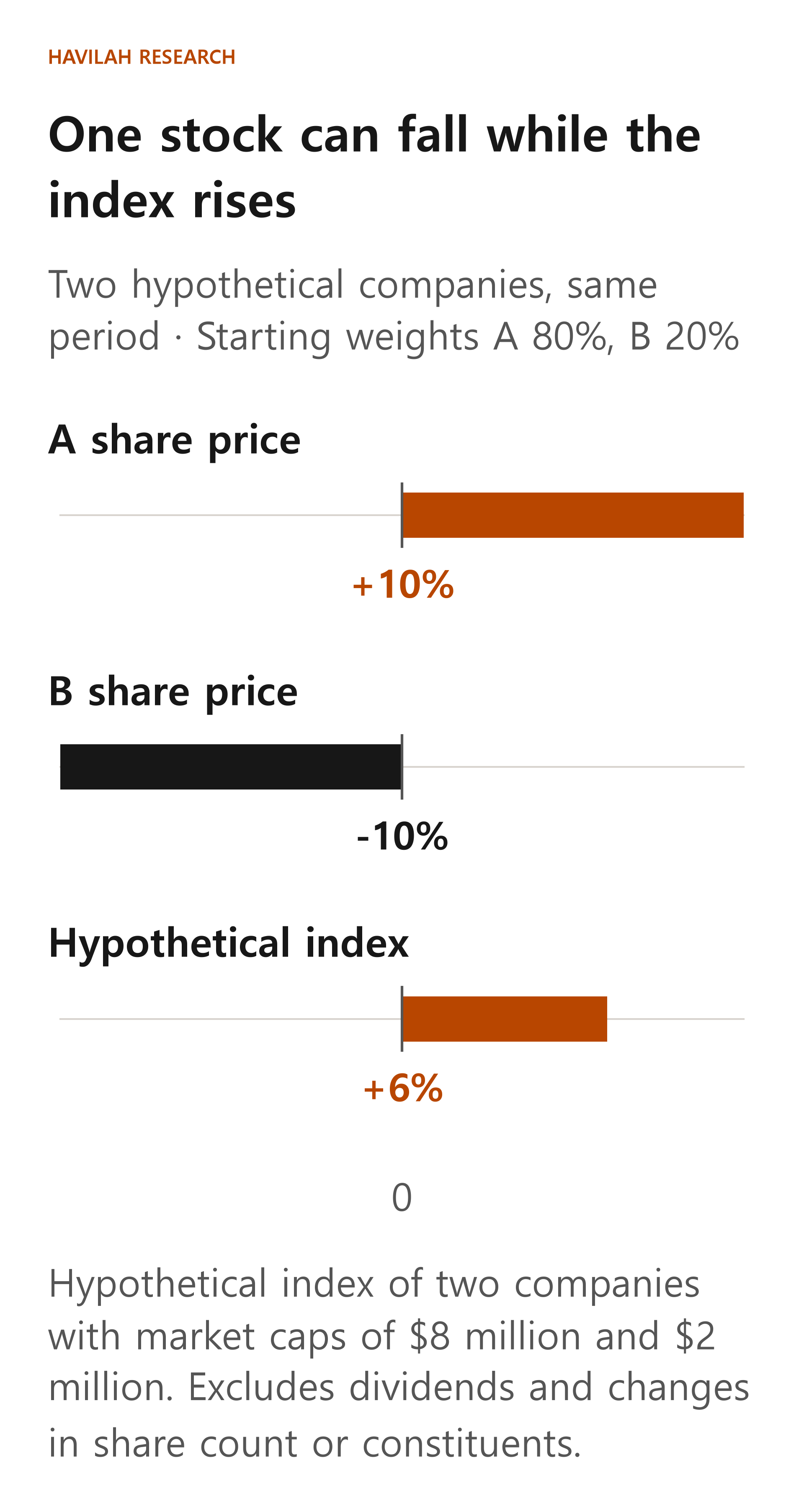
If instead each company had started with a 50% weight, the index change for this period would be 0%. In that case the two stocks count equally, so you add +10% and −10% and divide by 2. Even with the same stocks and the same price changes, the index result depends on how the weights are assigned. These numbers are assumptions to explain weighting; they are not actual returns of the S&P 500 or the Nasdaq indexes.
4. The index can rise while your stock falls
In the example we just worked through, the index rose 6% while Stock B fell 10%. An investor who held only B got a different result from the index. The same principle explains cases where gains in a few large companies offset declines in other stocks.
So do not take a rising index as a sign that "every company's business has improved" or that "it is fine to buy any stock now." An index shows the price movement of a selected basket of stocks. You need to check each company's results, and the price you paid, separately.
Holding many stocks does not mean that the risk is spread evenly, either. If a few companies carry a large weight, their moves largely decide the result. When you look at an index, check the weights of its top holdings and sectors as well as the total number of stocks.
5. An index and a product that tracks it are not the same
"So can I just buy one share of the S&P 500?"
An index itself is a calculated number, so you cannot buy it directly the way you buy a stock. Instead, you can invest in a fund that is managed to deliver performance similar to the index. A fund is a product that pools money from many investors and invests it in assets such as stocks.
A fund that you can buy and sell on an exchange just like a stock is called an ETF (exchange-traded fund). Some ETFs are designed to track the S&P 500, and others the Nasdaq-100. Not every ETF tracks a stock index, so check the product description to see what it aims to do.
The returns of an index and of an ETF that tracks it are not always exactly the same, either. Differences can come from the fund's running costs and from the way it actually holds its assets. "Tracks an index" also does not mean "cannot lose money." If the index falls, a product that tracks it can lose money too.
Do not expect a product to perform the same as the Nasdaq Composite you hear about in the news just because "Nasdaq" appears in its name. First check which index the product actually tracks, and how.
6. Try reading market news this way
First, look at the exact name of the index. Tell the S&P 500, the Nasdaq Composite and the Nasdaq-100 apart. Also keep exchange names and index names separate when you read.
Second, look at which companies count the most. Do not stop at a description saying the index holds many companies; look at its top holdings and their weights as well. This is how you find out which companies' moves are likely to affect you the most.
Third, compare performance on the same basis. Do not mix a one-day gain with a gain since the start of the year when you compare. Also check whether a figure counts only the change in share prices, or whether it also reflects reinvesting the dividends paid. If you rank results using numbers calculated on different bases, the comparison will be off.
Finally, read the description of the product you can actually buy. Check the name of the index, the assets it invests in, its costs and the possibility of loss. If you understand only the index and skip over how the product is built, you may end up with a result different from what you expected.
An index is a starting point for reading the market. Once you separate what it holds, how it weights its holdings and which product you would actually invest in, market news becomes much clearer.