
When you open a foreign stock in your broker's app, you see the letters NYSE or NASDAQ next to the company name. Some stocks are marked OTC instead.
They all appear on U.S. stock screens, so why are the names different? It is not hard once you separate what you are buying from where it is traded.
In this lesson, we will draw a map of the markets where stocks are bought and sold. You do not need to memorize every exchange name from the start. It is enough to know which market the stock you are looking at belongs to, and what information you can check.
1. An exchange is a market where stocks are bought and sold
You place stock orders in your broker's app. But the app itself is not the U.S. stock market. A broker takes investors' orders and connects them to places where they can be traded.
An exchange is an organization that runs the rules and the trading systems that let people buy and sell stocks. When the terms offered by a buyer and a seller match, a trade takes place. Trading also happens through electronic systems, so a "market" does not have to mean people gathered in one building, handing shares to each other.
The best-known stock exchanges in the United States are the New York Stock Exchange and Nasdaq. The New York Stock Exchange is usually shortened to NYSE.
NYSE or Nasdaq next to a stock usually tells you the exchange where that stock is listed. It is not the name of a broker, nor the name of a product the company sells. However, the meaning of a field can differ from screen to screen, so also read whether it refers to the listing market or to the market where a trade was executed.
2. What does it mean to be listed?
Listing means that a company's shares have passed an exchange's review and been registered as a security that can be traded there. Exchanges set standards for things such as a company's financial condition, how widely its shares are held and how the company is run. There are also standards a company must keep meeting after it lists.
When you invest in a listed company, you can look up public documents that describe its business and financial condition. A company's announcement of important information to investors is called a filing (disclosure). Filings are the starting point for checking what the company does, how much it earned and what risks it faces.
But a listing is not a guarantee that the share price will rise. Even if a company met the standards to enter the market, you can lose money if its business gets worse or if you buy its shares at too high a price.
Do not judge a company's strength, or whether its shares are cheap, only by the exchange it is listed on. The listing label is a clue that tells you which market rules apply and where to look for information.
3. The listing exchange and the place your trade happens can differ
"I bought a Nasdaq-listed stock, so my order must have been traded on Nasdaq, right?"
Not necessarily. A stock listed on an exchange can also be bought and sold on other exchanges or on trading systems outside the exchanges. Brokers use several routes to handle orders.
Here, it helps to separate two questions.
| What you want to check | Question |
|---|---|
| Listing exchange | Which exchange is this stock listed on? |
| Where the trade was executed | Where was this particular order traded? |
If you bought the same class of shares, a different trading venue does not make you a shareholder of a different company. Still, check the price you actually paid, the number of shares and the costs in the record of your filled order.
At first, you do not need to memorize every order route. Just do not conclude, from the exchange name in the stock information alone, where and how your order was handled.
4. Do not lump OTC and unlisted stocks together
OTC stands for "over-the-counter." It refers to trading that takes place outside an exchange, also called off-exchange trading. As we saw above, even exchange-listed stocks can be traded off-exchange.
On the other hand, when stocks are classified and someone says "OTC stocks," they usually mean stocks that are not listed on a U.S. exchange and are traded over the counter. OTC is not the name of a single exchange in the way NYSE or Nasdaq is.
This group includes companies that have not met an exchange's listing standards, but it also includes securities that represent shares of foreign companies that chose not to list on a U.S. exchange. So it can be a mistake to think "OTC means small, troubled companies." That does not mean you can trust and trade all of them, either.
For some of these stocks, public information about the company may be scarce, or it may be hard to find someone to trade with. Liquidity is how easily you can buy or sell when you want to without giving up much on price. When liquidity is low, you may find it hard to sell the quantity you want at the price shown, even though a price appears on the screen.
Nor does every stock that is not listed on an exchange appear on these public over-the-counter screens. Some, such as shares in a company held only by its founders or a small number of investors, are traded through private agreements between individuals. Such shares may come with restrictions on who is allowed to buy them or on the conditions for selling them again.
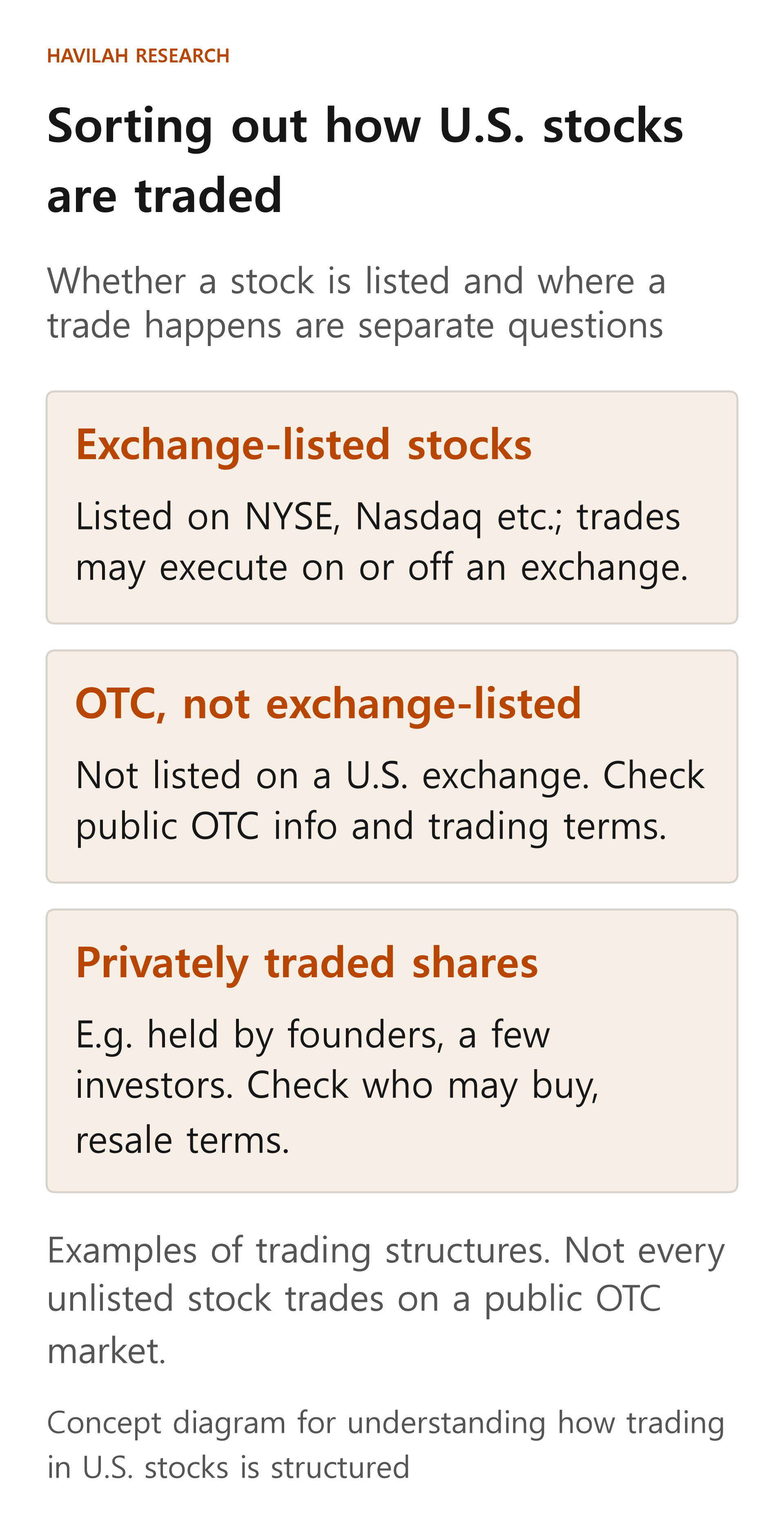
The key is to ask two questions separately: "Is it listed on a U.S. exchange?" and "How can it be traded?" Do not assume from the single word "unlisted" that the information you can check and the trading conditions are the same.
5. Listed stocks can still lose you money
Suppose a hypothetical company is listed on a U.S. exchange. You buy 100 shares of its stock at $20 a share.
$20 × 100 shares = $2,000
If the share price later falls to $15, the same 100 shares are worth $1,500.
$15 × 100 shares = $1,500
That is $500 less than the $2,000 you first invested, an unrealized loss of 25% of your investment.
($1,500 − $2,000) ÷ $2,000 × 100 = −25%
These are hypothetical numbers for illustration, and commissions, taxes, dividends and exchange-rate changes are left out. We also assume that the number of shares does not change. The fact that the company is listed will not give you back this $500.
Conversely, being unlisted does not automatically mean that a company's business has no value. But you need to look more carefully at the information available for checking the business, who you can trade with and the conditions for selling later. "Is this a good company?" and "Is this an investment I can understand and trade?" are questions to check together.
6. When you open a stock's page, read it in this order
First, check the company's exact name and its stock code. The stock code is a short set of letters used to identify a stock, also called a ticker. Be careful not to pick a different stock just because the company name looks similar.
Next, look at the listing market or trading market field. Check whether it says NYSE or Nasdaq, or whether it is an OTC security not listed on an exchange. Securities with similar names can be different types of securities, so read the product type as well.
Then look for recent business and financial information on the company's investor relations page and in its filings. If you can see the share price but struggle to find the company's latest information, it is better not to rush into buying just because the price is low.
Finally, check whether you can buy and sell that stock through your broker, and whether any separate trading restrictions apply. Being able to see a quote is different from being able to place an order in your account. If it is hard to find out whether a stock can be traded, ask your broker before you place an order.
Now the map of the market should be a little clearer. The company that issued the shares, the broker that connects your trades, the listing exchange and the place where trading actually happens each play a different role. Once you keep them apart, you will know what to check first when you come across an unfamiliar stock.
Now that you know how the market is structured, it is time to see whether the market as a whole has gone up or down. In the next lesson, we will look at what the S&P 500 and the Nasdaq indexes show.