
You bought a stock, and your account now shows "Gain: $200." Can you take that money out and spend it right away?
Not if you have not sold the shares yet. The gain on the screen is an amount calculated at the current price. It is not the same as money that has actually come in.
Once you start investing, you will often see numbers that look alike. If you separate how much you put in, what your shares are worth now and how much you received when you sold, your account becomes much easier to understand.
1. When you invest, look at your reason as well as the price
People buy stocks with different ideas in mind. Some buy because they think a company's products and profits will grow. Others trade because they expect the price to move in the near future.
Either way, they can lose money if their expectation is wrong. Holding for a long time is not automatically safe, and trading over a short period is not automatically a mistake.
The word "speculation" is often used for taking on high risk to make a quick profit from price movements. But it is hard to draw a sharp line between investing and speculation by holding period alone. Someone who holds for a month may have a basis for the trade and a plan for losses, while someone who holds for several years may have bought on nothing more than a vague rumor.
If you are just starting out, think about three things before putting a label on it: why you are buying, what changes if your expectation turns out to be wrong, and whether you could lose this money without it disrupting your daily life.
2. The value of your shares is not money in your bank account
Suppose you bought 100 shares of a hypothetical stock at $10 a share. The money you first put into the stock is as follows.
$10 × 100 shares = $1,000
Later, the share price rises to $12. If you have not sold a single share yet, the shares you hold are valued at $1,200.
$12 × 100 shares = $1,200
Compared with the $1,000 you first invested, that is $200 more. This is an unrealized gain: a gain calculated at the current price, not at a price you actually sold at.
| Item | Result |
|---|---|
| Amount paid to buy at the start | $1,000 |
| Current value of the shares | $1,200 |
| Unrealized gain before selling | $200 |
This example assumes there are no commissions, taxes, dividends or exchange-rate changes. The price you actually get when you sell may differ from the price you saw on the screen. If the share price falls again, the unrealized gain shrinks or turns into an unrealized loss.
3. The whole sale amount is not profit
Now suppose you sell 20 of your 100 shares at $12 a share. The sale proceeds are $240.
$12 × 20 shares = $240
But you also paid money to buy those 20 shares. You originally paid $10 a share, so the 20 shares you sold cost you $200.
$10 × 20 shares = $200
So when you subtract the $200 you originally put in from the $240 of sale proceeds, the profit from the shares you actually sold is $40.
$240 − $200 = $40
A profit locked in by selling like this is called a realized gain. The sale proceeds are $240, but the profit is not $240. To find out when you can actually withdraw the proceeds or use them again, check the settlement of the trade and your broker's terms.
You still hold 80 shares you have not sold. At a price of $12, the remaining shares are worth $960, and the money you originally put into them was $800. The remaining unrealized gain is $160.
$12 × 80 shares = $960
$960 − $800 = $160
The $40 realized gain on the shares you sold plus the $160 unrealized gain on the remaining shares comes to $200. This is a simple example in which all the shares were bought at the same price and only some were sold. If you bought at several different prices or paid costs, the actual calculation of your gain or loss will be different.
4. Separate losses before and after selling, too
Suppose the price of the remaining 80 shares later falls to $8 a share. The remaining shares are then worth $640.
$8 × 80 shares = $640
Compared with the $800 you originally put into these shares, that is an unrealized loss of $160. If you have not sold yet, it is not a loss locked in by a sale. But that does not mean the loss has gone away. If you sold now, you could end up selling at that price, and the price could fall further.
On the 20 shares you already sold, a $40 gain has been locked in. Taking the $160 unrealized loss on the remaining 80 shares into account as well, the result for all 100 shares you originally bought is currently a $120 loss.
Realized gain $40 − remaining unrealized loss $160 = overall loss $120
Here too, costs, taxes, dividends and exchange rates are left out. The value of your shares is calculated at the price before you sell and does not guarantee the amount you would receive if you actually sold.
5. If a price rises by as much as it fell, is it back where it started?
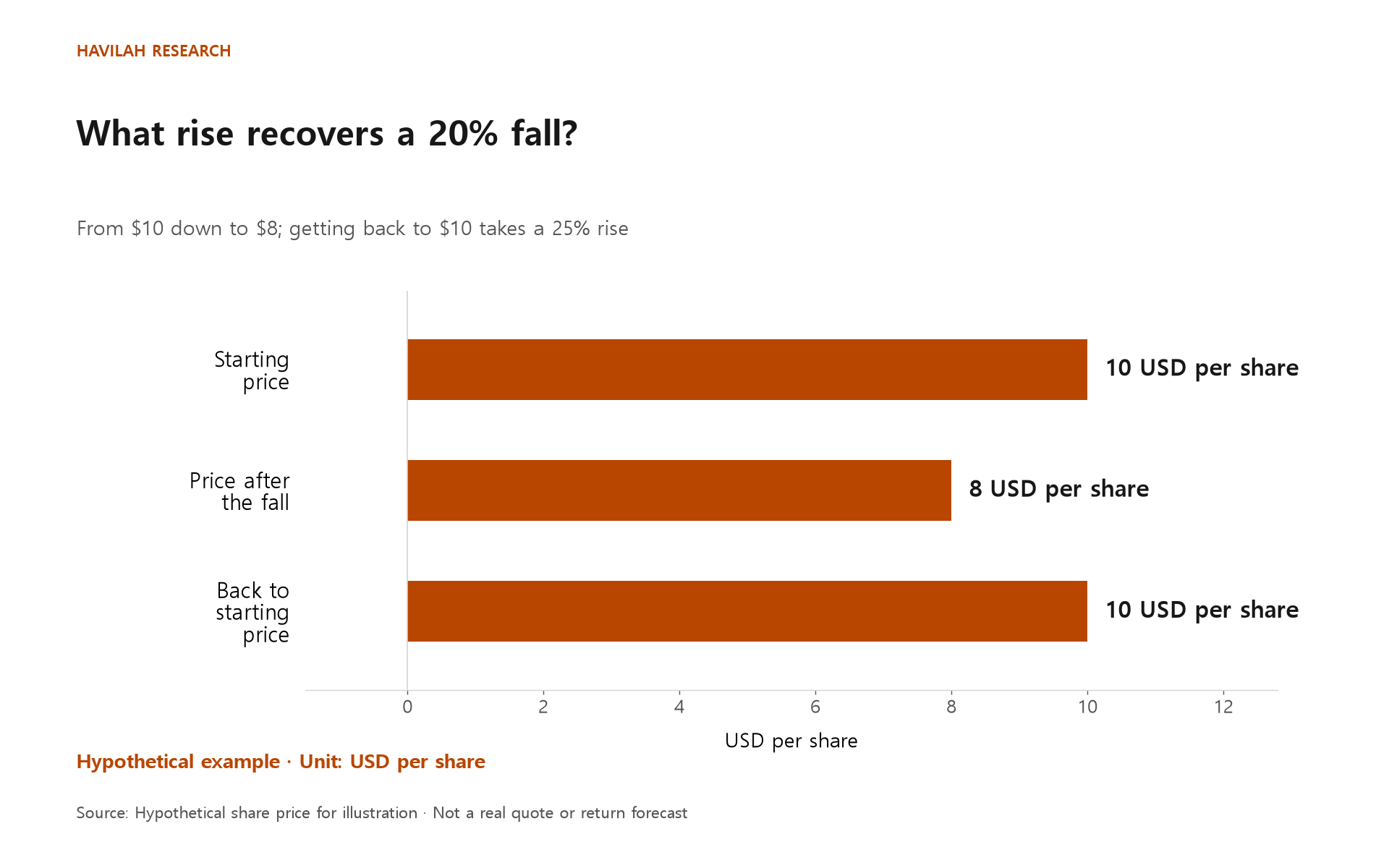
If a stock that was $10 a share falls to $8, it has dropped by $2, or 20%.
($8 − $10) ÷ $10 × 100 = −20%
To get from $8 back to $10, it has to rise by $2. This time, the lower price of $8 is the base for the calculation.
($10 − $8) ÷ $8 × 100 = 25%
After a 20% fall, the price has to rise 25% to get back to where it started. That is because the base price is different on the way down and on the way up.
There is no guarantee that the price will return to where it started. The company's business may get worse or the recovery may take longer than expected, and you could lose some or all of the money you put into the stock. In particular, if it is money you will need soon, consider the possibility that you may have to sell at a loss when you need the money.
6. Look at these four things separately in your account
When you first buy, check how much you spent on the shares. While you hold them, look at their current value and your unrealized gain or loss. If you have sold, look separately at the sale proceeds and the actual gain or loss within them.
Finally, think about when you will need the money and how big a loss you could handle if your expectation is wrong. Commissions and taxes, and for foreign stocks the exchange rate as well, can also affect your actual result.
It helps just to remember that the numbers in your account answer different questions. Telling "what it looks like now" apart from "what you have actually locked in by selling" is the starting point.
In the next lesson, we will look at a map of the market to see where U.S. stocks are traded.