
"Profit is up 20%, so why did the share price fall?"
When you first follow earnings releases, this can seem strange. The company made more money, so it feels as if its shares should be worth more.
But the stock market does not price shares on last year's results alone. It also looks at how much better investors expected things to get, whether the company can keep earning that profit, and what price people were already paying for the shares.
For the same results, "it improved" and "it fell short of expectations" can both be true at once.
1. A company can beat last year and still fall short of expectations
The hypothetical food company Steady Foods earned a profit of $1 million last year. Here, profit means net income: what is left after ingredients, wages, interest, taxes and other costs are taken into account. It is different from new cash that came into the bank account and from dividends paid to shareholders.
Suppose that before this year's earnings release, the market expected the company to earn $1.5 million. But the net income actually reported was $1.2 million. All three figures are net income for a full year, calculated on the same basis.
| Figure compared | Annual net income |
|---|---|
| Profit actually earned last year | $1 million |
| Profit expected for this year | $1.5 million |
| Profit actually earned this year | $1.2 million |
Compared with last year, the company earned $200,000 more.
($1.2 million − $1 million) ÷ $1 million × 100 = 20% increase
But compared with expectations, it was $300,000 short.
($1.2 million − $1.5 million) ÷ $1.5 million × 100 = −20%
Results improved 20% on last year but fell 20% short of the expected amount. The first calculation is measured against last year's $1 million, and the second against the expected $1.5 million. The two 20% figures are measured against different things.
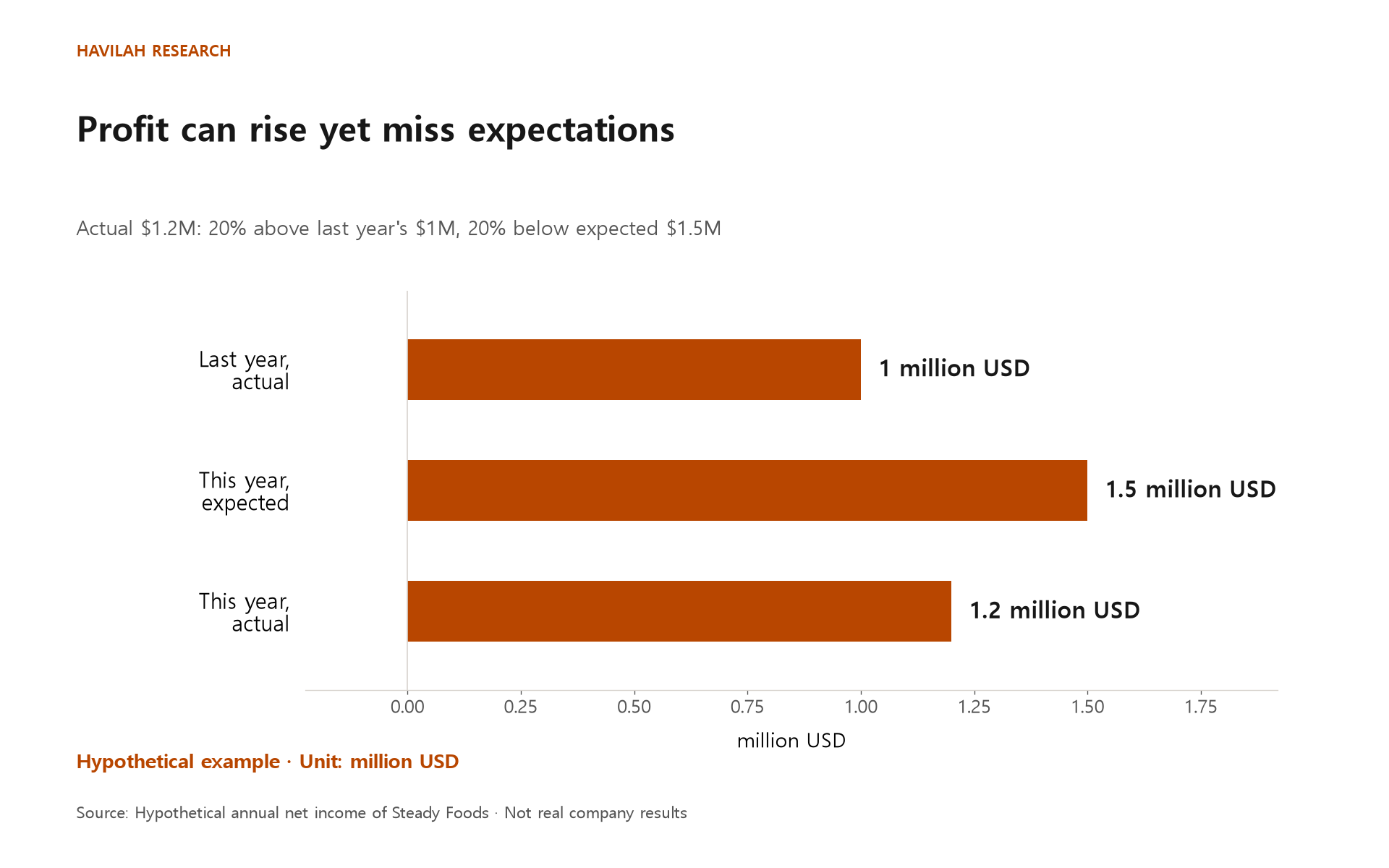
If investors had already bought the shares expecting strong growth, a result of $1.2 million may be a disappointment. This is why news of rising profit alone does not guarantee a rising share price.
Keep in mind, though, that the market's expectation is not one fixed number. Even the average forecast you see in the news, known as the consensus estimate, is put together from the estimates of some analysts. It does not show exactly what every investor thinks or what expectations are built into the share price.
2. Sometimes what comes next matters more than this result
If a company earns more than expected, will its share price definitely rise? Not necessarily.
Even if this period's results are good, investors may worry about next year if the company says, "Ingredient costs could rise sharply and reduce our profit." The outlook a company gives for its future results is called guidance. It is management's forecast, not a settled result.
You also need to look at why profit rose. Profit that grew because the company steadily sold more products is different from a one-off gain on selling a building it no longer used. Not all of the money received for the building is profit, either. The value of the building on the company's books and the costs of the sale have to be taken into account.
If you treat a one-off gain as profit that will repeat every year, you may see the company's future too favorably. That does not mean such gains are always bad. The point is to separate what the company earned its money from, and whether it can earn it again.
The results are a record of past performance, and the outlook is an expectation about the future. If you lump the two together and stop at "It's a good company," it will be hard to understand how the share price reacts.
3. Divide the company's profit into the portion for each share
Now let's put profit and share price on the same scale, because a company's total profit cannot be compared directly with the price of a single share.
Assume Steady Foods had 1 million shares throughout both years. All of them are common shares with the same rights, and there were no other changes in the number or types of shares.
Dividing last year's net income of $1 million by 1 million shares gives $1 per share.
$1 million ÷ 1 million shares = $1 per share
Dividing this year's net income of $1.2 million by the same 1 million shares gives $1.20 per share.
$1.2 million ÷ 1 million shares = $1.20 per share
The profit that corresponds to each share like this is called earnings per share, or EPS for short. Owning one share does not mean $1.20 is paid into your account. EPS is the company's profit divided by the number of shares; paying a dividend is a separate decision.
For real companies, the number of shares can change during the period, or the calculation can be adjusted for different types of shares. In those cases, do not just use the number of shares on the last day; check the EPS the company reports and its explanation of how it was calculated. Here we look only at the simple case in which the number of shares does not change.
4. Profit can rise while the price paid for that profit falls
Suppose the share price was $20 after last year's earnings release and $18 after this year's. This compares prices at two different points in time. It does not mean the price fell from $20 to $18 on the day of this year's release.
Let's divide the share price at each point by the annual EPS reported at that time.
Last year: share price $20 ÷ EPS $1 = 20x
This year: share price $18 ÷ EPS $1.20 = 15x
This ratio is the price-to-earnings ratio, usually called the P/E ratio. It shows the share price as a multiple of one share's profit for 1 year. A fall from 20x to 15x means that the share price attached to the same $1 of profit has gone down.
This example assumes that profit is positive. If profit is 0, the division cannot be done, and if the company is making a loss, you should not look at a negative P/E and decide the stock is "cheaper."
| Item | After last year's earnings release | After this year's earnings release |
|---|---|---|
| EPS for the year | $1 | $1.20 |
| P/E ratio | 20x | 15x |
| Price of 1 share | $20 | $18 |
EPS rose 20%, but the share price fell by $2.
($18 − $20) ÷ $20 × 100 = −10%
If investors judge that growth is likely to slow or that the business has become riskier, the price they are willing to pay for the same profit can fall. That is how a company's profit can rise while its share price falls.
On the other hand, if the multiple had stayed at 20x this year, the price would have been $1.20 × 20 = $24. When profit grows, the share price can rise too. The key point is that the multiple that will apply is not fixed in advance.
The 15x, the 20x and the $24 are assumptions in this example, not a fair value or a price target. The P/E ratio only shows the relationship between the share price and profit; on its own, it cannot prove why the price is what it is. And because profit is not all paid out as dividends, you should not read 20x as "a promise to get your money back in 20 years."
5. Read earnings news in three separate parts
First, look at what actually changed. Check whether the figure is revenue or net income, and whether it covers one quarter or the full year. Revenue is the amount of sales, while net income is the result after costs and other items, so you cannot swap one for the other in a comparison.
Next, look at what was expected before the release. Check when the estimate was made and what period it covers. If you take an estimate that was revised after the release and say the results "fell short of expectations," the comparison does not hold. If there is no pre-release estimate you can check, you can simply leave that part of the judgment open.
Finally, read what the company said about the future. You can find the earnings release materials and management's explanations in the investor relations (IR) section of the company's website. Check whether costs rose only temporarily, whether customer orders fell, and whether the company can keep earning this level of profit.
Do not conclude that "expectations were too high" just because the share price fell. Other news may have come out the same day, or the whole market may have moved. Keep the confirmed numbers separate from your own guesses about the reasons.
A company's profit, the market's expectations and the price paid for its shares are three different things. Looking at them separately helps you avoid the mistake of treating good results as an automatic signal to buy.
In the next lesson, we will build on what we have learned so far to tell investing apart from speculation, and the gains and losses shown in your account apart from the money that actually changed hands.