
One stock costs $5 a share and another costs $100 a share. When you are new to investing, the $5 stock looks cheaper and seems to have more room to rise.
But one share is only part of a company, not the whole of it. It is hard to judge whether the whole is cheap by looking only at the price of one piece.
If you cut a pizza into smaller slices, each slice gets smaller. The price per slice may fall, but that does not necessarily mean the price of the whole pizza has fallen. With stocks, too, you first need to see how many shares the company is divided into. Of course, unlike a pizza, a company goes on doing business and makes or loses money. We will use this comparison only to separate the slice from the whole.
1. Multiply the share price by the total number of shares
The price the stock market puts on all of a company's shares together is called its market capitalization, or market cap. Put simply, it is the value of all the shares added up, at the price they trade at in the market.
For a company with only one class of shares, you calculate it like this.
Market cap = price of 1 share × total number of shares currently held by shareholders
Shares that the company has bought back and holds itself, called treasury shares, are left out. Treasury shares are the company's own shares, held in its own name. Nor do you multiply by the maximum number of shares the company could issue in the future.
Let's compare two hypothetical companies, Sunrise Bread and Harvest Bread. Assume both have only one class of shares, all with the same rights, and that we use prices and share counts from the same point in time.
| Item | Sunrise Bread | Harvest Bread |
|---|---|---|
| Price of 1 share | $5 | $100 |
| Total number of shares | 10 million shares | 100,000 shares |
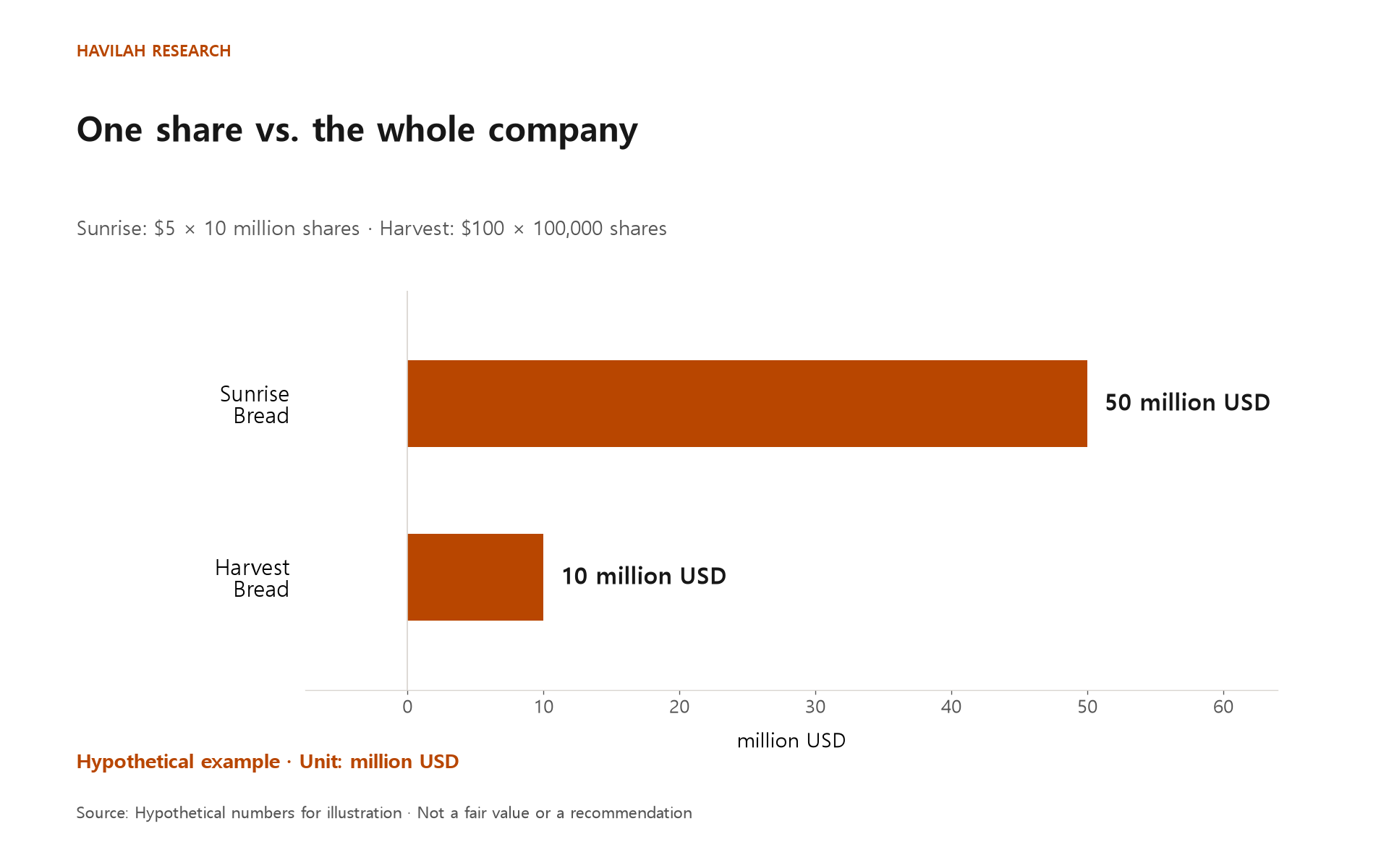
| Market cap | $50 million | $10 million |
For Sunrise Bread: $5 × 10 million shares = $50 million.
For Harvest Bread: $100 × 100,000 shares = $10 million.
Sunrise Bread's price per share is low, but the price on all of its shares together is 5 times Harvest Bread's. That is because it has many more small pieces.
This calculation does not mean you could actually buy the whole company for that amount. The price can move while you are buying a large number of shares, and a deal to take over a company also needs separate negotiation. Market cap is the value of all the shares at the current share price.
2. Do you make more money if you buy more shares?
"But if I buy the $5 stock, I can own lots of shares, can't I?"
That's true. But the number of shares you hold does not decide your return on its own. You need to look at how much you invested and by what percentage the price moved.
Let's compare two cases in which you invest $1,000 in each company separately. To keep the calculation easy to follow, trading costs, taxes, dividends and exchange-rate changes are left out.
With Sunrise Bread, you can buy $1,000 ÷ $5 = 200 shares.
With Harvest Bread, you can buy $1,000 ÷ $100 = 10 shares.
Now assume both share prices rise 10%. Rising by the same percentage is an assumption made for the comparison; it does not mean the two stocks actually rise together.
| Item | Sunrise Bread | Harvest Bread |
|---|---|---|
| Number of shares held | 200 shares | 10 shares |
| Price of 1 share after a 10% rise | $5.50 | $110 |
| Value of the shares held | $1,100 | $1,100 |
| Profit compared with the money first invested | $100 | $100 |
Sunrise Bread rises by $0.50 a share, for a profit of $0.50 × 200 shares = $100.
Harvest Bread rises by $10 a share, for a profit of $10 × 10 shares = $100.
If you have not sold yet, these are unrealized gains. You hold different numbers of shares, but you invested the same amount and both prices rose by the same percentage, so the result is the same.
3. A cheap share does not mean a smaller loss
This time, instead of a rise, assume both share prices fall 20%. This is not a fall after the 10% rise above; it is a separate case in which the price falls straight from the original purchase price.
Sunrise Bread falls by $1, which is 20% of $5, to $4.
$4 × 200 shares = $800
Harvest Bread falls by $20, which is 20% of $100, to $80.
$80 × 10 shares = $800
In both cases, you lost $200 of the $1,000 you originally invested. The loss is no smaller just because the stock costs $5 a share.
Do not confuse the price of one share with the risk to your whole investment. If you bought a lot of shares of a cheap-looking stock, even a small change in the price per share can add up to a large amount in your account.
4. A small company is not the same as a cheap one
Now that you know the market caps, can you conclude right away which company is cheap?
Harvest Bread has the smaller market cap. But if its business is small, its profit is low and it has a lot of debt, a small market cap alone does not make it a good investment.
On the other hand, even if Sunrise Bread's market cap is larger, there may be reason to consider that price if it earns far more profit and has plenty of room to grow.
Saying a stock is undervalued means its current price is low given the money the company can earn and the risks it has to bear. It does not simply mean that its price per share or its market cap is small.
Market cap is a starting point for comparison. To judge whether that price is expensive or cheap, you need to look at what business the company earns its money from and how much it earns, whether it can keep making a profit and whether it can afford to repay its debts. We will cover this in detail later, when we study financial statements and company valuation.
5. On a quote screen, check things in this order
For a stock you have not looked at before, find the market cap next to the share price. This widens your view from the price of one share to the price on the whole company.
If you calculate it yourself, check that the share price and the number of shares refer to the same point in time. If the company has issued new shares but you multiply by the old number of shares, you will get a figure that differs from the company's current size.
In U.S. company documents, "shares outstanding" is the item to look at for the number of shares currently held by shareholders. It excludes treasury shares held by the company. Do not confuse it with the limit on the number of shares the company is allowed to issue. For a company with more than one class of shares, also check the class of shares and the basis on which the market cap is calculated. Do not simply multiply the one share price on the screen by the total number of shares.
Next, work out how many shares you can buy with your money, but do not decide that a larger number of shares is an advantage. A 20% fall on $1,000 is a $200 loss, whatever the price of one share.
The order to remember is simple. Look at the price of one share, the total number of shares and the market cap together, and then look at the money the company will make and its risks. The key point of this lesson is to tell a "small number" apart from a "good price."
Yet even good companies with growing profits sometimes see their share prices fall after an earnings release. In the next lesson, we will look at a company's results and investors' expectations separately.