
A stock that was $10 yesterday is $11 today. The company did not build a new factory overnight, so why did the price go up?
A stock has no list price that the company sets each day. The price is formed when people who want to buy shares trade with people who want to sell them.
First we will look at how a price comes about, and then at why the amount people are willing to pay changes.
1. A price exists only when someone buys and someone sells
Suppose shares of the hypothetical company Spring Bread are being traded.
Sam wants to sell at $10 a share. Alex is willing to buy at that price. Their terms match, and 20 shares are traded. When an order actually turns into a trade like this, the order is said to be filled (executed).
The share price in this trade is $10, and the money spent on buying the shares is as follows. Trading costs are left out.
$10 × 20 shares = $200
What if Sam wants $10 but Alex will pay no more than $9? If neither of them changes their terms, no trade takes place between the two. Saying you want to buy is not the same as actually buying.
The "last price" on a quote screen is the price at which the most recent trade took place. It is not a fair price set by the company, nor a promised price at which anyone can buy or sell as many shares as they want right now. The screen may also show, separately, the prices currently offered by those who want to buy and those who want to sell.
2. When the terms of the next trade change, the share price changes
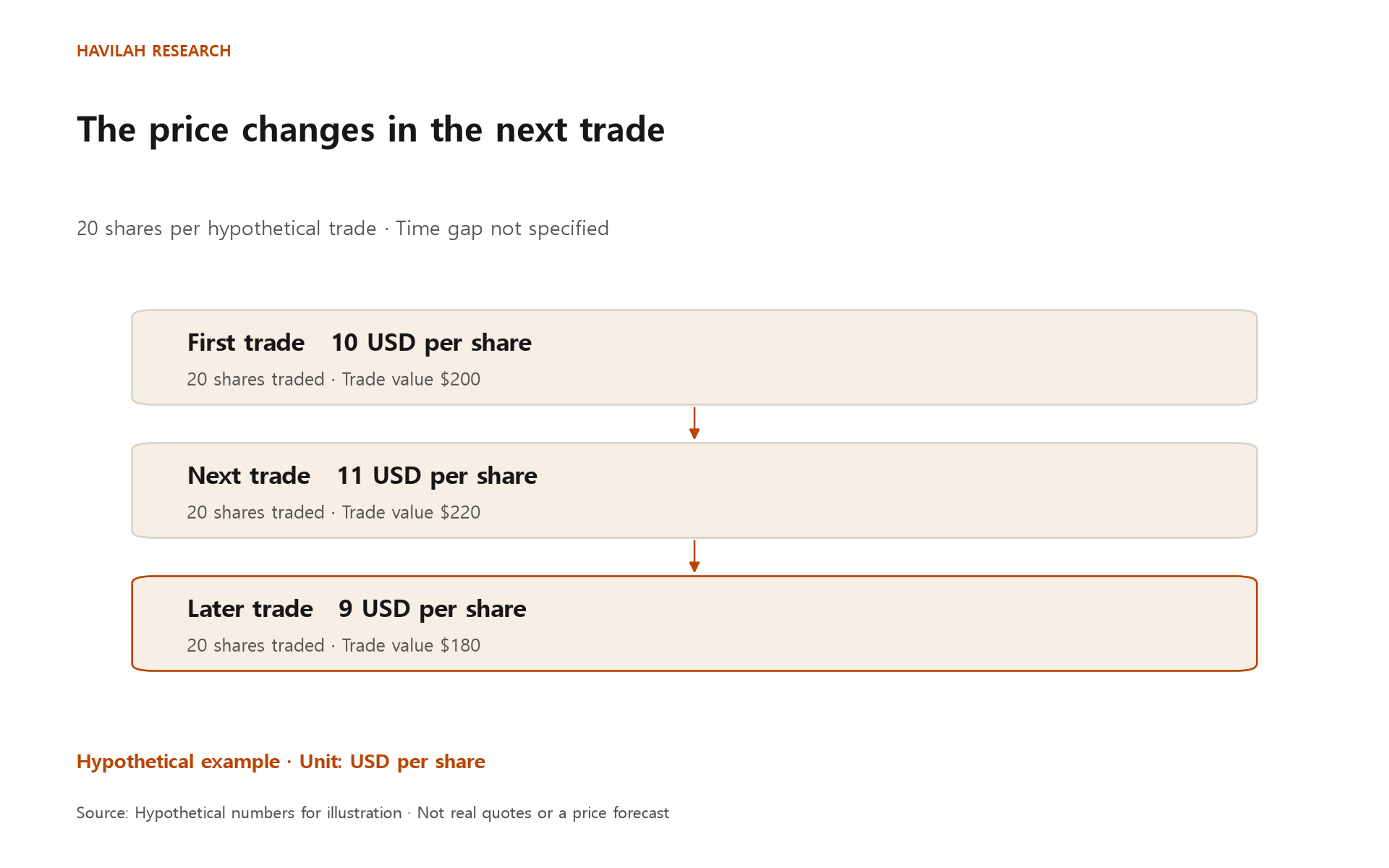
This time, suppose no one is willing to sell at $10 anymore, and someone will sell only if they get at least $11. If a new buyer accepts that price and buys 20 shares, the next trade takes place at $11.
$11 × 20 shares = $220
Buying the same 20 shares now costs $20 more than in the earlier trade. That does not mean all shareholders sold their shares at $11 at once. What changed is the price of the newest trade.
Later, suppose someone who wants to sell quickly accepts $9, and someone buys 20 shares at that price. The trade value is then $180.
$9 × 20 shares = $180
The figure below is an example that assumes three trades like these took place. It is not a forecast that the share price will move to these prices whenever news comes out.
People often say, "It went up because lots of people wanted to buy." But every share that is traded has both a buyer and a seller. If 20 shares were traded, someone bought 20 shares and someone sold 20 shares.
The number of people is not the only thing that matters. What also matters is how many shares people want to buy or sell at each price, and which side is willing to give ground on price. In one situation, a single person may want to buy a lot of shares; in another, many people may each want to sell a few.
This relationship, in which the number of shares people want to buy and the number they want to sell change with the price, is called supply and demand. If buyers in a hurry to trade accept a higher price, or sellers accept a lower one, the price of the next trade can change.
3. People name their price based on what they expect from the company's future
So why would someone who would go no higher than $10 yesterday be ready to pay $11 today?
Suppose Spring Bread has signed a large supply contract. Investors think it may sell more bread and earn more profit in the future. When people expect a company to make more money, the amount they think is reasonable to pay for its shares can rise.
On the other hand, if the company loses its main customer, expectations about the money it will make in the future may fall. Then some people may refuse to buy at the previous price, and others may be willing to sell even at a lower price.
Profit is the amount left after subtracting costs, such as ingredients and wages, from sales. It can differ from the cash that actually comes into and goes out of the bank account. Selling more bread does not necessarily mean profit rises too. The price of flour may jump, or it may cost more to keep up with the orders.
Share prices do not react only to numbers that have already been announced. They also reflect expectations about how much those numbers will improve or worsen in the future.
Still, good news does not always push a price up. The price may already have risen because people were expecting that news. We will look more closely in Lesson 6 at cases where results and expectations diverge.
4. When earnings look similar but feel less certain, people want to pay less
Suppose two bakeries are both expected to earn similar profits next year.
One supplies many shops steadily. At the other, one large customer accounts for most of the orders. If that customer ends its contract, the second bakery's profit could fall sharply.
Investors look not only at expected profit but also at the chance that the expectation turns out to be wrong. All else being equal, the more likely they feel a loss is, the less they may be willing to pay for the shares.
Changes outside the company matter too. If the economy weakens and people seem likely to cut their spending, or if the interest available from other investments rises, fewer people may want to take on the risk of stocks. Interest is the money you receive in return for lending money.
Changes like these do not move every company's share price in the same way. Customers, debt and growth prospects differ from company to company, and investors' expectations differ too. If you draw a conclusion from a single reason, such as "Interest rates went up, so this stock is bound to fall," you will miss part of the picture.
5. Separate the fact that the price moved from the reason it moved
"It rose 5% today" describes a change in price. "People bought because they think profits will grow" is an explanation of that change. The two are not the same thing.
A move may be caused by a new announcement from the company, but it may also be caused by large investors moving money or by the mood of the market as a whole. A short-term move in a share price cannot always be put down to one clear reason.
On a day when a share price moves sharply, start by checking three things.
- What has actually changed in the company's business?
- How does that change affect the money it will make, or its chance of losses, in the future?
- Is this new information, or something people were already expecting?
For Spring Bread's supply contract, do not stop at the news of the contract. Look at how long it runs, how much revenue it brings and what extra costs it will require. If you do not know the costs yet, you cannot say for sure what the profit will be. This is why you should not conclude that the business has improved just because the trading price went up.
Share prices are made in trades. The prices people put forward in those trades reflect their expectations about the future, their worries about losses and any immediate need to buy or sell. When you look at a price, look at both the movement itself and the business behind it.
But if one company's stock costs $5 and another company's costs $100, is the $5 stock the cheaper investment? In the next lesson, we will look at the "total number of shares" hidden behind the price of a single share.