
You bought a stock and its price went up. A while later, a dividend arrived as well.
"The share price went up and I got a dividend. So how much did I actually make?"
When you look at the money a stock brings you, you need to count two things together: the difference between the price you bought at and the price you sold at, and the dividends you received while you held the shares. At the end, you also need to subtract costs and taxes.
Let's follow the trades of one person who bought 100 shares. All the numbers are a hypothetical example, and everything is calculated in U.S. dollars. We will leave aside any exchange-rate differences that arise when you convert the money into your home currency.
1. Selling for more than you paid gives you a capital gain
Suppose you bought 100 shares of a stock at $10 per share. The money you put in at the start was $1,000. To keep the calculation simple, assume there were no extra costs when you bought.
$10 × 100 shares = $1,000
Later, you sold all the shares at $11 per share. The sale proceeds were $1,100, which is $100 more than you originally paid.
($11 − $10) × 100 shares = $100
A profit that comes from the difference between the price you bought at and the price you sold at is called a capital gain. So far, this calculation does not include dividends, selling costs or taxes.
What if the share price reached $11 but you had not sold yet? Your account might show an unrealized gain (also called a paper gain) of $100. This means that if you value your shares at the current price, they are worth that much more. It is not the same as a profit you have received in cash by selling the shares.
If the price falls again before you sell, the unrealized gain shrinks too. In the same way, when you have an unrealized loss, do not tell yourself, "I haven't sold yet, so I haven't lost anything." You have not locked the loss in as cash, but the shares you hold are already worth less.
2. You can also receive dividends while you hold the shares
When a company pays out money to its shareholders, you receive a dividend. This is money that can come in without your selling any shares.
Suppose that while you held those 100 shares, the company paid $0.20 per share. If you met the conditions for receiving it, your dividend before tax is $20.
$0.20 × 100 shares = $20
In this example, you did not use the dividend to buy more shares; you kept it as cash. Assume also that the cash earned no interest. You held exactly 100 shares from start to finish and did not add or withdraw any other money along the way.
There is a reason for setting these conditions. If you had used the dividend to buy more shares, the number of shares you hold would change, and so would the gains and losses as the share price moved afterward. That case needs to be kept separate from the simple calculation here.
Also, not every company pays dividends. A company that has been paying dividends can cut or stop them if its business gets worse. Owning a stock does not by itself mean that a steady amount of cash will come in.
3. Add the price difference and dividends to see your total return
Now go back to the case where you sold all the shares at $11 per share. Adding the $20 dividend to the $100 you gained from the price difference gives a profit of $120 before costs and taxes.
Capital gain $100 + dividend $20 = $120
You can also work out how much you made compared with the $1,000 you originally put in. Divide the profit by the money you first invested and multiply by 100.
$120 ÷ $1,000 × 100 = 12%
A return that includes dividends as well as the change in price is called the total return. In this example, the total return before costs and taxes is 12%. The share price alone rose 10%, but adding the dividend changes the result of the investment.
| What was calculated | Result |
|---|---|
| Money paid to buy the shares at the start | $1,000 |
| Money received from selling all the shares | $1,100 |
| Dividend received separately, before tax | $20 |
| Profit before costs and taxes | $120 |
| Total return before costs and taxes | 12% |
Checking it again in cash gives the same answer. The $1,100 from selling the shares plus the $20 dividend makes $1,120. Subtract the $1,000 you originally paid, and $120 is left.
This 12% is the return from the time you bought the shares to the time you sold them. This example does not assume a 1-year holding period, so you should not call it an annual return. The same 12% means something different depending on whether you earned it in a month or over several years.
4. Subtract costs and taxes to see what you keep
A profit of $120 does not mean you keep all of it. If there are trading costs and taxes, the money you actually keep is smaller.
This time, suppose you paid $10 in costs when you sold the shares at the end. Assume also that all the taxes you paid in connection with this investment add up to $15. The $15 is an amount chosen for this explanation; it does not represent an actual tax rate or the tax law of any particular country.
$120 − selling costs $10 − taxes $15 = $95
Your profit after costs and taxes is $95. Measured against the $1,000 you originally invested, the return is 9.5%.
$95 ÷ $1,000 × 100 = 9.5%
Let's also check that the money adds up from start to finish. To keep this example simple, assume you paid the tax all at once at the end.
Sale proceeds $1,100 + dividend $20 − costs $10 − taxes $15 = final cash $1,095
Your original $1,000 became $1,095, which matches the $95 profit worked out above. This confirms that the dividend was not added twice and the tax was not subtracted twice.
A pre-tax return is the result before taxes are subtracted, and an after-tax return is the result after taxes are subtracted. But a figure labeled "pre-tax" does not by itself tell you that trading costs have been subtracted as well. When you compare numbers, check whether costs and taxes have each been taken into account.
Here, there were no costs when buying, so the money you put in at the start was exactly $1,000. If you had paid a separate cost to buy, you would need to include that cost in the money you put in at the start. If you added money or took some out along the way, the timing of those amounts would also matter, so you should not apply this formula as it is.
5. You can lose money overall even after receiving dividends
This time, suppose you sold at the end for $9 instead of $11. Everything else is the same, and for now we compare the results before costs and taxes.
The loss from the price change is $100.
($9 − $10) × 100 shares = −$100
Even after adding the $20 dividend, the overall result is −$80. Since you invested $1,000 at the start, the total return is −8%.
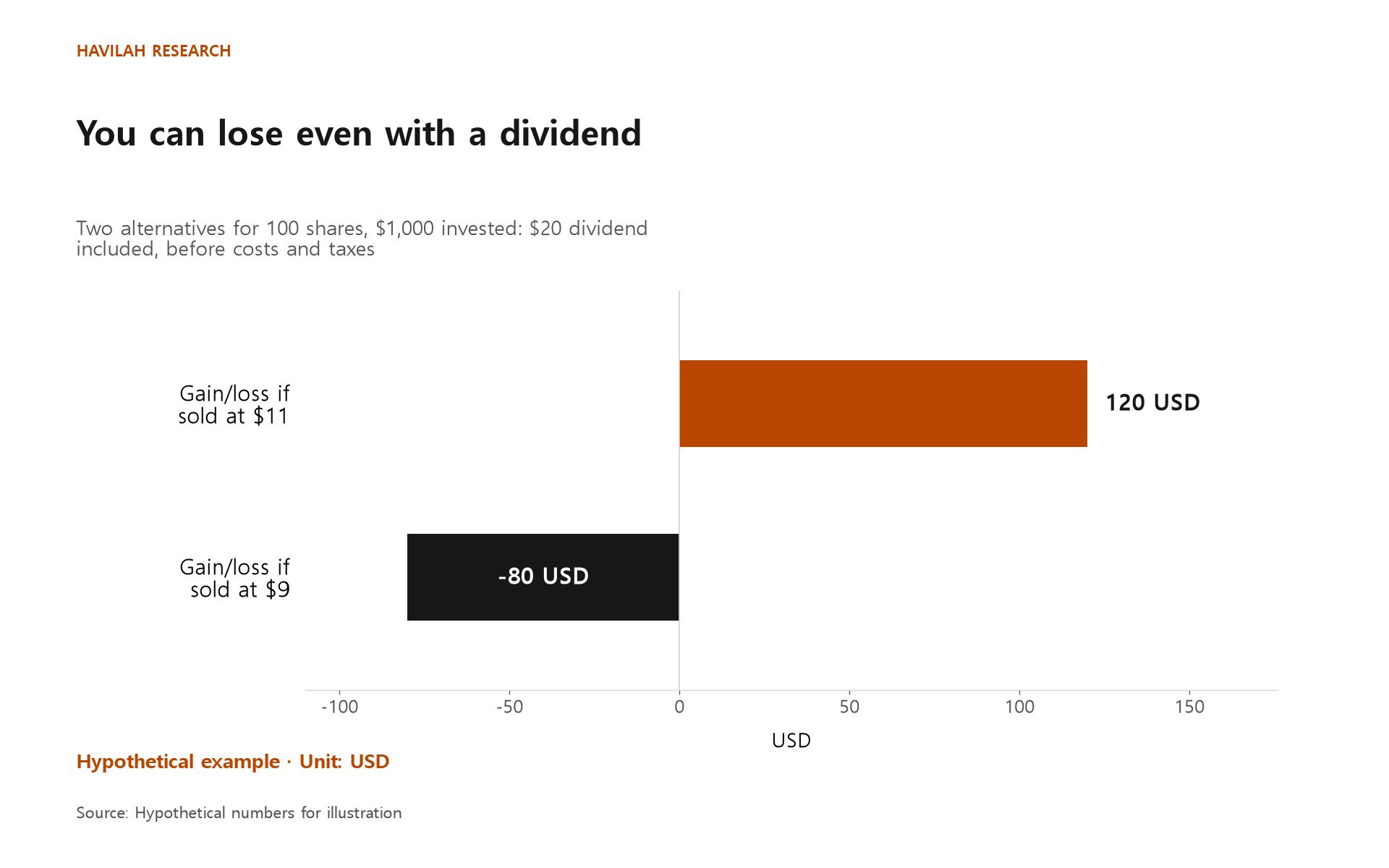
This is why you cannot say, "I got a dividend, so I made a profit." The dividend did come in, but it did not make up for all of the loss from the fall in the share price.
Also, a dividend is not free money that appears out of nowhere. When a company pays cash to its shareholders, the cash left in the company falls by the same amount. The money has moved into the shareholders' accounts, so you should not think the same money is still sitting inside the company as well.
This movement of money is one of the factors reflected in the share price. But the actual share price is also affected by company news and market conditions. You cannot assume that the share price will move by exactly the amount of a dividend just because the dividend is paid. Nor is it guaranteed that you will make a profit by collecting a dividend and then selling right away.
When you look at your investment results, check just three things in order: how much you made or lost on the share price, how much you received in dividends, and how much went out in costs and taxes.
Once you understand each way of making money separately, you need to put them back together. What matters to you is not one good-looking number on one side, but how much the whole amount you invested grew or shrank.
So who sets share prices, and why do they go up and down? We will look at that in the next lesson.