
A bakery is doing good business. Orders are growing and it wants to buy another oven, but the money in the company's bank account is not enough.
The owner could put in more of their own money or borrow from a bank. But there is another way.
"Invest in our company. In return, we will give you shares that make you one of its owners."
This is one of the main reasons companies issue shares: to raise the money their business needs. The trade-off is that more shareholders will share in the company's future profits and losses.
1. Money from the founder alone may not be enough
Consider a hypothetical company called Spring Bread. Its founder put their own money into the company and started a bakery. At first, the founder held all 10,000 of the company's shares. With no other shareholders, the founder owned 100% of the company. In the examples below, assume that the existing shares and any newly issued shares carry exactly the same rights.
Over time, more customers came. With a new oven and more staff, it looks as though the bakery could sell a lot more bread. But it has to buy the oven before it can bake more bread, and the money from selling that bread comes in only afterward.
In other words, a company can have a chance to make money in the future and still be short of money to spend now.
At this point, an outside investor can put money into the company and become a shareholder. The company uses that money to expand its business, and the investor hopes that if the business does well, the value of their shares will rise too. Getting the money a business needs in this way is called raising capital.
Of course, a company does not always issue shares to open new shops. It may raise money to develop products or to pay off debt. So when you hear that a company "has raised money from investors," the next question to ask is "What does it plan to spend the money on?"
2. Issuing new shares increases the number of shares
Suppose Spring Bread decides to create 2,000 new shares and sell them to an outside investor at $10 per share. When a company creates and sells new shares like this, it is called a new share issue. "New" means exactly what it says: these shares did not exist before.
The investor pays the company the following amount.
2,000 shares × $10 = $20,000
The company receives $20,000, and the investor receives the 2,000 newly issued shares. The money does not go into the founder's personal bank account. For both this new share issue and the sale of existing shares it is compared with later, we leave out taxes, issuance costs and trading costs.
The company's total number of shares changes too.
10,000 existing shares + 2,000 new shares = 12,000 shares
The founder still holds 10,000 shares. But now that the total is 12,000 shares, the founder's ownership percentage changes.
10,000 ÷ 12,000 × 100 ≈ 83.33%
The outside investor's ownership percentage is 2,000 ÷ 12,000 × 100, or about 16.67%. Both percentages are rounded to two decimal places.
| Item | Before the new shares are issued | After the issue |
|---|---|---|
| Shares held by the founder | 10,000 shares | 10,000 shares |
| Shares held by the outside investor | 0 shares | 2,000 shares |
| Total shares | 10,000 shares | 12,000 shares |
| Founder's ownership percentage | 100% | About 83.33% |
When existing shareholders still hold the same number of shares but those shares make up a smaller percentage of the total, their ownership is said to be diluted.
That does not mean they have immediately lost out by as much as their percentage fell. The company has just received a fresh $20,000. The founder's piece is now a smaller percentage, but the cash and business opportunities of the company that piece belongs to have changed as well.
If the company raises money on good terms and grows its business, existing shareholders can benefit too. But if it issues a lot of shares too cheaply or spends the money badly, they can end up worse off. This is why it is hard to judge gain or loss from the ownership percentage alone.
3. Shares sold by existing shareholders are different
This time, suppose the new share issue above never happened. In a separate situation, the founder sells 2,000 of their 10,000 shares to someone else at $10 per share.
The amount is the same $20,000. But this time the founder receives the money, because the company has not issued any new shares.
The founder is left with 8,000 shares, and the new investor holds 2,000 shares. Only the owner of those shares has changed, so the total is still 10,000 shares. No money has come into the company.
| Transaction | Who receives the $20,000 | Total shares after the transaction |
|---|---|---|
| The company issues 2,000 new shares | The company | 12,000 shares |
| The founder sells 2,000 existing shares | The founder | 10,000 shares |
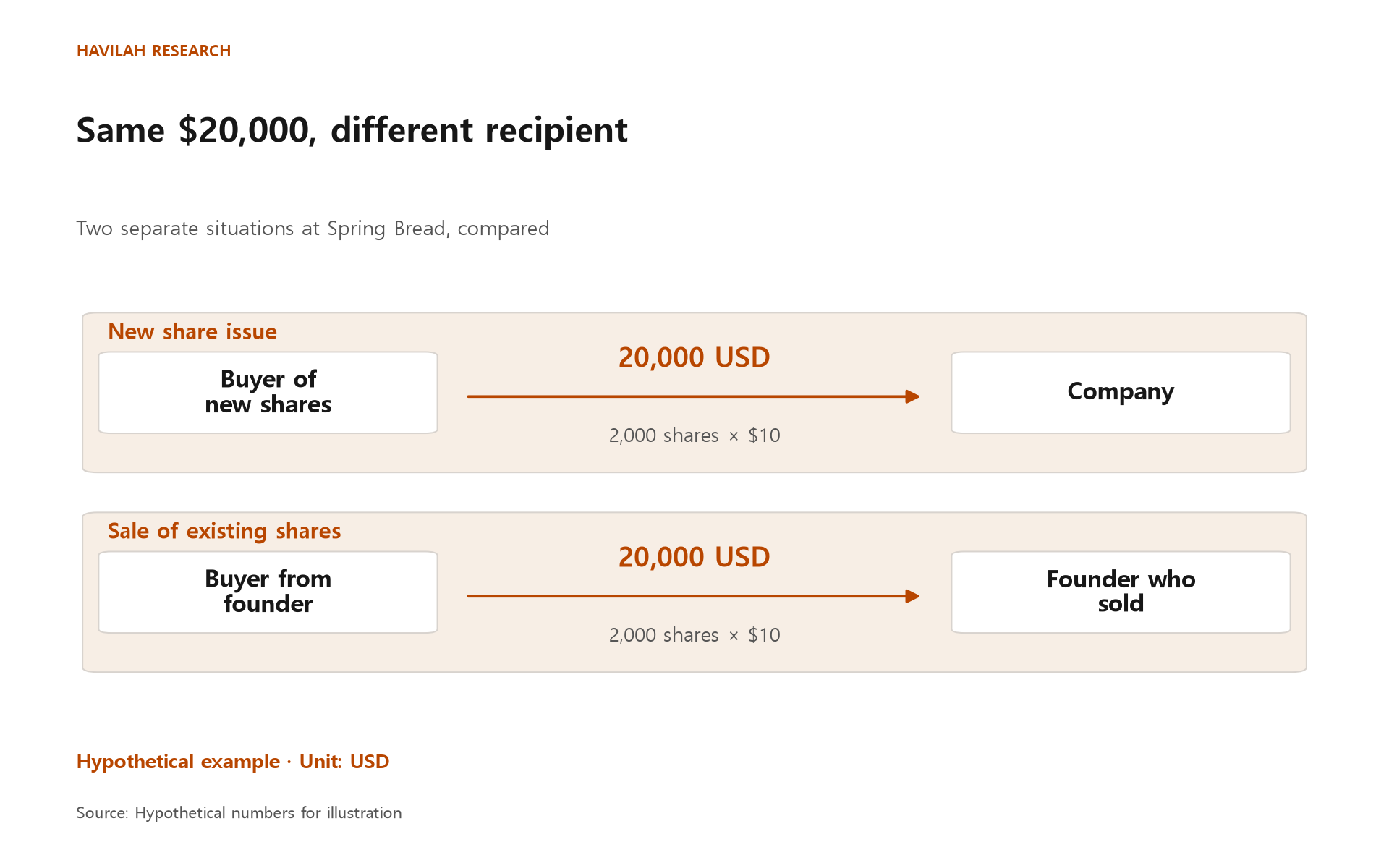
So the mere fact that someone bought this company's shares does not mean the company received new money. You need to check whether they bought new shares issued by the company or shares that another shareholder already held.
For Spring Bread, the difference is large. The new share issue gave it money to buy an oven, but the founder's personal sale of shares on its own does not add anything to the money the company has for buying ovens.
4. How is this different from borrowing from a bank?
When a company borrows from a bank, it usually has to repay the money and pay interest on set terms. The amount originally borrowed is called the principal, and the money paid in return for borrowing it is called interest.
Even if Spring Bread's business does worse than expected, its loan agreement does not simply go away. If it cannot sell enough bread but still has to pay interest and repay the principal, the company can get into deeper trouble.
An ordinary investment in shares, on the other hand, is not a promise to return the principal plus interest on a set date, the way a loan is. The investor becomes a shareholder and shares in whatever results the business produces.
For the company, this is a different kind of burden from borrowing. Instead of repaying a fixed principal with interest, it gives other people an ownership stake and shares with them what it earns if it does well. With more shareholders, it may also need to discuss important decisions with them.
Even so, money raised by selling shares is not free. Part of what the founder could have earned by owning the whole company alone now goes to the new shareholders. The new shareholders, for their part, come in accepting the risk of losing money.
What happens if the bakery buys another oven but no more customers come? It can bake more bread, but if the bread does not sell, profit does not grow. Receiving investment and succeeding in business are two different things.
5. In an IPO, too, check where the money goes
When a company sells its shares to the general public for the first time, this is called an initial public offering (IPO). A company that used to look for a small number of investors offers its shares to a wider range of investors.
In an IPO, the company may issue new shares, and shares held by existing shareholders may also be sold. When the two are mixed, not all of the money from the sale goes to the company.
When Reddit announced its IPO in 2024, for example, the offering included both shares issued by the company and shares sold by existing shareholders. Reddit did not receive the money from the shares sold by existing shareholders. The two bakery transactions above appeared side by side in a real IPO.
A company preparing for an IPO publishes a prospectus, a document that describes its business and the terms of the share sale, among other things. When you read one, do not try to memorize every item at first. Start by looking for these three things.
- Who is selling the shares: the company or existing shareholders?
- How much money goes to the company?
- What does the company plan to spend that money on?
For Spring Bread, you could sum it up like this: "The company issues new shares, receives $20,000 and plans to buy an oven with it." The next thing to look at is whether the new oven can actually lead to more profit.
A company shares out its ownership to get the money its business needs. Investors put in money and, in return, take part in the future of that business. When you see news of a share issue, look not only at how much money was raised but also at who receives it and what it will be used for.
So how do people who buy shares actually make money? We will pick up that story in the next lesson.