
Picture a bakery that is always full of customers. The bread is delicious, and the company keeps opening new shops. Watching this company, you start to wonder:
"This business looks set to do even better. Could I become one of its owners too?"
You can, if you buy its shares. You do not need to buy the whole company. You buy a small piece of it and become one of its many owners.
That does not mean you can walk out with free bread from the day you become a shareholder. Let's start with what buying a stock actually means.
1. One share is a small piece of a company
Stock is the ownership of a company divided into small pieces, called shares. A person who owns shares is called a shareholder.
Imagine a hypothetical company called Good Bread. Its ownership has been divided into 10,000 shares, all on the same terms. If you buy 100 of them, 100 of the 10,000 shares are yours.
A piece of ownership like this is called a stake. Saying "I have a stake in that company" means "I own part of that company."
However, the company's property and the shareholders' property are kept separate. The ovens and the money in the shop's bank account belong to the company. Buying shares does not let you take an oven home or take money out of the company as you please.
What you bought is not bread or ovens. It is the right to own the company together with its other owners.
2. If you buy 100 shares, how much of the company do you own?
Work out what proportion of all the shares your shares make up. This proportion is your ownership percentage.
Let's put in Good Bread's numbers. All of them are hypothetical, made up for this explanation.
| Item | Number of shares |
|---|---|
| All of the company's shares | 10,000 shares |
| Shares you own | 100 shares |
| Shares owned by other people | 9,900 shares |
Dividing your 100 shares by the total of 10,000 shares gives 0.01. Multiplying that by 100 to turn it into a percentage gives 1%.
100 ÷ 10,000 × 100 = 1%
In other words, you own 1% of Good Bread. The other shareholders together own 99%.
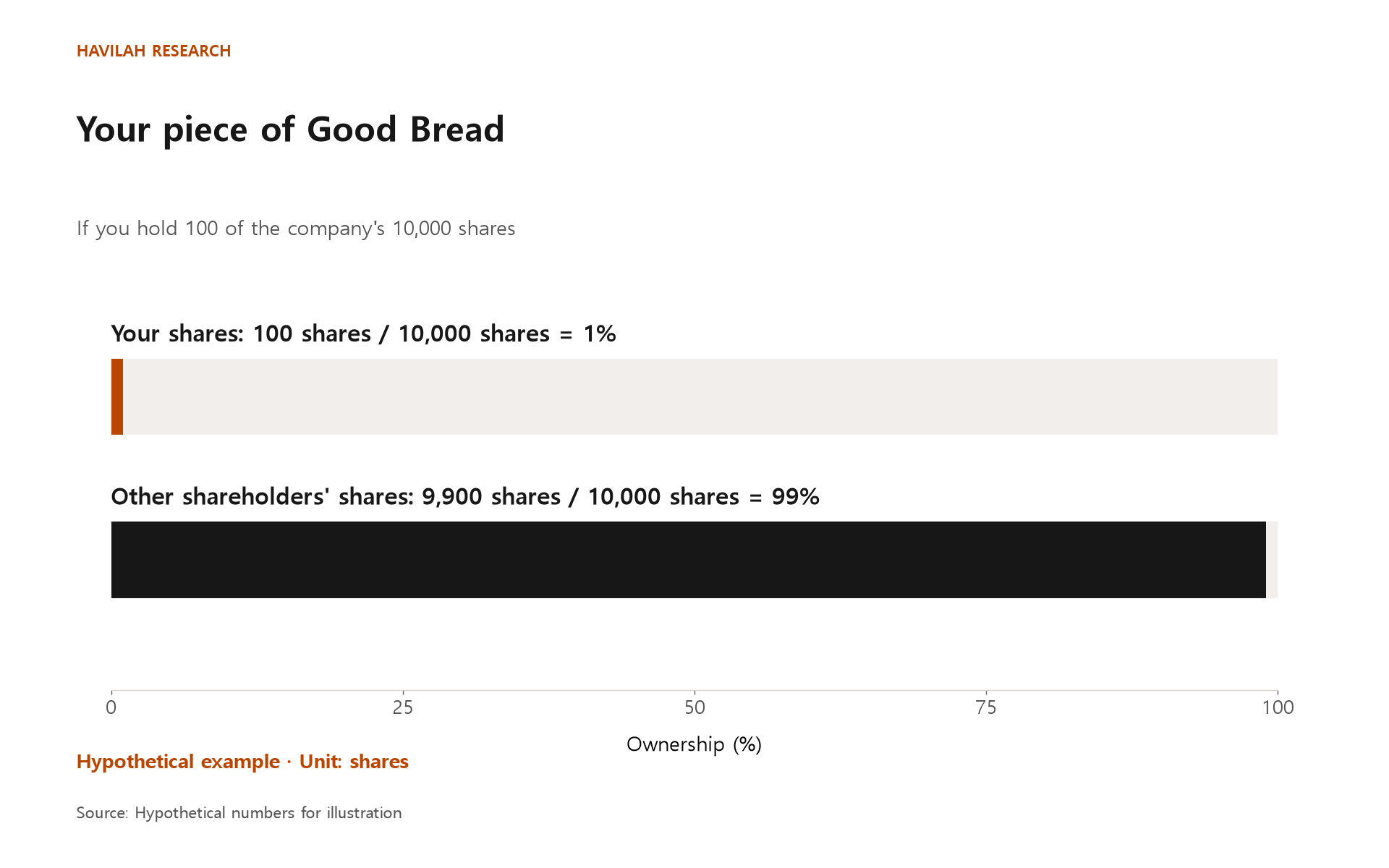
"I bought 100 shares" does not, on its own, tell you whether that is a lot. You also need to know how many shares the company has in total.
The money you need to buy the shares is a separate calculation. If one share costs $5, buying 100 shares costs $500.
$5 × 100 shares = $500
The 1% tells you how big your piece of the company is, and the $500 tells you how much you spent to buy that piece. The two numbers answer different questions. Trading commissions and the cost of converting your money into dollars are left out here.
3. What changes when you become a shareholder?
A company sometimes pays out money to its shareholders. Money you receive this way is called a dividend.
Suppose Good Bread decides to pay a dividend of $0.50 per share. If you hold 100 shares that meet the conditions for receiving it, you get $50 before tax.
$0.50 × 100 shares = $50
But not every company pays dividends. A company may prefer to spend more on opening new shops or developing products. Even when a company makes a profit, money does not automatically arrive in your account.
You may also have a say in the company's important decisions. The meeting where shareholders gather to decide major matters is called a shareholders' meeting. The right to cast votes there is called a voting right.
However, owning a few shares does not let you decide the company's business on your own. Depending on the type of share, the voting rights may differ, or there may be none at all. Being a shareholder is not the same as running the company however you like.
In practice there are several types of shares, but you do not need to memorize them all at the start. Just remember that you should check what rights come with the shares you buy.
4. Can you lose money even though you own part of the company?
Yes. A stock is not a product that promises to give you back the money you put in.
What if Good Bread has fewer customers and starts spending more than it earns from selling bread? Fewer people may then want to buy its shares. Even shares you bought for $500 may later have to be sold for less than that.
If the company closes down altogether, the loss can be even larger. When a company's assets are sold off, the money is not paid to shareholders first. Debts and other amounts that must be paid first are settled, and only if money is left over does any of it go to ordinary shareholders.
If nothing is left over, shareholders may get nothing at all. That is why you should not think, "The company owns buildings and equipment, so my money must be safe."
A share price can fall even when the company has no immediate problem. People may judge the company's future less favorably than before, or the mood of the whole market may turn sour. You need to look at both the expectation that the company will do well and the price you paid for its shares.
Also, owning 1% of a company does not mean your risk is 1%. Your piece of the company may be small, but if you have put most of your money into that one stock, the effect on your life is large.
5. When you first look at a stock, start with the company
On a stock's quote screen, the price and how much it has gone up are shown in large type. So the first question you tend to ask is "What percent is it up today?" But behind that number is a company that actually sells goods or services, pays its costs and tries to make a profit.
To begin, pick one company you are interested in and write down your answers to these three questions.
- What does the company sell to make money?
- Why do customers choose this company instead of another one?
- What could happen that would make its business go badly?
For Good Bread, you might write: "It makes money by selling bread. Customers come for the taste and the convenient location. If ingredient prices rise or a more popular bakery opens nearby, its profit could fall."
It is not an elaborate analysis, but it is enough as a starting point. It is very different from buying on price alone without knowing what the company does. These three lines cannot decide for you whether to buy, but they show you what to look into next.
Buying a stock means owning part of a company and putting your money on that company's future. If it does well, you have a chance to profit, but if your expectations turn out to be wrong, you also bear the loss.
So why would a company give part of its ownership to other people? In the next lesson, we will look at why companies issue shares.