
Even after researching a company for a long time, you may hesitate when it comes to actually placing an order. If you write down in one place what you based the purchase on, up to what price you thought buying was reasonable and what you will do if you are wrong, the missing pieces become clear.
An investment report is not a document full of difficult words written to sound like a professional. It is a record that organizes the business and numbers you understand, your expectations and risks, and your rules for action, so that you could explain them to someone else.
Sum up a hypothetical company on one page
We will use the numbers from the previous lessons, but once again, think of this as a hypothetical company, not a real one. Assume this company provides software to business customers on a subscription basis. Revenue can grow if customers keep using it and new customers sign up, but the estimates can turn out wrong if competitors cut prices or customers leave.
The report could read like this.
| Item | Hypothetical entry |
|---|---|
| Business | Provides software to business customers and charges usage fees. |
| Reason to invest | Revenue may grow if it keeps its customers and keeps adding new ones. |
| Risks to check | Watch for the loss of large customers, price cuts by competitors and rising costs. |
| Starting numbers | Assumes recent annual revenue of $1,000 thousand ($1 million) and first-year growth of 10%. |
| Value estimate | Applying several assumptions gives about $73.13 per share. |
| Current decision | At the hypothetical share price of $100, wait and check the assumptions again. |
The revenue and the company description here are assumptions for learning. They are not facts about any real company. The annual report of a U.S. company, the 10-K, includes the company's financial reporting. In a real report, write down the periods, units and figures you have checked in the company's filings, and leave anything you have not yet checked blank.
Show how the numbers were reached
In Lesson 204, we calculated that if recent revenue of $1,000 thousand grows by 10%, first-year revenue becomes $1,100 thousand. We then estimated the future cash from the business by making assumptions about costs, taxes, equipment spending and so on.
In Lesson 205, we converted that cash and the sale proceeds of the business at the end of year 3 into present value, added the cash held and subtracted debt, and calculated the value of one share at about $73.13. Changing the discount rate from 10% to 12% gave about $69.29. The sale proceeds are hypothetical, not an amount that could actually be received.
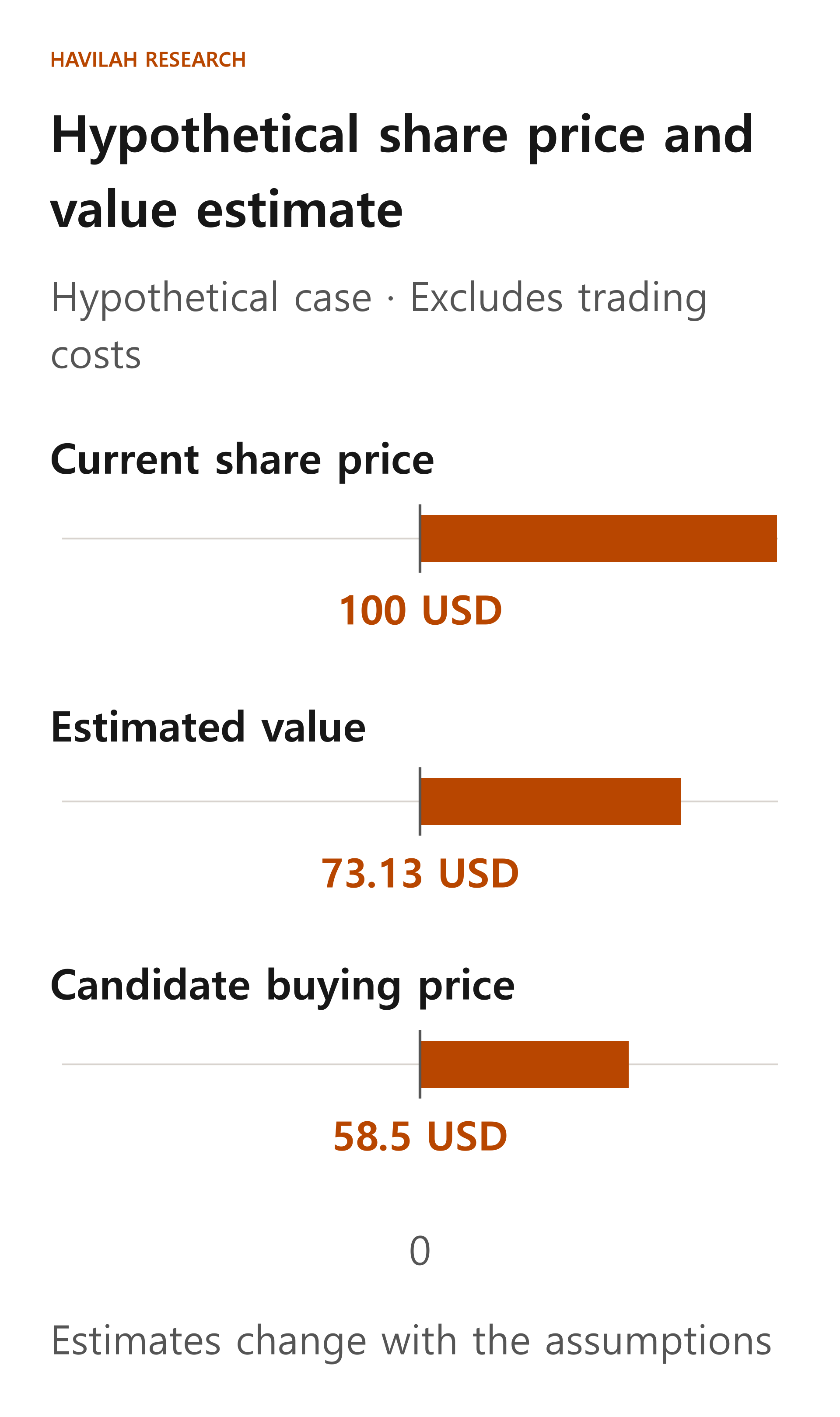
In Lesson 206, we calculated that the candidate price, leaving a 20% cushion below the $73.13 estimate, is about $58.50. Compared with the share price of $100, the gap is about $41.50. Expected trading costs are not included here.
$100 − $58.50 = $41.50
This gap does not turn into a profit on its own. The share price may never fall to the candidate price, and if it does, the reason may be that the company's value has fallen further. If the price reaches the candidate level, check the filings and your assumptions again at that time.
Separate your reasons to buy, wait or pass
In this hypothetical case, we assumed the share price is above the estimated value and there is not enough information about customer losses. So for now, the decision written down is "wait." This does not mean every investor should make the same decision. With a different outlook and different risk standards, the decision can differ too.
If you are considering "buy," write down which price and quantity fit your standards and whether you could bear the risk even after paying the costs. If it is "wait," note what you will check before deciding again. If it is "pass," state clearly why: you do not understand the business, the risk is beyond what you can bear, or the information is insufficient.
Thinking it is a good company does not by itself set a buying price. Conversely, passing on a stock you were interested in does not mean you have concluded that the company's future is bad.
Check the order size and your whole account
Before considering a real trade, look separately at your emergency fund and the money you will need to spend soon. Decide both how much money goes into one stock and how much risk your whole account can bear.
In the separate hypothetical account in Lesson 207, applying both the loss limit and the investment limit gave a maximum of 13 shares. That number came only from the price, exchange rate and fees at that time, and from the assumption of trading whole shares. If the price or conditions change, you need to recalculate. Your order could also be filled far below your stop-loss price.
If you already hold other stocks or ETFs in the same industry, your risks can overlap even if you appear to own many different stocks. Check what your holdings are made up of as well. Diversification does not eliminate losses, but it helps you see which risks your money is concentrated in.
Check before and after your first order
If you are trading for the first time, check on your broker's actual screen the stock and ticker symbol, the buy or sell direction, the quantity, the order type and how long the order stays valid. Check the expected fees and currency conversion terms as well before you place the order. After sending the order, check separately how many shares were filled and unfilled and whether any cancellation was completed.
If you decide not to trade, that is a decision too. You can practice reading order statuses with simulated trades and test your own rules first.
After a trade, record your original reason for investing, the actual fill price and the costs. Also write down what you will look at when the next earnings release comes out or something important changes. Even if the result was good, look back at whether it was luck and whether you kept to the risk you planned; even if the result was bad, look at what you can learn from your decision process.
The final stage of investing is not knowing every answer. It is checking what you do not know, correcting your judgment when the evidence changes, and making decisions within the limits you can bear.