
A company keeps changing after you buy its shares. Its results may turn out better than expected, or an important customer may leave. What matters more than holding on to the view you had when you invested is checking how new facts change that view.
That does not mean you need to trade every time news comes out. First look at what the new information is and how it relates to your original reason for investing.
Write down facts and interpretations separately
Suppose a hypothetical company announces that its quarterly revenue growth has slowed. "Growth slowed" is a fact you can confirm in the filing. "Customers are leaving for good" is an interpretation that needs more evidence.
When you look at a U.S. company's filings, you can check the financial statements, the company's explanations and the risk factors in the quarterly report, the 10-Q. The annual report, the 10-K, contains descriptions of the business, the annual financial statements and the main risks. The forms and filing schedules can differ from company to company.
Start by checking whether the comparison is with the same period last year, whether the numbers are quarterly or annual, and whether the unit is dollars or thousands of dollars. If you record the company's explanation and your own interpretation separately, you can also trace later why your judgment changed.
Put the new assumption into your model
The hypothetical company in Lesson 204 had recent annual revenue of $1,000 thousand, and on the assumption that revenue would grow 10% in the first year, we estimated $1,100 thousand. Because the unit is thousands of dollars, $1,000 thousand is $1 million. Now suppose that, after seeing the new information, you lower the first-year growth assumption to 5%.
$1,000 thousand × 1.05 = $1,050 thousand
That is $50 thousand lower than the original estimate of $1,100 thousand. If the operating margin is assumed to be 10% in both cases, first-year operating income falls from the original $110 thousand to a new estimate of $105 thousand. The margin was left unchanged to make the comparison easy. In reality, prices and costs can change together, so the margin can change too.
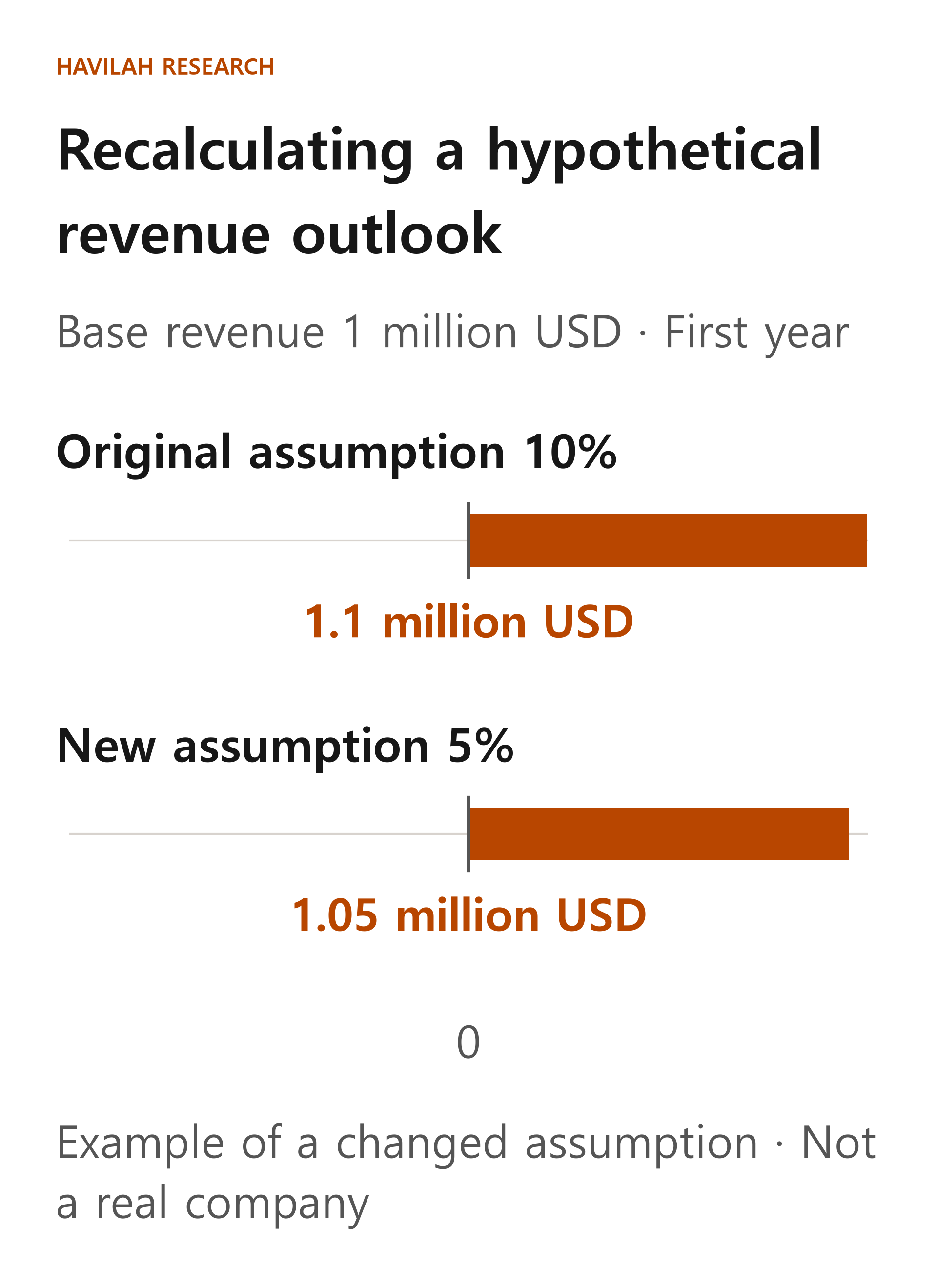
This is a hypothetical revision of the outlook. It does not mean you must change the revenue growth rate to 5% just because a new filing came out. First check why the numbers changed and what supports the change.
How do industry conditions and interest rates affect your assumptions?
Industry conditions are the business environment of the industry a company belongs to. For example, if customers delay investment, orders can fall, and if competitors increase supply, selling prices can drop. How much this affects a particular company depends on its products and contract terms, so do not jump to conclusions about its results from industry news alone.
When interest rates change, a company's cost of funding and the return investors require can change. But a 1 percentage point rise in the central bank's policy rate does not mean you raise every company's discount rate by exactly 1 percentage point. You also need to review the company's debt terms, its risks and your other assumptions.
In Lesson 205, in a hypothetical calculation that held the other assumptions fixed and changed the discount rate from 10% to 12%, the estimated value of one share fell from about $73.13 to about $69.29. This difference only shows how sensitive the calculation is; it is not a precise forecast of the share price following an actual change in interest rates.
Look again at the price and the size of your holding
If you revised your outlook, recalculate the future cash and the estimated value under the new assumptions and compare them with the current share price. If the share price has already fallen a lot, the bad news may be reflected in the price to some extent, but you cannot know for sure how much.
If the business outlook has worsened but the price has not moved, the balance between expected return and risk may have changed. Conversely, even if the outlook has improved, the share price may have risen even more and become expensive. Also check what share of your whole account the stock makes up, and whether your other holdings are exposed to similar risks.
Your decision does not have to be buy or sell. You can keep holding if your reasons still stand, adjust the weight if the risk has grown, or check further or wait if you do not understand enough yet. Which choice is right depends on your investment goals and how much risk you can bear.
Keep a record you can look back on
In your investment notes, record "what facts you checked, which of your earlier assumptions you changed and what you still do not know." For example, write them down separately like this: "Quarterly revenue growth slowed. I lowered the first-year growth assumption from 10% to 5%. In the next filing, I will check whether the customer losses are temporary."
It is important not to defend your original view just because the price has fallen, and, on the other hand, not to read every decline as a failure of the business. In the next lesson, we will bring all the analysis and trading plans so far together in a one-page investment report.