
In the previous lesson, you learned that past performance can look good if you pick only the companies that survived. This time, we will look at the order in which things happen. What goes wrong if you check good earnings after they are announced, and then calculate as if you had bought at the cheaper price from before the announcement?
The date on a report is not the date you learned it
Companies add up their revenue and profit for a set period and then announce them. For example, results for January to March cover a period that ends on March 31, but that does not mean investors already know the final results on that day. It takes time to put the figures together and release them.
The error of assuming you already knew information that had not been made public at the time is called look-ahead bias, or letting the future leak into the test. It is an important issue when you check whether a strategy could actually have been carried out as described in the past.
The following is a hypothetical case, not a real company or real prices. Assume the company announced its results after the regular trading session ended; all times below are U.S. Eastern Time (ET). For many U.S. markets, the regular trading session runs from 9:30 a.m. to 4 p.m. ET.
| Time | What happens in the hypothetical case |
|---|---|
| March 31 | The period covered by the results ends |
| April 25, 4 p.m. ET | Regular session closes; share price $100 |
| April 25, 4:15 p.m. ET | The company announces good results |
| Next trading day's opening price | $120 |
| Later selling price | $126 |
The $100 at 4 p.m. on April 25 is the price before the announcement. If your decision was based on results announced at 4:15 p.m., you cannot count it as a purchase at the regular-session closing price, which had already passed. Trading after the close is sometimes possible, but the times and prices at which you can actually place orders depend on your broker and on market conditions.
One starting price changes the return
To keep the calculation simple, we will buy one share and sell one share, and leave out commissions and taxes.
If you wrongly assume you knew the results, and buy at $100 before the announcement and sell at $126, you get the following.
(126 - 100) ÷ 100 × 100 = 26%.
If you assume you could buy at the next trading day's opening price of $120 after checking the results, and sell at $126, you get the following.
(126 - 120) ÷ 120 × 100 = 5%.
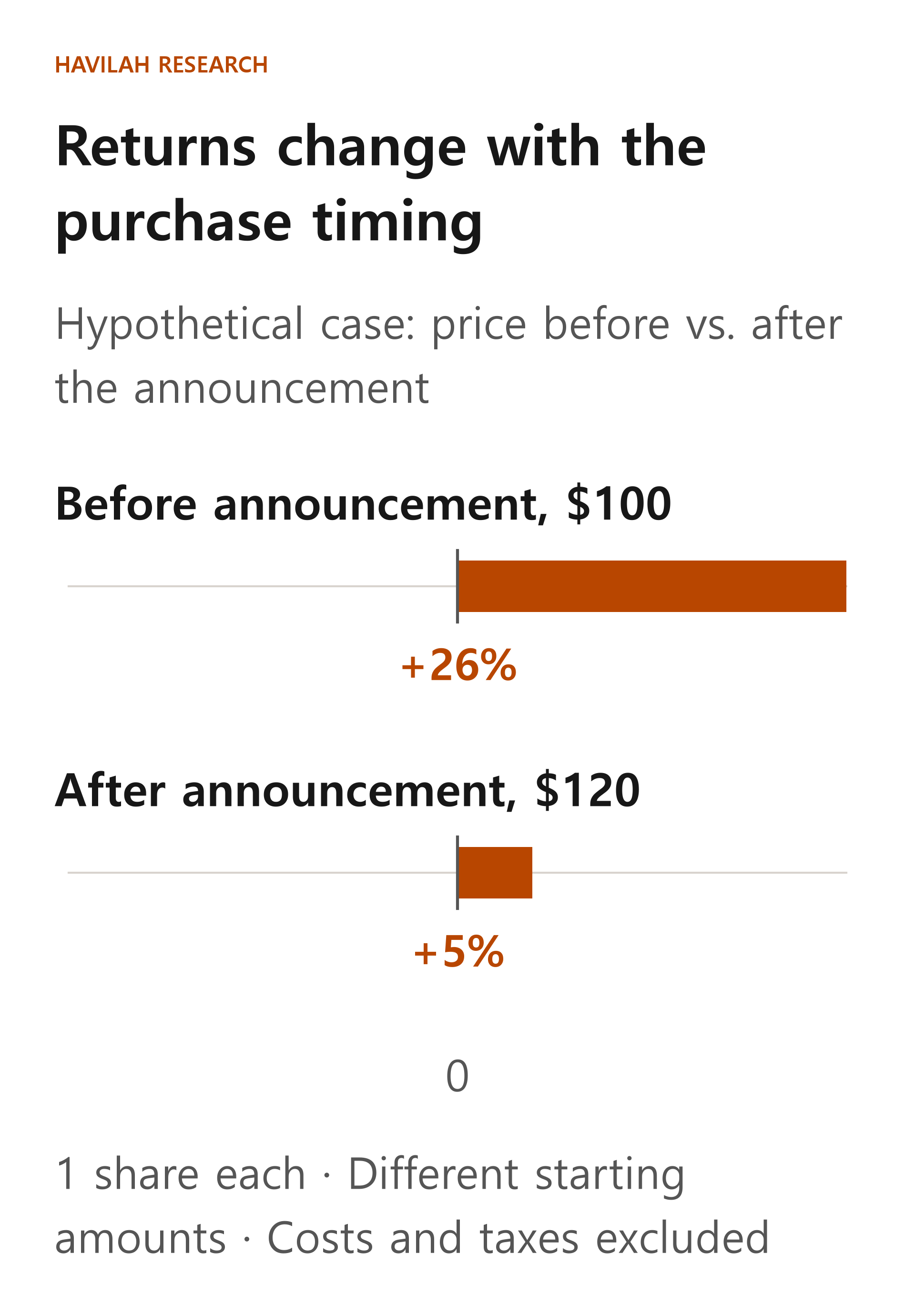
Both returns are based on the same single share, but the money needed at the start is different: $100 in one case and $120 in the other. Being able to buy at $120 is itself an assumption for illustration. In reality, your order might not be filled at that price because of the order type, price swings, trading volume and the gap between the bid and ask prices.
This case does not mean the price gap is always this large. The share price can also fall after an earnings release. What matters is that, before you calculate any result, you line up the time when you could have seen the information with the time when you could have placed an order.
The timing that a data table hides
A table of financial data usually shows the last day of the quarter that the results belong to. If you mistakenly use this date as the date the information became public, you may end up using numbers that were announced only at the end of April for a purchase at the end of March.
There are at least three dates to check: the period the results cover, when they were made public, and when they appeared in the data you use. The time a filing came out and the time a data provider added it can differ. If the data was corrected later, the numbers you see today can also differ from the numbers published at the time.
For example, if revenue was first reported as 100 and later corrected to 90, then when you recreate a decision made at the time of the announcement, you must not assume you knew the 90 from the start. On the other hand, for a decision made after the correction, you need to take into account the correction and when it was made. The 100 and 90 are hypothetical numbers for illustration.
With stock splits, check the price record too
Consider a 2-for-1 stock split, which divides each share into two. Suppose a hypothetical share price is $100 just before the split and $50 just after, with no other price change in between. One share becomes two, so the value of your holding stays the same: $100 before and $100 after. The split by itself has not cut your wealth in half.
If you use adjusted prices, where past prices are restated on an after-split basis, the pre-split price in this example may be shown as $50. If you apply both the split-adjusted price and the larger number of shares from the split, you count the split twice and can calculate the return incorrectly. Each data provider adjusts prices in its own way, so also check whether dividends are included in the adjustment.
Adjusted prices are not wrong in themselves. Comparing the ratios of prices that were adjusted in a consistent way helps remove the break caused by a split. But if a rule selects stocks by whether the actual share price was below $50 at a certain point in the past, be careful not to use prices that were changed later to reflect a split. Keep them apart from the prices at which the stock actually traded at the time.
What to check in practice, in order
When you look at a strategy's past performance, first find out what information it is said to have used to buy. Next, check when that information was made public and when it appeared in the data, and only then work out when an order could actually have been placed and at what price. Do not assume that the last day of the results period is the same as the announcement date.
For price data, check whether it is the regular-session close or an extended-hours price, and how splits and dividends were reflected. Even with the same strategy, the results can change if the timing of the information and the assumptions about execution change.
Here is one question to check your understanding. If a strategy that buys on results announced after the close was calculated as buying at that day's regular-session closing price, what is the problem? The announcement came after the close, so you cannot treat the trade as buying at that price with knowledge of the results. To assume a trade after the announcement, you need to work out again when an order could actually have been placed and the price at which it would have been filled.
In the next lesson, we will look at whether rules that fit past records closely also work in a new period.