
Suppose you hear that a company has won an order for large factory equipment. That is welcome news for investors, but the company does not receive all the money on the day it gets the order. It can take time to build the equipment, deliver it and collect payment from the customer.
For manufacturers with long production times in particular, there is a long gap between an order and the results. Investors need to look not only at the size of an order but also at when, and after what costs, that order will turn into profit and cash.
Orders are not revenue
Winning an order means a customer has asked the company to supply goods or services. The backlog is the part of the orders already received that has not yet been fulfilled. Like the queue of order tickets in a restaurant kitchen, it shows how much work is left to do. However, real contracts can be changed or canceled, and companies differ in which orders they count in their backlog.
Suppose a hypothetical factory had a backlog of $200 million at the start of this year. During the year, it received $100 million of new orders and fulfilled $80 million of existing orders, which it recorded as revenue. Assume that $20 million of orders were canceled in the same period and that nothing else changed.
The year-end backlog is $200 million + $100 million − $80 million − $20 million = $200 million. There were plenty of new orders, but once you subtract the orders that turned into revenue and the canceled orders, the backlog is the same as at the start. All the numbers are a hypothetical example for illustration.
In real contracts, the timing of revenue can differ. Some contracts record revenue when the goods are delivered and the customer receives them. Others, depending on the contract terms and the accounting standards, record revenue while the work is in progress. You need to check which method applies.
Does a large backlog mean revenue rises right away?
Even when many orders remain, delivering them can take several years. If parts supplies are delayed or customers change their schedules, the expected timing of revenue changes too. A backlog does not mean this year's revenue.
In its report at the end of 2025, Boeing explained that there is significant uncertainty about when its remaining orders will turn into revenue. RTX stated that its backlog excludes contract options that have not yet been exercised and potential orders that may arise under contracts where the customer places orders as needed. These two cases show that you need to read what each company's backlog contains and when it is likely to be converted.
When you read a company's report, check together, where possible, the new orders received, the amount converted to revenue, cancellations and changes, and the remaining backlog. The backlog amount can also change because of exchange rates or because the company bought or sold a business. If you cannot tell why the backlog increased, do not automatically read it as a rise in orders.
A busy factory does not necessarily mean higher profit
The utilization rate is the ratio of how much a factory actually produced to how much it is able to produce. If a hypothetical factory that can make 100 units of the same product a month under normal conditions made 75, its simple utilization rate is 75 ÷ 100 × 100 = 75%. Companies can differ in how they define and measure production capacity.
Some of the costs of running a factory do not easily fall when output falls. The costs of machinery and buildings are typical examples. When output rises, these costs are spread over more products, so the cost per product can fall.
But running a factory too hard can increase overtime, repairs, defects and logistics costs. If order prices are low or raw material prices rise, profit can fall even when utilization is high. That is why you need to look at the utilization rate and margins together.
If the hypothetical factory above recorded revenue of $80 million and costs of $65 million in a year, its gross profit was $15 million. With everything else the same, if costs come in $10 million higher than expected, profit falls to $5 million. These numbers are before selling, general and administrative expenses, interest, taxes and other items are subtracted. Some real contracts include terms for sharing the burden of cost changes with the customer, so check what the contract says.
A company can run short of cash even when it makes a profit
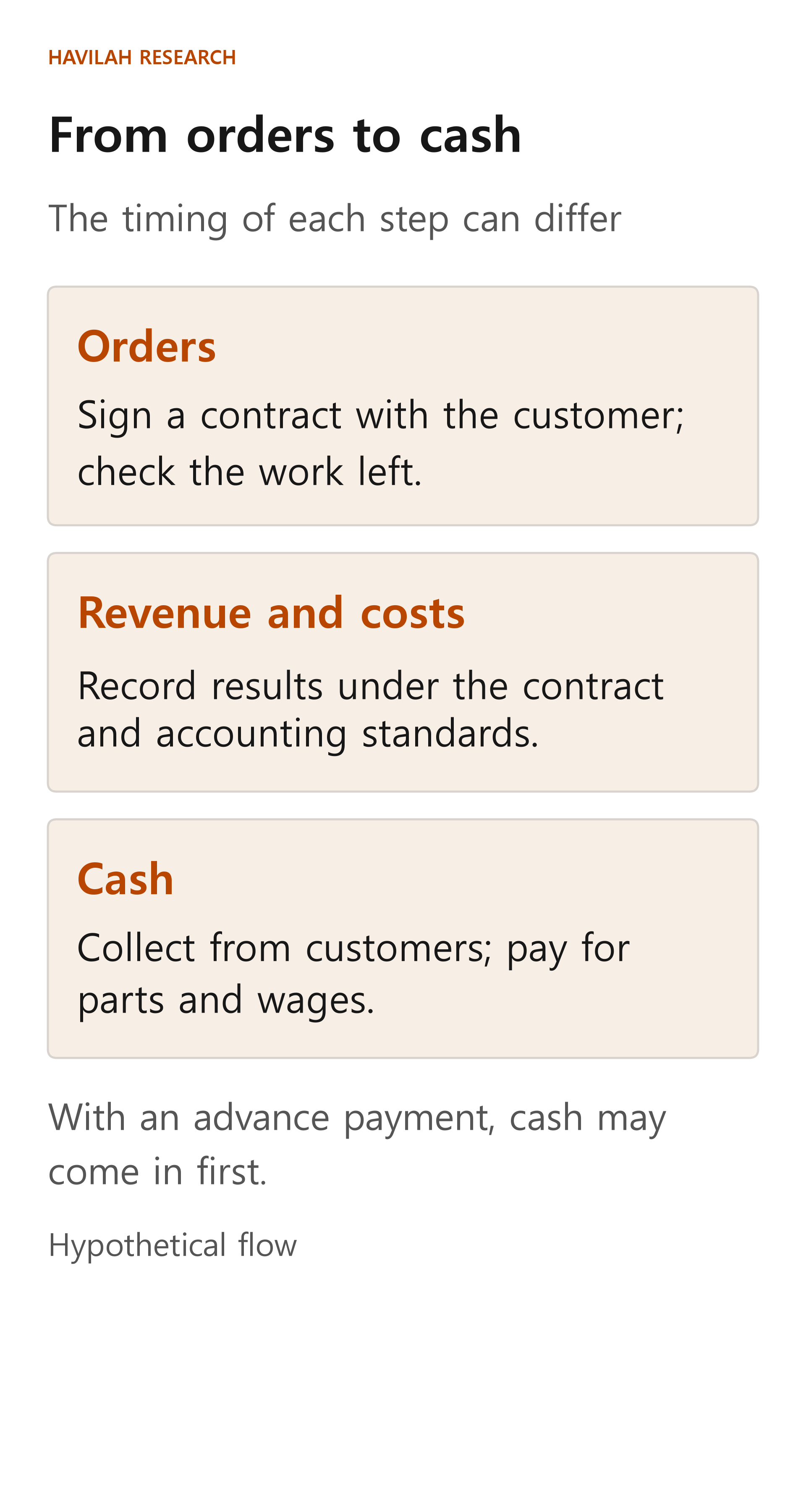
To make its products, a company may have to pay for parts and wages first. Customers, on the other hand, sometimes pay in advance and sometimes pay after delivery. So the time when revenue or profit is recorded and the time when cash changes hands can differ.
In the hypothetical example above, suppose the company received $20 million in cash from customers that year and actually paid out $65 million in cash for product costs. If you simplify by assuming no other cash inflows or outflows, its cash falls by $45 million. This example looks at the cash flow for that year. It does not show the final profit or loss when the contract ends.
In real analysis, look together at the money customers owe the company, the money it has received in advance from customers, and the funds it needs for inventory and operations. Even when revenue rises, the immediate funding burden can grow if payments come in late or parts have to be bought first.
Did end customers buy as much as the company sold?
When a manufacturer hands goods over to a dealer, that does not mean they have also been sold to end customers right away. If dealers order to refill their stock, the manufacturer's revenue can rise. Later, once dealers have enough stock, they may cut new orders even if end-customer demand holds steady.
For example, if a dealer starts with no goods in stock, the manufacturer supplies 100 units, and the dealer sells 70 units to end customers, 30 units are left. This calculation assumes no returns or other movements. The 100 units the manufacturer sold and the 70 units end customers bought are different numbers.
In its 2025 report, Caterpillar explained that if inventory held by independent dealers and others is higher than they want, they may put off purchases. Conversely, if inventory is too low, they may not be able to sell when customers want to buy. A rise in inventory can also be part of getting supply ready, so do not decide whether it is good or bad from a single number.
Applying this to real companies
| Company | What to look at in the business | Question for investors |
|---|---|---|
| Boeing | Remaining orders for aircraft and related products | When will they be delivered to customers and recorded as revenue? |
| RTX | Contracts for aerospace and defense products and services | Which contracts are in the remaining orders, and when will they be fulfilled? |
| Caterpillar | Equipment sales and dealer inventory | Are the manufacturer's sales and end-customer demand moving in the same direction? |
This table compares business structures as described in each company's 2025 report. It is not an investment recommendation or an assessment of current results. Even under the same name, a backlog can differ in scope and contract length, so do not judge which company is better just by putting the numbers side by side.
When you look at a company, check in order how long the remaining orders will take to fulfill, who bears the cost if costs rise, and when the cash it needs will go out. Add inventory and end demand to this, and you can judge more calmly how likely it is that more orders will lead to real profit.