
A company's earnings per share came in above analysts' estimates, yet its share price fell. The earnings release looked good, so why does this happen?
A share price is shaped not only by the profit reported for one quarter but also by expectations about the money the company will earn in the future and by the price investors are willing to pay. You need to look at why the result beat the estimate and at the outlook together.
Start with what is behind the earnings beat
Earnings per share is a company's profit expressed per share, abbreviated as EPS. For a hypothetical company, the EPS estimate for this quarter is $1.00, and reported EPS is $1.10. Assuming the same period and the same calculation basis, actual earnings are $0.10 higher than expected. As a percentage, that is (1.10 − 1.00) ÷ 1.00 × 100, or 10% higher.
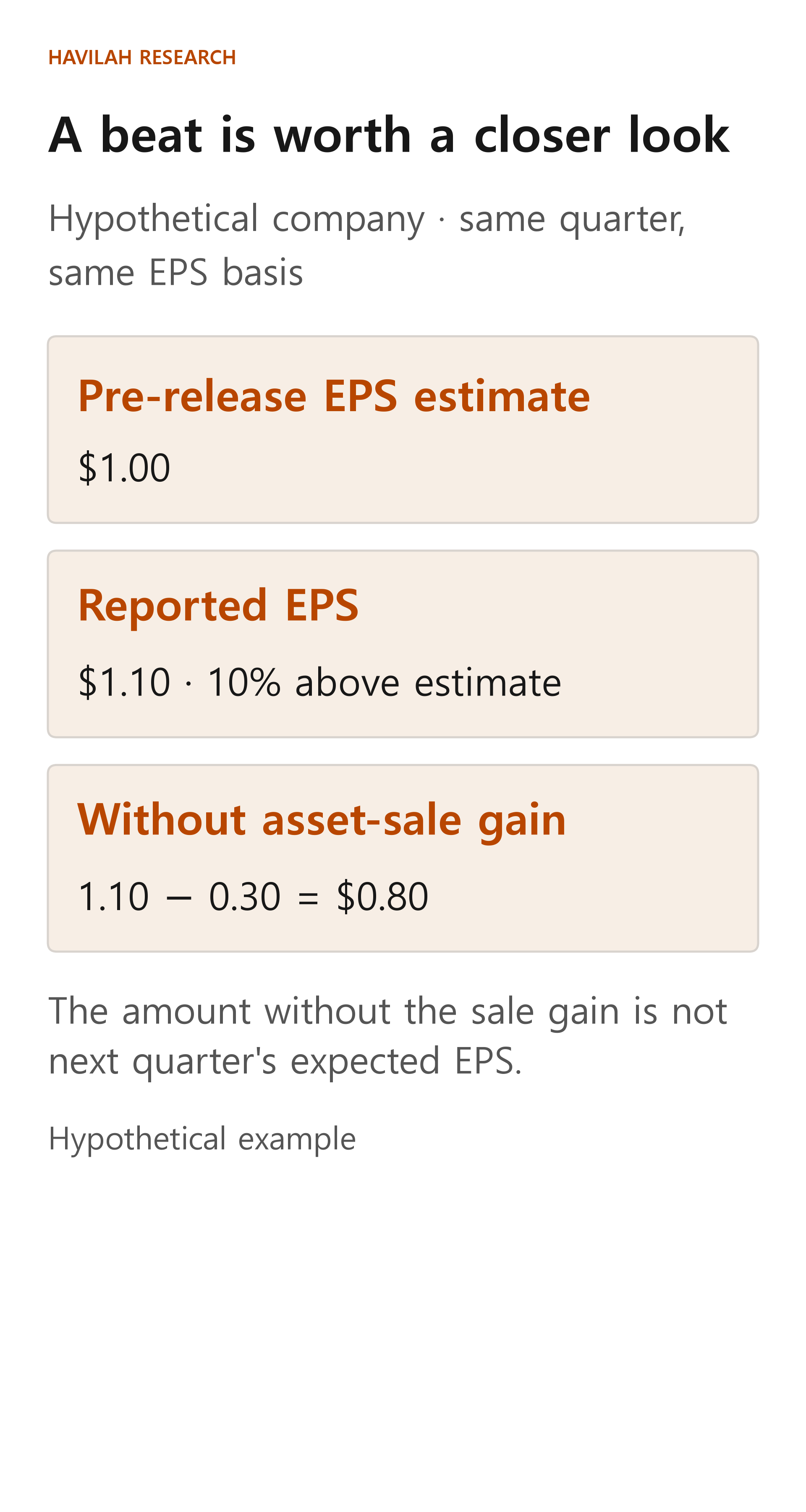
Now suppose that $0.30 per share of this $1.10 is an after-tax gain from selling an asset. Assuming the number of shares and everything else stay the same, removing only that item leaves 1.10 − 0.30, or $0.80 per share.
A gain on an asset sale can be a real profit. Whether the same gain will repeat every quarter, however, is a separate question. The $0.80 left after the exclusion is not next quarter's expected earnings either, because the income the sold asset would have produced, and other costs, can also change.
The quarter is over, but the outlook can change
Even if this quarter's results were better than expected, the company may lower its revenue outlook for the next period. For example, if a hypothetical company changed its revenue outlook for next year from $120 to $108, the difference is $12, and the outlook is 12 ÷ 120 × 100, or 10%, lower than before.
Next year's revenue outlook is an amount that has not been earned yet. It does not mean actual revenue will definitely be $108. In the earnings materials, also check whether the outlook changed because of fewer orders, exchange rates or the sale of a business.
The fact that results beat expectations while the outlook was lowered is not enough to conclude that the share price must fall. The reaction can also depend on how far the market had already expected that change and on what other information came out.
What expectations were already in the share price?
One way to compare a stock's price with its earnings is the price-to-earnings ratio, or P/E. It is the share price divided by earnings per share for the same basis and period. For example, if the share price is $20 and EPS over the past year was $1, the P/E is 20x.
You cannot tell from that single number whether 20x is high or low. You need to look at how much future growth investors expect, what risks they take on to earn that profit and what similar companies' businesses look like, among other things.
If a company's share price already assumed fast growth, some investors may decide that results only slightly above the estimate do not fully support that expectation. Individual analysts' estimates can also differ from the consensus average. You cannot observe the expectations built into a share price precisely as a single number, and different investors can reach different judgments from the same earnings release.
What to check in the release, in order
First, check that the estimated and actual EPS cover the same period and use the same currency and accounting basis. If it is an adjusted EPS that the company presents separately, also look at which items were excluded. Then check why revenue and profit changed and whether there was any one-time gain.
Next, read the outlook the company gave and the reasons behind it. Also look at the expectations that may already be priced in, the relationship between the share price and earnings, and the company's debt and cash. It is better not to assume that the share price move right after an earnings release can be explained by a single reason.
A result above the estimate is an important starting point. If you go one step further and look at where the profit came from and what could change from here, you will understand better what the numbers mean.