
A company earned more than it did a year earlier, yet its share price fell after the earnings release. Another company's profits shrank, yet its share price rose. Why does this happen?
Investors estimate future results and buy and sell shares even before a company reports. So it is not enough to ask how far the reported results differ from last year. You also need to look at what people expected.
What is an estimate?
People who analyze companies, at brokers and other firms, estimate a company's future revenue and profits. A representative figure built from the estimates of several analysts is called the consensus estimate. Each data provider may differ in which analysts it includes, when it collects the estimates and how it calculates the figure.
The consensus estimate is not a number that shows exactly what every investor thinks. Even among analysts, some forecasts can be far more optimistic or pessimistic than the average, and different investors look at different information. Still, it can be a useful benchmark when you compare the actual results with the estimates made before the release.
Better than last year can still be below expectations
Earnings per share (EPS) is a company's profit expressed per share. Suppose a hypothetical company earned $0.80 per share in the same quarter last year, and analysts' estimate for the same quarter this year was $1.00. The actual EPS the company reports is $0.90. Assume that all three numbers are calculated on the same basis.
Compared with last year, EPS rose by (0.90 − 0.80) ÷ 0.80 × 100, or 12.5%. Compared with the estimate, however, it works out as (0.90 − 1.00) ÷ 1.00 × 100, which is 10% lower. The same result looks different depending on what you compare it with.
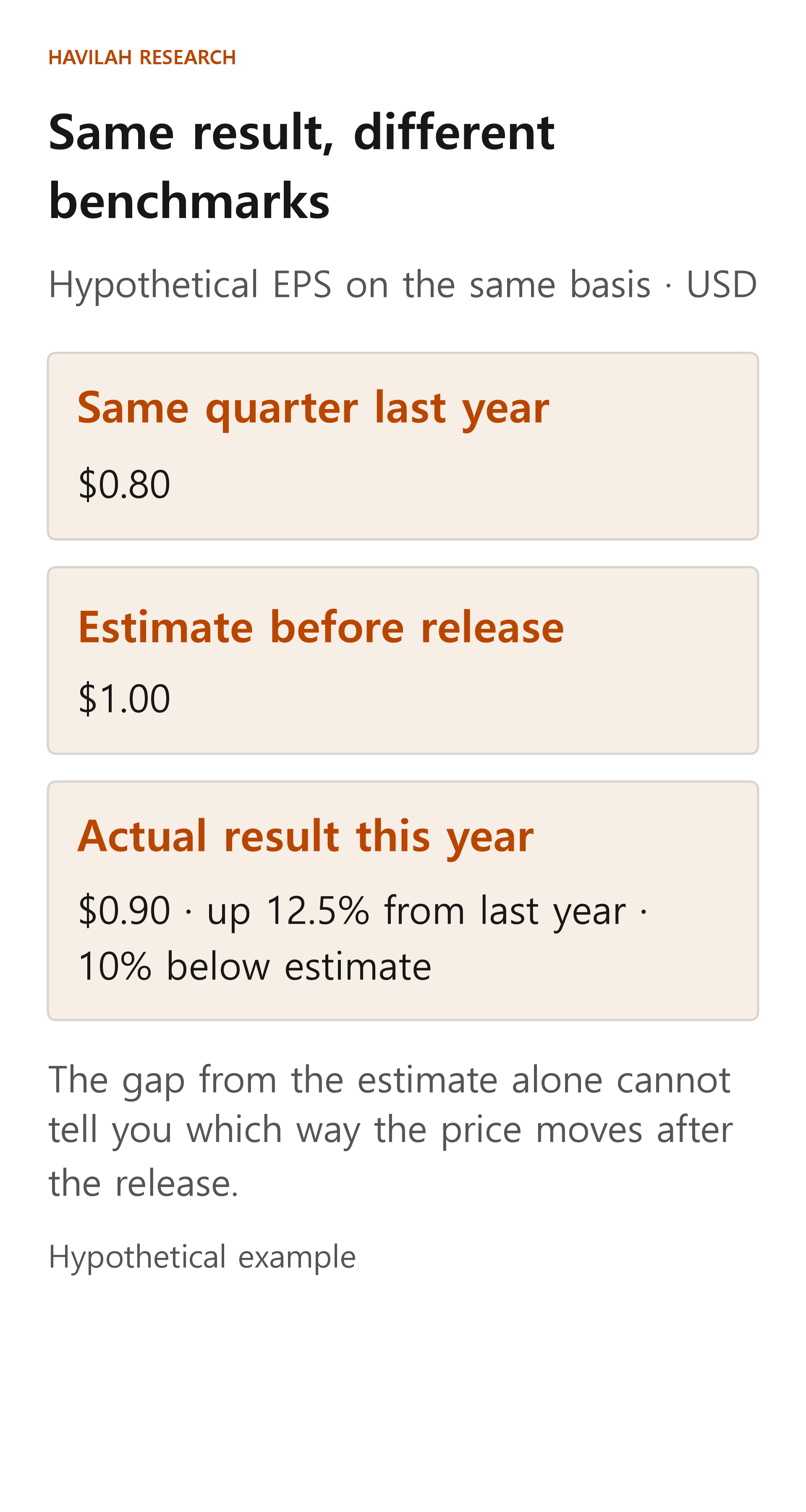
A result above the estimate is sometimes called an earnings beat or a positive surprise, and a result below it an earnings miss. These terms are just a short way of describing the comparison. They are not a promise that the share price will rise or fall right after the release.
Also check what the company says about what comes next
The outlook a company gives for its future revenue or profits is called guidance. The results for the quarter just reported describe a period that is already over, while guidance is the company's own expectation for the business ahead.
For example, even if this quarter's results beat estimates, the company may lower its outlook because it is worried that demand will slow next quarter. Conversely, even if this quarter's results fell short of expectations, the company may share positive information about future orders or profitability. Either way, you cannot know in advance how the market will react.
Guidance is not a confirmed result. Broadcom, for example, stated in an earnings release that the outlook it gave was an estimate as of the time of the release and that actual results could differ materially. Companies also differ in which items they give guidance for and over what period.
Are you comparing the same numbers?
EPS, too, can be calculated on different bases. If you mix the figure prepared under accounting standards with an adjusted figure that the company presents separately after excluding certain costs, it is hard to tell whether the result really beat the estimate. Check that you are comparing the same period, the same currency and the same calculation basis.
When you look at an adjusted figure, it also matters what was left out. For example, if stock-based compensation or acquisition-related costs were excluded, you should also look at the original figure that includes those costs. If the estimate is 0, you cannot calculate a percentage difference that uses the estimate as the denominator. If the estimate is negative, the percentage is hard to interpret, so it is better to check the amount of the difference and the basis of the calculation separately.
The order for reading an earnings release
First, check when the pre-release estimate was compiled and on what basis the actual results are being compared. Next, look at why revenue, margins and cash flow changed. It also matters whether exchange rates or one-time transactions affected the numbers.
Finally, read the company's outlook and the risks investors focused on. The fact that a company delivered good results is different from the expectation that it will keep doing as well. The gap between the results and the estimate is a starting clue for your investment decision. A single number is not enough reason to buy or sell.