
A company announces that both its revenue and its net income rose from last year. That is welcome news, but as an investor you need to ask one more question. Where did that profit come from, and can it continue?
An unusual change in the numbers does not by itself mean there is a problem. Treat it first as a clue that tells you to look for the reason.
Revenue rose, but when does the money come in?
A company sometimes sells goods or provides a service and receives the money later. Money it is owed in this way is called accounts receivable. The time when revenue is recorded in the accounts and the time when cash is received from customers can be different.
Suppose a hypothetical company produced the following results last year and this year. Revenue is the amount for each 1-year period, and accounts receivable is the amount not yet collected at the end of each year. All amounts are in dollars.
| Item | Last year | This year | Change |
|---|---|---|---|
| Annual revenue | 100 | 120 | Up 20% |
| Accounts receivable at year-end | 20 | 40 | Up 100% |
Revenue growth is (120 − 100) ÷ 100 × 100 = 20%. Growth in accounts receivable is (40 − 20) ÷ 20 × 100 = 100%. The company sold more, but the money it had not yet collected at year-end grew even faster.
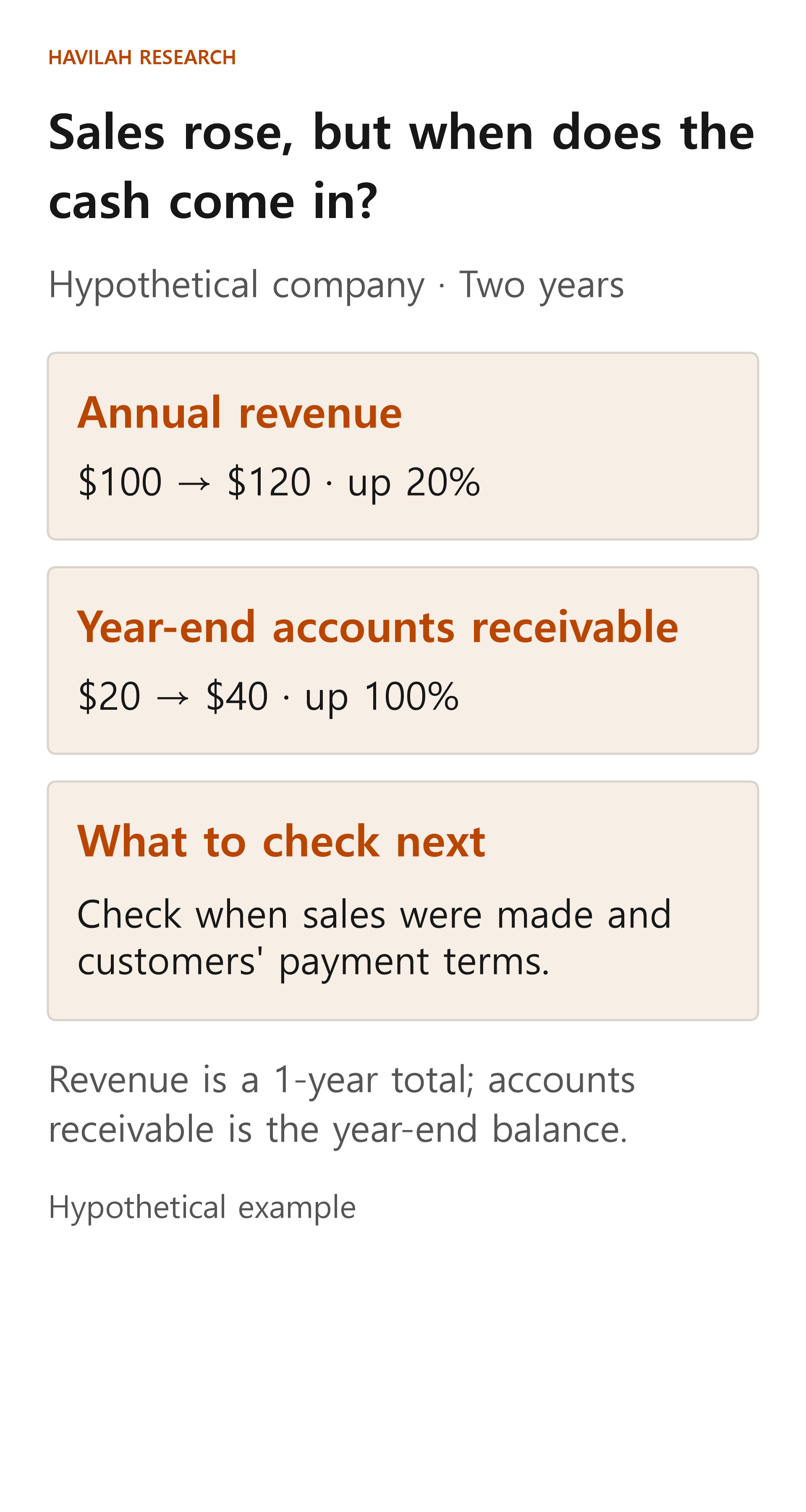
This alone does not tell you that customers cannot pay or that the company recorded its revenue wrongly. Sales may have been concentrated at the end of the year, or the company may have given customers longer to pay. Revenue is a total for the whole year, while accounts receivable is the balance on a single day at year-end, so the gap between the two growth rates does not directly measure how much the company failed to collect.
In the filings, look at whether the terms of sale changed, and whether old unpaid amounts or amounts the company expects it will not be able to collect have grown. It also helps to check whether the money was actually received in the following quarters.
Also look at why inventory is building up
Inventory is the products a company holds to sell in the future, or the materials it needs to make them. A company may build up inventory to prepare for higher sales. On the other hand, inventory may have piled up because products did not sell as well as expected.
Check not only how much inventory rose but also how it moved compared with revenue, and whether the company recorded an expense because it judged that the inventory had lost value. A single increase in inventory is not enough to conclude that sales are weak. Look at the company's explanation and at the changes in the next period as well.
Will this profit happen again?
Net income can include not only the results of the core business but also gains and losses that happened once, such as from selling an asset. That is why you need to check in the filings what transactions took place.
Suppose a hypothetical company's net income this year was $100, and this included a $40 gain from selling an asset, after tax. If you keep everything else the same and take out only this one item, 100 − 40 = $60 is left. This shows that you should not assume all of this year's $100 will come back next year.
But this $60 is not next year's expected net income. Other revenue and costs can change too, and once the asset has been sold, the income the company used to earn from that asset can also change. When you take out an item, also check whether tax has been accounted for and which other costs and income change along with it.
Pay given in shares is also an expense
Compensation that gives employees shares, or the right to receive shares, on top of their cash salaries is called stock-based compensation. Even if the same amount of cash does not leave the company right away, it is still pay given to employees. If a company leaves this expense out of the adjusted profit it presents, compare that figure with the profit before the expense was excluded.
When new shares are actually issued, the percentage of the company that existing shareholders own can shrink. However, not every award necessarily leads to new shares being issued at the same time. Check the terms of the awards and the actual change in the number of shares in the filings.
After you find an unusual number
Accounts receivable, inventory, one-time gains and stock-based compensation each raise a different question. Is the company collecting the money for its sales? Are its products selling well? Can its profit recur? What is changing in the shareholders' share of the company?
Look at revenue and net income on the income statement, check accounts receivable and inventory on the balance sheet, and then also look at the cash that actually came in and went out through operating activities on the cash flow statement. If you cannot find the reason for a mismatch in the filings, do not rush to a conclusion. Simply keep it as a question to check further.