
A neighborhood shop sells its goods and makes a profit. But if its customers have agreed to pay next month, the money has not reached the shop's bank account yet. If the rent is due right now, the shop can be short of cash even though it made a profit.
Companies work the same way. Profit and cash answer different questions. Profit shows how much a business earned over a period, while cash shows the money that actually came in and went out.
Making a sale does not mean the money arrives right away
If a company hands goods to a customer and agrees to be paid later, the money it has not received yet is called accounts receivable. Even after a sale has been recorded as revenue, the payment may come in later.
At the same time, the company may already have spent money preparing those goods and paying its employees. In that case, even if sales grow and produce a profit, cash falls when more money goes out than comes in.
An increase in accounts receivable does not by itself mean that customers are paying late or that the company is in trouble. The balance can also grow simply because sales increased or because the timing of transactions shifted. You need to look at how much is actually being collected and at the payment terms as well.
Turning profit into cash: a worked calculation
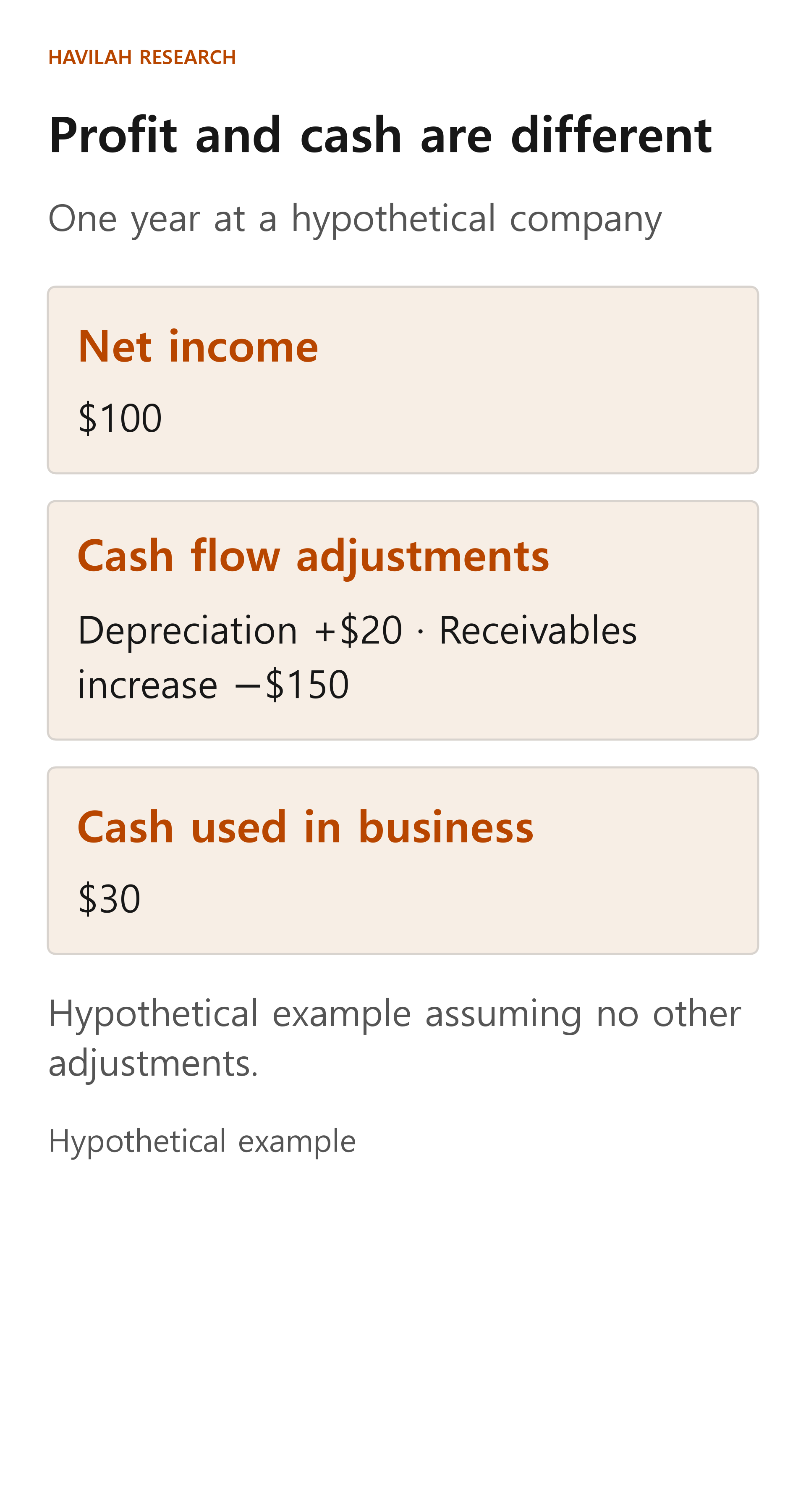
Below is a hypothetical example to make the idea easier to follow. Over one year, a company records net income of $100. Net income is the profit left after costs, taxes and other items are taken out of revenue.
The indirect method, one way of preparing a cash flow statement, starts from net income. It then adjusts for expenses that involved no movement of cash and for changes in the assets and liabilities the business needs to operate. Here we look at just two of those items.
The company's accounts receivable rose by $150 during the year. In this example, assume this increase is the part of the period's sales that has not been collected yet. Assume also that depreciation of $20 was recorded as an expense when net income was calculated.
Depreciation spreads the cost of equipment bought earlier over the years in which it is used. No new cash went out in this period for that cost, so when you calculate cash flow, you add back the amount that was already subtracted from profit. It does not mean that new money came in.
If you assume, for simplicity, that there are no other adjustments, the cash from the company's business activities works out as follows.
| Hypothetical year | Amount |
|---|---|
| Net income | $100 |
| Add back depreciation | +$20 |
| Increase in sales not yet collected | −$150 |
| Cash used in business activities | −$30 |
Add $20 to $100 and subtract $150, and operating cash flow comes to minus $30. Operating cash flow is the cash actually generated or used by a company's everyday business activities, such as selling products or providing services. This hypothetical company recorded a profit, yet its business activities used $30 of cash.
The bank balance also changes with investment and debt repayment
Now assume the same hypothetical company had $120 in cash at the start of the year. Its business activities used $30, as calculated above. It also spent $50 on new equipment and $20 on repaying the principal of its debt. Assume there were no other cash inflows or outflows.
Cash at the end of the year is $120 minus $30, $50 and $20 in turn, which leaves $20. Even though the company made a profit, if it has a lot of payments to make going forward, you need to check whether this balance is enough.
When a company runs short of money, it can use the cash it already holds, sell assets, borrow more or issue new shares. But raising money is not always possible, nor always on favorable terms. Equally, you should not conclude from negative operating cash flow alone that the company is about to run out of cash. Look at its existing cash and its other ways of raising money together.
How does this look in a real filing?
In its annual filing for 2025, the beverage company Monster Beverage described an increase in accounts receivable as one of the items that affected its operating cash flow. In the same year, the company's operating cash flow as a whole was positive. One adjustment that worked to reduce cash does not mean that the company's total cash flow was negative.
As an investor, you can compare net income on the income statement with operating cash flow on the cash flow statement for the same period. If the gap between them is large, look at the adjustment items in the cash flow statement, such as accounts receivable, inventory and depreciation. Check spending on equipment and debt repayment separately.
What matters is why cash fell and how long it lasts
A single drop in cash is not enough to tell you whether a company is good or bad. Receivables can grow for a while when sales rise and the money has not been collected yet, and a company may spend cash on equipment its business needs. On the other hand, if collections keep slipping, or the company has to borrow again and again to get the money it needs, that is a reason to look more closely.
As you compare several periods, ask three questions. Is profit actually turning into cash? How much will the company need in the future for equipment and for repaying debt? Will it have enough cash and ways of raising money when that time comes?
Profit helps you understand how the business performed, and cash helps you understand its ability to pay. Looking at the two numbers together lets you read a company's situation more clearly.