
Two companies have borrowed the same amount. One has to repay its debt in 10 years, the other next month. Even though their debts are the same size, the money each needs to have ready right now can differ.
A debt's maturity is the point when the promised principal must be repaid. As an investor, look not only at the total amount of debt but also at how much has to be repaid and when, and where the money to repay it will come from.
What gets repaid at maturity?
When a company borrows from a bank or issues corporate bonds, it pays interest and repays the principal under the terms of the agreement. A corporate bond is a security a company issues when it borrows money from investors. When and how principal and interest are paid differs from one agreement to another.
The money for repayment may be cash the company already holds or cash it will earn from its business in the future. Sometimes a company sells assets, or borrows new money to repay existing debt. Borrowing new money to repay old debt is called refinancing.
Refinancing is not always possible. If market conditions or the company's creditworthiness worsen, it may be hard to borrow new money, or the company may have to pay higher interest than before.
Working out a hypothetical source of repayment
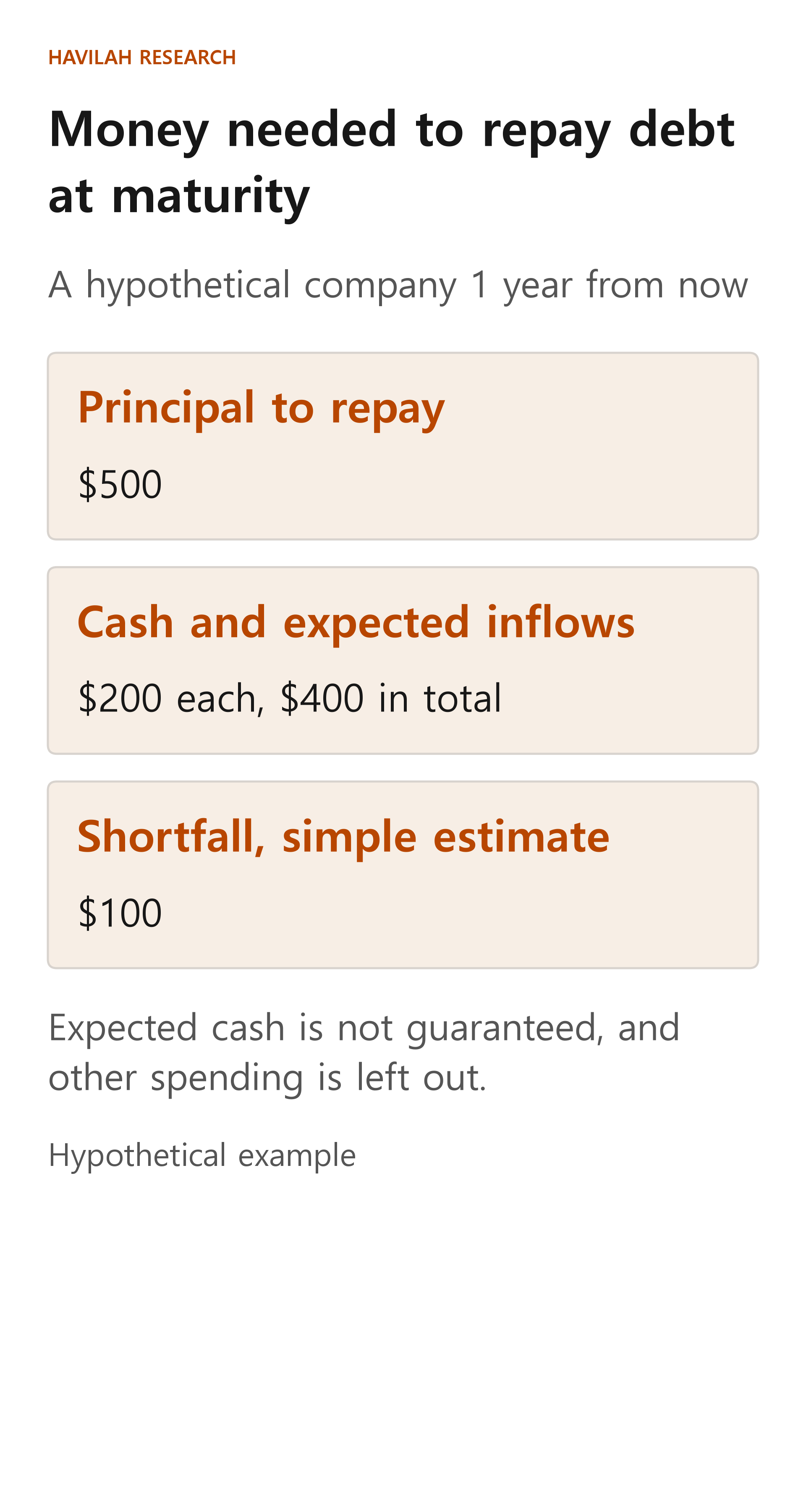
Suppose a hypothetical company must repay $500 of principal in 1 year. It already has $200 of cash it can use at maturity, and it expects another $200 of cash to come in from its business before then. Other inflows and outflows, interest and taxes are left out of this simple example.
Adding the $200 of cash it has now to the $200 it expects gives $400, the amount assumed to be available for repayment. Compared with the $500 of principal to be repaid, that is $100 short. There is no guarantee that the expected cash will actually come in, so this is not a certain result.
| Hypothetical item | Amount |
|---|---|
| Principal to repay at maturity | $500 |
| Cash available now | $200 |
| Extra cash expected before maturity | $200 |
| Shortfall under these assumptions | $100 |
In this example, all the available money goes to repayment, so no spare cash is left for running the business. In reality, the company may also need money for wages, taxes, equipment maintenance, interest and so on, so look more carefully at how much it needs to have ready.
If it borrows again, look at the interest too
Suppose the company is able to borrow the missing $100. If the new loan carries a fixed interest rate of 8% a year, the principal stays the same for 1 year and there are no fees or similar costs, the interest for that year is $8.
If it borrowed the same $100 at 4% a year, the interest for 1 year would be $4. The difference between the two cases is $4 a year. This is a hypothetical calculation that applies only to the new $100 borrowed; it is not the company's total interest expense.
With a floating-rate loan, the interest burden can change as the benchmark rate changes in the future. Even with a fixed rate, the cost can change if the debt is refinanced at a new rate when it matures. Whether refinancing is possible, and on what terms, has to be checked at that time.
Do not overlook the terms of the agreement
A loan agreement can include conditions the company must meet, often called covenants. For example, the company may have to maintain certain financial ratios, or it may be limited in how much more it can borrow. Breaking these conditions can lead to adverse consequences under the agreement, such as a demand for early repayment, so looking only at the maturity date is not enough.
Howard Hughes, a U.S. real estate company, described in its filings the risk that it might be unable to refinance maturing debt, or might have to refinance it on unfavorable terms. This is a risk factor the company presented; it does not state that such an event actually happened.
What should investors check?
Look in the notes to the financial statements for the debt maturity schedule and whether the interest rates are fixed or floating. Then look at the cash available, the cash the business generates, the spending needed in the future and the loan terms together.
There is also a risk that a company cannot pay the principal or interest due at maturity on time. If you check not only the size of the debt but also when payments are due, how easily the company can raise money and how much spare cash it has, you will better understand the pressure the company may face.