
A gym collects 6 months of membership fees in advance. The money is already in its bank account, but members can use the facilities for the next 6 months. In exchange for this money, the gym must provide the service it promised.
Money a company receives from customers before it provides goods or services is called a customer prepayment, or advance payment. The part not yet recorded as revenue may appear in the accounts as deferred revenue, a contract liability or a similar item. This is because, although the company has not borrowed money from a bank, it still has an obligation to fulfill for its customers.
Money received up front still comes with a promise
Suppose a hypothetical company receives $300 in cash in advance for 6 months of service. The customer can use the service as soon as they sign up, and the company provides the same service every month. There are no refunds or extra charges, and revenue is recorded evenly over the service period.
Once the company has provided the first month of service, the amount it records as revenue in this example is $300 divided by 6 months, or $50. The $250 for the 5 months not yet provided remains as deferred revenue. This does not mean the company must pay the $250 back in cash. In this hypothetical contract, it is the amount that corresponds to the obligation to provide the remaining service.
If, instead, the contract lets customers get their money back when they cancel, you need to look at the refund obligation. The services to be provided and the refund terms differ from contract to contract.
What if the money has already been spent?
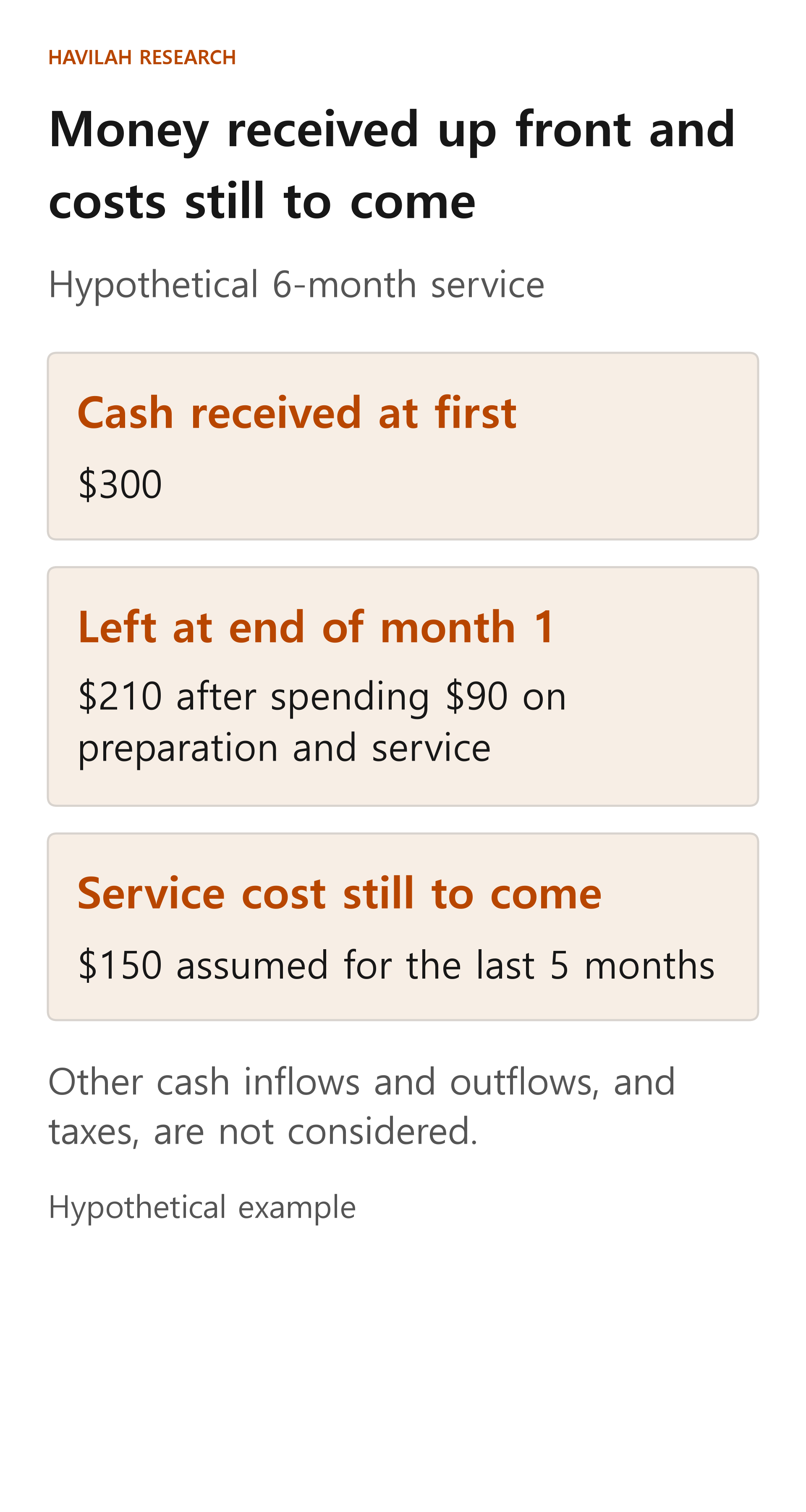
Now suppose the hypothetical company spends $60 of the $300 it received in cash on preparing the service, and $30 in cash on providing the first month of service. No other cash comes in or goes out in connection with this prepayment. At the end of the first month, the cash left from this prepayment is $300 minus $60 and $30, or $210. Other cash the company already had is not included in this calculation.
If providing the service costs $30 a month for each of the remaining 5 months, the remaining service cost is $150. Paying this $150 out of the $210 left from the prepayment leaves $60. This is a simple cash example that leaves out taxes, interest and other spending. The $60 is not the final profit of the company as a whole.
| Hypothetical item | Amount |
|---|---|
| Cash received from the customer in advance | $300 |
| Cash spent on preparation and the first month's service | $90 |
| Cash left from the prepayment at the end of the first month | $210 |
| Expected service cost for the remaining 5 months | $150 |
| Cash left after paying only that cost | $60 |
The $250 of deferred revenue at the end of the first month and the $150 of remaining service cost are different numbers. One is the amount of customer contracts not yet recorded as revenue; the other is the cash assumed to be needed to provide the service in the future.
How is it different from bank debt?
Bank borrowings are money that must be repaid, with interest, under the terms of the loan. Deferred revenue generally arises from contracts that require the company to provide goods or services to customers. If a contract is canceled or its terms change, a refund or another obligation may arise. So although both can appear among liabilities, you cannot treat them as the same thing.
Adobe, the U.S. software company, explains in its filings that its deferred revenue includes amounts billed or received in advance for subscription services, and that some customer deposits may be refundable depending on the terms. Check how advance payments, advance billings and refundable amounts are mixed at each company. The deferred revenue balance may not all be cash already received.
Is rising deferred revenue a good sign?
An increase in amounts received or billed in advance can be a clue that customer contracts have grown. But the balance also changes when the company changes when it bills, or how many months it bills at once. The total contract term and the billing period can differ. So it is hard to conclude from a rise in deferred revenue alone that the company has more customers or that its future profit is assured.
The cost of providing the service in the future could also rise. Check, too, the terms under which customers can cancel or get a refund. Read when the company expects to fulfill its remaining contracts, along with its cash flow and changes in its operating costs.
A customer prepayment can give a company cash right away, but it also creates a promise to the customer. The key is to look at when the money was received together with what the company must provide or pay back in the future.