
Cash and bank debt on a balance sheet are fairly familiar. But when you come across items called goodwill and lease liabilities, you may have no idea what they mean.
Goodwill is an asset that usually arises when a company acquires another business. A lease liability is an obligation linked to the money a company will pay in the future under a contract to rent buildings, equipment or other items. Once you can tell what each one represents, you can better read the company's past decisions and the burdens it faces ahead.
Why does goodwill arise?
Suppose a hypothetical company acquires the whole of another company for $500. It examines the acquired assets and liabilities one by one, and it measures the assets that can be identified separately and the liabilities it takes on at their fair value on the acquisition date. Fair value is the value measured on the basis of a transaction between market participants at that point in time. In this example, the measured assets minus the measured liabilities come to a net amount of $350. Assume there are no other complex adjustments.
In this simple example, goodwill is the $150 difference between the $500 purchase price and the $350 of identified net assets. Net assets here means assets minus liabilities. The measured amounts can differ from the amounts previously recorded in the books.
The acquired company's employees and customer relationships, and the benefits the buyer expects from combining the two businesses, can be taken into account when the purchase price is set. But do not think of the $150 of goodwill as a price tag attached precisely to particular customers or benefits. Real acquisition accounting can be more complex, depending on how the deal is structured and valued.
Is a lot of goodwill a good thing?
Goodwill is not like a right to receive money or something that can be sold right away. Look at how much the company paid for the acquisition and whether the business has delivered the expected results since then.
Under the accounting standards that apply, a company reviews the value of its goodwill and, if necessary, can record an impairment loss, which lowers the book value. An impairment loss may not mean that the same amount of new cash goes out at that time, but it is a clue that the expectations held at the time of the acquisition may have changed.
What kind of obligation is a lease liability?
Think of a company that rents its stores instead of buying them. If it must pay a fixed rent over the contract term, it has an obligation to make payments in the future. Under the accounting standards, the company can record a lease liability together with an asset linked to its right to use the property.
A lease liability can differ from simply adding up all the future rent. Money paid in the future comes at a different time from money paid now, so the liability is calculated by applying a discount rate that converts future payments into amounts at the present time. A discount rate is the rate used to convert a future amount into today's money.
Calculating a hypothetical rent
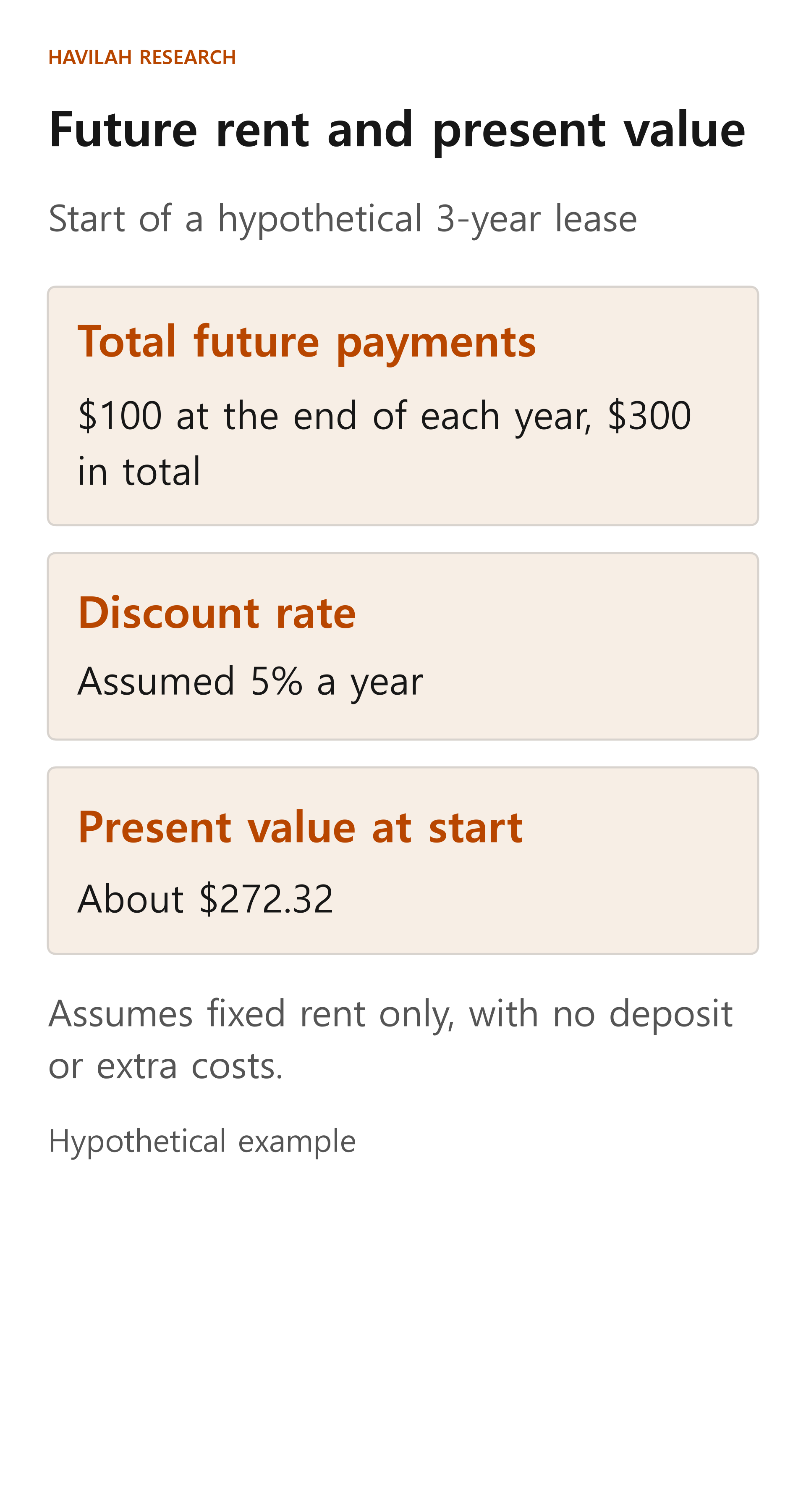
Suppose a company starts a new fixed lease under which it pays $100 at the end of each year for 3 years. The discount rate is 5% a year, and there is no deposit, extra fee, variable rent or other adjustment.
Added up without discounting, the payments come to $100 a year × 3 years = $300. Converting each payment into its present value at the start of the lease gives the following.
| When paid | Calculation | Present value |
|---|---|---|
| After 1 year | 100 ÷ 1.05 | About $95.24 |
| After 2 years | 100 ÷ 1.05² | About $90.70 |
| After 3 years | 100 ÷ 1.05³ | About $86.38 |
Adding the unrounded amounts gives about $272.32. Under these simple assumptions, this is the figure that represents the lease liability at the start of the lease. Each amount in the table and the total have been rounded to two decimal places.
Plug Power, a U.S. company, explains in its filings that at the start of an operating lease it measures the lease liability as the present value of the lease payments not yet paid. The term, discount rate, variable payments and disclosure basis of real contracts can differ from this hypothetical case.
What should investors look at?
If goodwill is large, check which company was acquired and for how much, and whether the business has gone as expected since the acquisition. For lease liabilities, look at when and how much must be paid, and how important the contracts are to running the company's stores or facilities.
Having lease liabilities does not mean the contract terms are exactly the same as those of a bank loan. Equally, you should not look only at bank borrowings and miss the obligation to pay rent. Looking separately at the nature of each asset and at the cash that will go out in the future lets you read the balance sheet in more depth.